Managing provider credentialing has become one of the most important yet time-consuming responsibilities in healthcare administration. From verifying licenses and certifications to ensuring compliance with payer and regulatory requirements, even small credentialing errors can lead to delayed reimbursements, compliance risks, and provider onboarding issues.
This is why many hospitals, clinics, and medical groups rely on CVO credentialing services to streamline the process, improve accuracy, and reduce administrative burden.
By outsourcing credentialing to specialized Credentialing Verification Organizations, healthcare providers can focus more on patient care while maintaining compliance and operational efficiency.
What Does CVO Mean in Healthcare?
CVO stands for Credentialing Verification Organization. In healthcare, a CVO is a specialized organization that verifies the qualifications, licenses, certifications, education, training, and professional history of healthcare providers.
These organizations help hospitals, clinics, physician groups, and healthcare networks ensure that providers meet industry and regulatory standards before they are approved to treat patients or participate in insurance networks.
The primary role of a CVO is to perform accurate and compliant primary source verification for healthcare professionals. This includes validating medical licenses, board certifications, work history, malpractice claims, DEA registrations, sanctions, and other important credentials directly from official sources.
What Is CVO Credentialing?
CVO credentialing is the process of evaluating and verifying a healthcare provider’s professional qualifications through a Credentialing Verification Organization. This process ensures that physicians, nurses, specialists, and other healthcare professionals meet all required standards before they can provide care, join healthcare organizations, or enroll with insurance payers.
The credentialing process involves collecting and verifying critical provider information, including:
- Medical licenses
- Board certifications
- Educational background
- Residency and training history
- Work experience
- DEA registration
- Malpractice insurance coverage
- Sanctions and exclusion checks
- References and professional history
One of the most important parts of CVO credentialing is primary source verification. This means the CVO confirms provider information directly with original issuing sources such as medical boards, universities, certification boards, and government databases. This step helps eliminate fraud, reduce compliance risks, and ensure healthcare organizations maintain high standards of patient safety.
CVO credentialing also supports payer enrollment and ongoing recredentialing requirements. Since provider credentials can expire or change over time, healthcare organizations must continuously monitor and update credentialing records to remain compliant and avoid reimbursement interruptions.
How Does the CVO Credentialing Process Work?
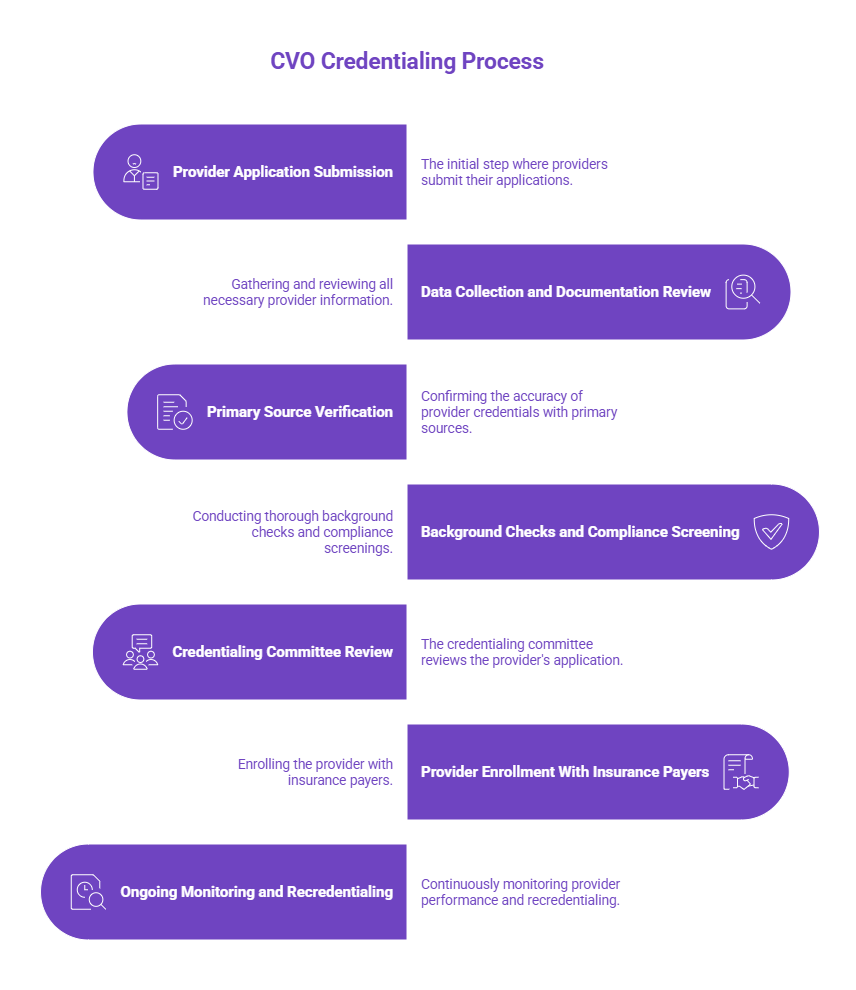
The CVO credentialing process follows a structured workflow designed to verify a healthcare provider’s qualifications, ensure regulatory compliance, and prepare providers for payer enrollment and clinical practice.
1. Provider Application Submission
The process begins when the healthcare provider submits a credentialing application along with required documentation. This typically includes medical licenses, board certifications, education records, work history, malpractice insurance details, and identification documents.
Incomplete or outdated applications are one of the most common reasons for credentialing delays, which is why accurate documentation is essential from the beginning.
2. Data Collection and Documentation Review
After receiving the application, the CVO reviews all submitted documents to ensure they are complete, valid, and up to date. Any missing information is identified and requested before moving to the verification stage.
At this stage, the organization may also gather additional provider information through databases such as CAQH and payer portals.
3. Primary Source Verification
Primary source verification is the core component of CVO credentialing. The CVO directly contacts official issuing sources to verify the authenticity of the provider’s credentials.
This includes verifying:
- State medical licenses
- Board certifications
- Educational degrees
- Residency and training programs
- DEA registration
- Employment history
- Sanctions and exclusions
Direct verification helps healthcare organizations maintain compliance and reduce the risk of fraud or inaccurate provider information.
4. Background Checks and Compliance Screening
The CVO performs compliance reviews and background screenings to identify any legal, disciplinary, or regulatory concerns. This may include checking:
- OIG exclusion lists
- NPDB reports
- State sanctions
- Malpractice claims history
- Criminal background records
These screenings help healthcare organizations protect patient safety and avoid compliance violations.
5. Credentialing Committee Review
Once all verifications are completed, the provider’s file is reviewed by a credentialing committee or authorized decision makers within the healthcare organization. The committee evaluates whether the provider meets the organization’s standards and regulatory requirements.
If approved, the provider can move forward with payer enrollment and clinical privileges.
6. Provider Enrollment With Insurance Payers
After credentialing approval, the provider may be enrolled with insurance companies and government healthcare programs. This step is necessary for providers to receive reimbursements for services delivered to insured patients.
Payer enrollment timelines can vary significantly depending on the insurance company and the completeness of documentation.
7. Ongoing Monitoring and Recredentialing
Credentialing is not a one-time process. Most healthcare organizations must recredential providers every two to three years to ensure licenses, certifications, and compliance records remain current.
Many CVOs also provide continuous monitoring services to track expiring credentials, sanctions, and regulatory updates in real time.
Average Timeline for CVO Credentialing
The complete credentialing process can take anywhere from 60 to 120 days, depending on:
- Provider responsiveness
- Payer processing times
- Verification delays
- Missing documentation
- State licensing requirements
Organizations that use experienced CVO partners and automated credentialing systems can often reduce delays and improve onboarding efficiency.
Why Healthcare Organizations Use CVOs
Healthcare organizations use Credentialing Verification Organizations to simplify provider credentialing, reduce administrative burden, and maintain compliance with strict industry regulations. As credentialing requirements become more complex, managing the entire process internally can consume significant time, staffing, and operational resources.
Reduced Administrative Workload
Credentialing requires extensive documentation, follow-ups, verifications, and compliance tracking. For hospitals and medical groups managing large provider networks, handling these tasks internally can overwhelm administrative teams.
Faster Provider Onboarding
Delays in credentialing can prevent providers from seeing patients and generating revenue. CVOs help accelerate onboarding by using standardized processes, automated systems, and experienced credentialing specialists who can quickly identify and resolve issues.
Improved Accuracy and Compliance
Credentialing errors can lead to denied claims, compliance violations, and reputational risks. CVOs specialize in primary source verification and regulatory compliance, helping organizations reduce mistakes and maintain accurate provider records.
Better Revenue Cycle Performance
Providers cannot bill insurance companies until credentialing and payer enrollment are completed. Delays in the credentialing process can directly impact cash flow and reimbursement timelines.
Scalability for Growing Organizations
As healthcare organizations expand into multiple locations or add more providers, credentialing demands increase significantly. CVOs provide scalable solutions that allow organizations to manage growth without increasing internal administrative pressure.
Access to Credentialing Expertise and Technology
Modern CVOs use credentialing software, automation tools, and real time monitoring systems to improve workflow efficiency and compliance tracking. Their expertise allows healthcare organizations to stay updated with changing regulations and industry requirements without building large in house credentialing teams.
Common Challenges in CVO Credentialing
Although CVO credentialing improves efficiency and compliance, the process can still involve several operational challenges. Healthcare organizations that understand these common issues are better prepared to reduce delays, improve workflows, and maintain accurate provider records.
Identifying potential obstacles early can help organizations create a smoother credentialing experience for both providers and administrative teams.
Incomplete Provider Documentation
One of the most common causes of credentialing delays is missing or outdated provider documentation. Applications that lack licenses, certifications, malpractice information, or employment history cannot move forward until all required information is submitted.
Even small documentation errors can significantly extend credentialing timelines.
Delayed Primary Source Verification
Credentialing depends heavily on primary source verification, which requires direct communication with licensing boards, educational institutions, certification organizations, and employers.
Some sources respond quickly, while others may take weeks to process verification requests. These delays can slow the entire credentialing workflow.
Payer Enrollment Delays
Even after credentialing is completed, providers may still face delays during payer enrollment. Insurance companies often have different processing requirements and timelines, making it difficult to predict approval dates.
Delays in payer enrollment can postpone reimbursements and impact revenue generation.
Compliance and Regulatory Risks
Healthcare credentialing must comply with standards established by organizations such as NCQA, CMS, and The Joint Commission. Failing to meet these standards can create legal, financial, and operational risks.
Healthcare organizations must also monitor expiring credentials, sanctions, and regulatory updates to remain compliant at all times.
Communication Gaps
Credentialing involves constant communication between providers, healthcare organizations, payers, and verification sources. Poor communication can result in missed deadlines, incomplete applications, and unnecessary processing delays.
Organizations without centralized credentialing systems often struggle to maintain consistent communication throughout the process.
Data Management and Record Keeping Issues
Managing large amounts of provider information manually increases the risk of data entry errors, duplicate records, and missing files. Inaccurate provider data can affect compliance, payer enrollment, and audit readiness.
Without proper credentialing systems, organizations may also struggle to track recredentialing deadlines and license expirations efficiently.
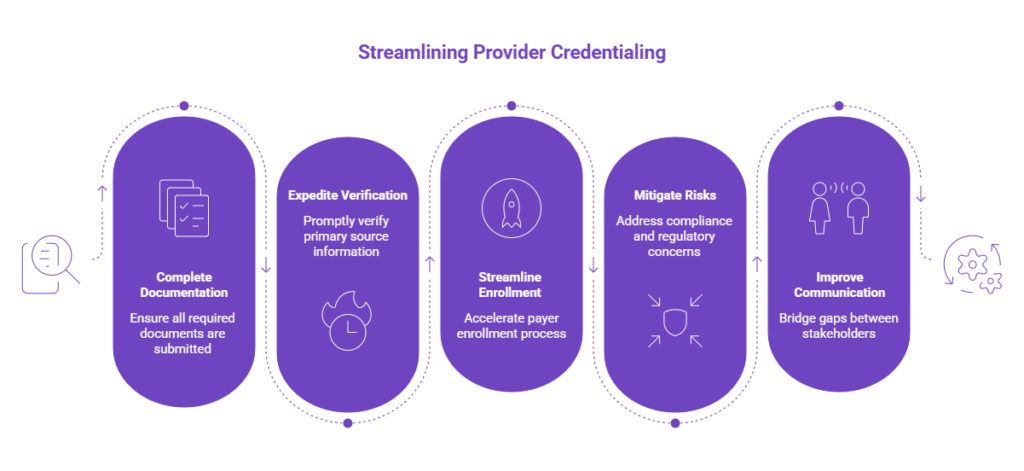
How Healthcare Organizations Can Reduce Credentialing Challenges
Healthcare organizations can minimize credentialing problems by implementing structured workflows and proactive management strategies, including:
- Standardizing provider application requirements
- Using automated credentialing software
- Maintaining updated provider records
- Tracking expiration dates proactively
- Improving communication with providers and payers
- Partnering with experienced CVOs
- Conducting regular compliance audits
Organizations that invest in efficient credentialing processes can reduce delays, improve provider onboarding, and strengthen long-term compliance management.
CVO Credentialing vs Provider Enrollment
Many healthcare professionals use the terms credentialing and provider enrollment interchangeably, but they are two separate processes that serve different purposes. Understanding the difference between CVO credentialing and provider enrollment is essential for avoiding delays, improving reimbursement timelines, and maintaining compliance.
| CVO Credentialing | Provider Enrollment |
| Verifies provider qualifications | Registers providers with insurance payers |
| Focuses on compliance and verification | Focuses on billing and reimbursement |
| Includes primary source verification | Includes payer application submission |
| Conducted before payer participation | Conducted after credentialing approval |
| Managed by CVOs or credentialing teams | Managed through payer enrollment specialists |
What Happens During CVO Credentialing?
CVO credentialing ensures that healthcare providers meet professional and regulatory standards before they begin practicing or join insurance networks. This process includes verifying:
- Medical licenses
- Board certifications
- Education and training
- Employment history
- Malpractice claims
- Sanctions and exclusions
The primary objective is to confirm that the provider is qualified, compliant, and safe to deliver patient care.
What Happens During Provider Enrollment?
Provider enrollment begins after credentialing approval. During this stage, healthcare organizations submit applications to insurance companies and government healthcare programs so providers can bill for services.
This process typically includes:
- Submitting payer applications
- Completing CAQH profiles
- Providing tax and practice information
- Negotiating payer participation
- Receiving payer approval and effective dates
Without provider enrollment, healthcare providers cannot receive reimbursements from insurance companies, even if they are fully credentialed.
Why Both Processes Matter
Credentialing and provider enrollment work together to support both compliance and revenue cycle management. Delays in either process can affect patient access, provider onboarding, and reimbursement timelines.
Healthcare organizations that streamline both workflows through experienced credentialing and enrollment support can improve operational efficiency and reduce costly delays.
CVO Credentialing vs Privileging
Another area that often creates confusion in healthcare administration is the difference between credentialing and privileging. While both processes evaluate healthcare providers, they serve different functions within healthcare organizations.
Credentialing verifies a provider’s qualifications, while privileging determines what clinical procedures or services the provider is authorized to perform within a healthcare facility.
| Credentialing | Privileging |
| Verifies provider qualifications | Authorizes clinical procedures |
| Focuses on licenses and certifications | Focuses on clinical competency |
| Required for compliance and enrollment | Required for patient care authorization |
| Applies to all healthcare providers | Commonly used in hospitals and surgical centers |
| Managed during onboarding and recredentialing | Managed by medical staff leadership |
What Is Credentialing?
Credentialing is the process of verifying that a healthcare provider has the proper education, training, licenses, and certifications required to practice medicine safely and legally.
This process confirms that providers meet regulatory and organizational standards before treating patients or participating in insurance networks.
What Is Privileging?
Privileging determines the specific medical procedures, treatments, or services a provider is allowed to perform within a healthcare organization.
For example:
- A surgeon may receive privileges for certain surgical procedures
- A cardiologist may be approved for specialized cardiac treatments
- An anesthesiologist may receive privileges for specific anesthesia services
Hospitals evaluate clinical experience, competency, training, and performance before granting privileges.
Why Credentialing and Privileging Are Both Important
Healthcare organizations use both processes to protect patient safety and maintain quality standards. Credentialing ensures providers are qualified to practice, while privileging ensures they are competent to perform specific clinical services.
Without proper credentialing and privileging procedures, healthcare organizations may face:
- Increased compliance risks
- Patient safety concerns
- Legal liability issues
- Accreditation problems
- Insurance reimbursement challenges
Modern healthcare organizations often manage credentialing and privileging together to create a more efficient provider onboarding and compliance process.
Regulatory and Compliance Standards for CVOs
Healthcare credentialing is heavily regulated, which means Credentialing Verification Organizations must follow strict compliance standards to ensure provider information is accurate, secure, and properly verified. Failing to meet these standards can expose healthcare organizations to legal risks, denied reimbursements, accreditation issues, and patient safety concerns.
NCQA Credentialing Standards
The National Committee for Quality Assurance (NCQA) establishes some of the most widely recognized credentialing standards in healthcare. Many healthcare organizations and insurance payers require credentialing processes that align with NCQA guidelines.
NCQA standards focus on:
- Primary source verification
- Provider application accuracy
- Ongoing monitoring
- Credentialing timelines
- Recredentialing requirements
- Documentation management
CVOs that receive NCQA certification demonstrate that their credentialing processes meet nationally recognized quality standards.
CMS Requirements
The Centers for Medicare and Medicaid Services (CMS) also establishes credentialing and provider enrollment requirements for healthcare organizations participating in federal healthcare programs.
CMS regulations help ensure that providers treating Medicare and Medicaid patients meet all legal and professional standards before receiving reimbursements.
Healthcare organizations must maintain accurate provider records and comply with CMS enrollment requirements to avoid payment disruptions and compliance penalties.
Joint Commission Standards
The Joint Commission requires hospitals and healthcare organizations to maintain thorough credentialing and privileging procedures as part of accreditation standards.
These standards focus on:
- Provider competency
- Clinical qualifications
- Patient safety
- Ongoing evaluations
- Performance monitoring
Healthcare organizations that fail to meet Joint Commission standards may risk accreditation issues and operational challenges.
HIPAA and Data Security Compliance
Credentialing involves handling sensitive provider information, making data security a critical part of the process. CVOs must maintain compliance with HIPAA regulations to protect confidential records and prevent unauthorized access to provider data.
Secure credentialing systems typically include:
- Encrypted document storage
- Access controls
- Secure data sharing
- Audit tracking
- Compliance monitoring systems
Strong data protection measures help healthcare organizations reduce cybersecurity and privacy risks.
State Licensing and Regulatory Requirements
In addition to national regulations, healthcare providers must also comply with state-specific licensing and credentialing requirements. Since regulations vary by state, CVOs must stay updated on changing laws and licensing standards.
This becomes especially important for:
- Multi-state healthcare organizations
- Telehealth providers
- Traveling healthcare professionals
- Large physician networks
Why Compliance Matters in CVO Credentialing
Maintaining compliance is essential for protecting both healthcare organizations and patients. Poor credentialing practices can lead to serious consequences, including:
- Insurance reimbursement denials
- Legal and regulatory penalties
- Provider onboarding delays
- Accreditation issues
- Patient safety risks
- Reputation damage
Organizations that partner with experienced and compliant CVOs are better positioned to maintain operational stability, pass audits, and reduce administrative risk.
How Long Does CVO Credentialing Take?
One of the most common questions healthcare organizations ask is how long the CVO credentialing process takes. While timelines vary depending on several factors, credentialing is generally a lengthy process because of the extensive verification and compliance requirements involved.
In most cases, CVO credentialing takes between 60 and 120 days from initial application submission to final approval. However, some cases may move faster or experience delays depending on provider responsiveness, payer processing times, and documentation accuracy.
Factors That Affect Credentialing Timelines
Several factors influence how quickly the credentialing process can be completed.
Completeness of Provider Documentation
Incomplete applications are one of the biggest causes of credentialing delays. Missing licenses, certifications, malpractice history, or work experience records can slow the process significantly.
Providers who submit complete and accurate information early often experience faster approvals.
Primary Source Verification Delays
Credentialing requires direct verification from medical boards, universities, employers, and certification organizations. Some verification sources respond quickly, while others may take weeks to process requests.
Since credentialing cannot move forward without verified information, delays at this stage can extend overall timelines.
Insurance Payer Processing Times
Provider enrollment with insurance companies often adds additional waiting periods after credentialing approval. Each payer has different processing procedures and review timelines.
Government programs and large commercial payers may take longer to approve provider participation applications.
State Licensing Requirements
Healthcare providers practicing in multiple states or applying for new licenses may experience longer credentialing timelines due to varying state regulations and licensing procedures.
This is especially common in telehealth and multi-state healthcare organizations.
Credentialing Volume and Organizational Workflows
Large hospitals and healthcare systems processing hundreds of providers simultaneously may require additional review time. Organizations using outdated manual systems may also experience slower credentialing workflows.
CVOs that use automation and centralized credentialing software can often improve processing efficiency.
How Much Does CVO Credentialing Cost?
The cost of CVO credentialing can vary depending on the size of the healthcare organization, the number of providers being credentialed, the complexity of payer enrollment requirements, and the level of credentialing support needed. While some organizations manage credentialing internally, many choose outsourced CVO services because they provide better efficiency, scalability, and long-term cost savings.
Average CVO Credentialing Costs
Most Credentialing Verification Organizations use one of the following pricing models:
| Pricing Model | Description |
| Per Provider Pricing | Charges based on each provider credentialed |
| Monthly Retainer | Fixed monthly fee for ongoing credentialing support |
| Per Application Fee | Charges for each payer enrollment application |
| Comprehensive Service Packages | Bundled credentialing and enrollment services |
The total cost typically depends on factors such as:
- Number of healthcare providers
- Specialty complexity
- Volume of payer enrollments
- Multi state licensing requirements
- Recredentialing needs
- Ongoing monitoring services
Large healthcare organizations often negotiate customized pricing structures based on provider volume and operational requirements.
How to Choose the Right CVO Partner?
Selecting the right Credentialing Verification Organization is one of the most important decisions a healthcare organization can make. A reliable CVO can improve provider onboarding, maintain compliance, reduce delays, and strengthen operational efficiency. On the other hand, an inexperienced or poorly managed credentialing partner can create costly disruptions and compliance risks.
Healthcare organizations should carefully evaluate potential CVO partners based on expertise, technology, scalability, and service quality.
Industry Experience and Healthcare Expertise
Credentialing requirements vary across healthcare specialties, payer networks, and state regulations. Choosing a CVO with extensive healthcare industry experience ensures the organization understands complex credentialing workflows and compliance standards.
Experienced CVOs are better equipped to handle:
- Multi-specialty healthcare practices
- Hospital systems
- Telehealth providers
- Multi-state licensing requirements
- Large provider networks
Organizations should also evaluate the CVO’s familiarity with payer enrollment and accreditation standards.
Compliance and Regulatory Knowledge
Credentialing compliance is constantly evolving. The right CVO should have strong knowledge of:
- NCQA standards
- CMS regulations
- Joint Commission requirements
- HIPAA compliance
- State licensing laws
Healthcare organizations should ask potential CVO partners about their compliance processes, audit readiness, and quality assurance systems.
Turnaround Time and Workflow Efficiency
Credentialing delays can directly impact revenue and provider onboarding. A strong CVO should have efficient workflows designed to reduce processing time and minimize administrative bottlenecks.
Healthcare organizations should evaluate:
- Average credentialing timelines
- Payer enrollment efficiency
- Recredentialing management processes
- Communication responsiveness
- Issue resolution procedures
Clear turnaround expectations are essential before entering a credentialing partnership.
Technology and Automation Capabilities
Modern credentialing relies heavily on automation and digital workflow management. CVOs using advanced credentialing software can often improve accuracy, reduce delays, and provide better visibility into credentialing progress.
Important technology features may include:
- Real-time credential tracking
- Automated expiration alerts
- Digital document management
- CAQH integration
- Compliance monitoring dashboards
- Secure cloud-based systems
Technology-driven credentialing improves efficiency and reduces manual administrative work.
Scalability and Long-Term Support
Healthcare organizations should choose a CVO capable of supporting future growth. Credentialing demands often increase as organizations expand locations, hire additional providers, or enter new payer networks.
Scalable credentialing support helps organizations avoid operational disruptions during periods of growth.
Questions to Ask Before Choosing a CVO
Before selecting a credentialing partner, healthcare organizations should ask important questions such as:
- What industries and specialties do you support?
- Are your credentialing processes NCQA compliant?
- What is your average credentialing turnaround time?
- How do you handle payer enrollment delays?
- What credentialing technology do you use?
- How do you monitor expiring credentials?
- Can your services scale with organizational growth?
- What reporting and communication systems are available?
Warning Signs to Watch For
Healthcare organizations should also be cautious of potential red flags, including:
- Lack of healthcare credentialing experience
- Poor communication practices
- Limited compliance knowledge
- No credentialing automation systems
- Unclear pricing structures
- Slow response times
- Inconsistent reporting processes
Choosing the right CVO partner can significantly improve credentialing efficiency, reduce compliance risks, and create a more organized provider management process.
Final Thoughts
CVO credentialing has become an essential part of modern healthcare operations. As credentialing requirements continue to grow more complex, healthcare organizations must ensure providers are properly verified, compliant, and approved before delivering patient care or participating in insurance networks.
From primary source verification and payer enrollment support to ongoing compliance monitoring and recredentialing, Credentialing Verification Organizations help streamline one of the most critical administrative processes in healthcare.
By reducing manual workload, improving accuracy, and accelerating provider onboarding, CVOs allow healthcare organizations to focus more on patient care and long-term operational growth.