Primary source verification in healthcare is one of the most important steps in provider credentialing, compliance management, and patient safety. Healthcare organizations rely on primary source verification (PSV) to confirm that physicians, nurses, and other providers possess valid licenses, certifications, education, and professional qualifications before they are approved to treat patients.
Without accurate primary source verification, healthcare organizations may face:
- credentialing delays
- denied payer enrollments
- reimbursement issues
- compliance violations
- patient safety risks
- legal liabilities
As credentialing regulations continue evolving, healthcare providers, hospitals, and medical billing companies must understand how PSV works and why it directly affects revenue cycle management.
In this guide, Health Med Affairs explains:
- what primary source verification is
- why it matters in healthcare
- how the PSV process works
- common credentialing challenges
- accreditation requirements
- the role of automation
- how PSV impacts reimbursements and provider onboarding
What Is Primary Source Verification (PSV)?
Primary source verification (PSV) in healthcare is the process of verifying a provider’s credentials directly with the original issuing organization or authority.
Instead of accepting copies of documents submitted by providers, healthcare organizations must confirm the information directly from the source that originally issued the credential.
Examples of Primary Source Verification
Primary source verification may include confirming:
- medical licenses with state licensing boards
- medical degrees with universities
- board certifications with certifying boards
- DEA registrations with the DEA
- malpractice history with insurers
- sanctions and exclusions with federal databases
The purpose of PSV is to ensure that healthcare providers are properly qualified, licensed, and legally authorized to practice.
Why Is Primary Source Verification Important in Healthcare?
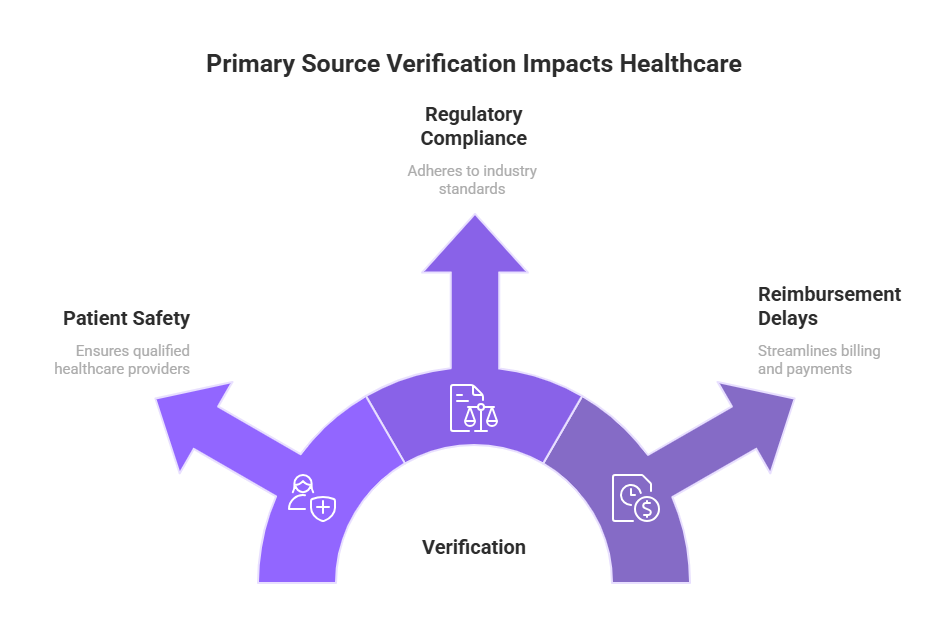
Primary source verification plays a critical role in:
- patient safety
- healthcare compliance
- provider credentialing
- payer enrollment
- risk reduction
- revenue cycle management
Healthcare organizations that fail to perform accurate PSV may face serious operational and financial consequences.
Protects Patient Safety
PSV helps prevent unqualified or fraudulent individuals from providing patient care.
By verifying credentials directly from issuing authorities, healthcare organizations reduce the risk of:
- falsified licenses
- fake certifications
- expired credentials
- disciplinary history concealment
Supports Regulatory Compliance
Accreditation organizations and government agencies require healthcare providers to complete PSV during credentialing and recredentialing.
These organizations include:
- The Joint Commission
- NCQA
- CMS
- URAC
- State licensing boards
Failure to comply with PSV requirements may result in:
- accreditation issues
- compliance violations
- payer contract problems
- regulatory penalties
Prevents Reimbursement Delays
Incomplete or inaccurate credential verification often delays:
- payer enrollment
- insurance participation
- provider onboarding
- reimbursement approvals
Healthcare organizations may experience:
- denied claims
- delayed payments
- provider enrollment rejections
- interrupted cash flow.
This is one of the most overlooked financial impacts of poor credentialing processes.
What Qualifies as a Primary Source?
A primary source is the original organization or authority that issued the credential being verified.
Common Primary Sources in Healthcare
| Credential | Primary Source |
| Medical License | State Medical Board |
| Board Certification | ABMS or specialty board |
| Medical Degree | Medical school or university |
| DEA Registration | Drug Enforcement Administration |
| NPI Information | NPPES Registry |
| Malpractice Coverage | Insurance carrier |
| Sanctions & Exclusions | OIG, SAM, NPDB |
Healthcare organizations must verify credentials directly from these sources or approved credentialing verification organizations (CVOs).
Primary Source vs Secondary Source Verification
Many providers confuse primary source verification with secondary verification.
Here’s the difference:
| Primary Source Verification | Secondary Source Verification |
| Verified directly with issuing authority | Verified using copies or indirect sources |
| Highly reliable and compliant | Less reliable |
| Required for credentialing | Usually not acceptable alone |
| Meets accreditation standards | May not meet compliance standards |
| Used for provider enrollment | Used mainly for reference purposes |
Example
- A state medical board confirming a physician’s license = Primary source
- A photocopy of the physician’s license = Secondary source
Accreditation organizations generally require primary source verification for credentialing compliance.
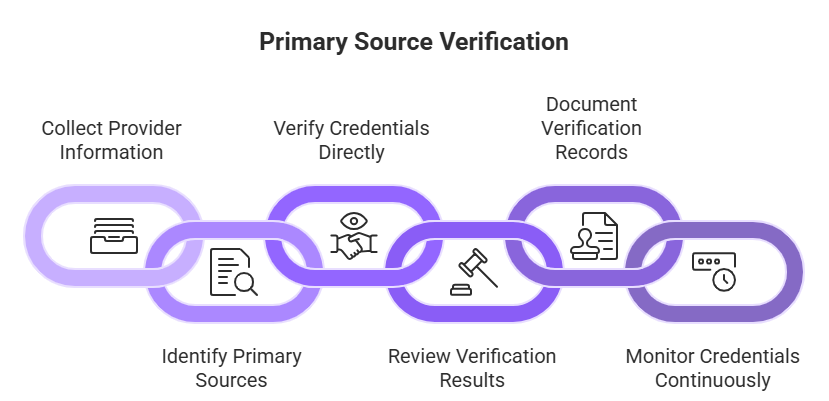
Step-by-Step Primary Source Verification Process
Understanding the PSV workflow helps healthcare organizations improve credentialing efficiency and reduce delays.
Step 1: Collect Provider Information
Credentialing teams gather:
- licenses
- certifications
- education history
- work history
- DEA registration
- malpractice coverage
- references
Step 2: Identify the Appropriate Primary Sources
Each credential must be matched to its original issuing authority.
Examples:
- Medical license → State board
- Degree → University
- Board certification → Specialty board
Step 3: Verify Credentials Directly
Credentialing staff verify credentials through:
- online databases
- secure portals
- phone verification
- direct email correspondence
- credentialing verification organizations
Step 4: Review Verification Results
The organization reviews:
- expiration dates
- active status
- disciplinary actions
- sanctions
- restrictions
- verification discrepancies
Step 5: Document Verification Records
Healthcare organizations must maintain detailed records including:
- verification date
- source used
- verifier name
- credential status
- supporting documentation
These records are critical during audits and accreditation reviews.
Step 6: Monitor Credentials Continuously
Credential verification is not a one-time process.
Healthcare organizations must regularly monitor:
- expiring licenses
- sanctions
- board actions
- credential renewals
- provider status changes
Credentials Commonly Verified Through PSV
Healthcare organizations verify multiple provider qualifications during credentialing.
Common Credentials Include:
- medical licenses
- nursing licenses
- DEA registration
- board certifications
- residency training
- fellowship training
- malpractice history
- work history
- sanctions and exclusions
- NPI registration
- hospital privileges
Each credential requires verification from the appropriate primary source.
Accreditation & Compliance Requirements for PSV
Several regulatory and accreditation organizations require primary source verification.
The Joint Commission
The Joint Commission requires healthcare organizations to:
- verify licenses directly
- maintain documentation
- conduct PSV during credentialing
- perform re-verification during recredentialing
NCQA
NCQA credentialing standards require:
- direct verification
- credential documentation
- expiration monitoring
- recredentialing compliance
Many insurance payers rely on NCQA credentialing standards before approving provider enrollment.
CMS Requirements
The Centers for Medicare & Medicaid Services (CMS) requires PSV for providers participating in:
- Medicare
- Medicaid
- federally funded healthcare programs
OIG & NPDB Monitoring
Healthcare organizations must also monitor:
- OIG exclusion lists
- National Practitioner Data Bank (NPDB)
- sanctions databases
Failure to identify exclusions may create major compliance risks.
Common Challenges in Primary Source Verification
Although PSV is essential, it can be highly complex and time-consuming.
Manual Verification Delays
Many organizations still rely on:
- fax requests
- manual phone calls
- paper documentation
This slows credentialing significantly.
Inconsistent State Licensing Systems
Each state board may have:
- different processes
- different response times
- inconsistent online systems
This creates operational bottlenecks.
Credentialing Staff Shortages
Credentialing teams often manage:
- large provider volumes
- multiple payers
- recredentialing cycles
- compliance monitoring
Limited staffing increases delays and errors.
International Provider Verification
Verifying international medical education and training can be especially difficult due to:
- language barriers
- overseas institutions
- delayed responses
- inconsistent documentation standards
Expired Credentials
Missed renewals may interrupt:
- payer enrollment
- hospital privileges
- provider participation
- reimbursements
Continuous Primary Source Verification & Monitoring
Modern healthcare organizations increasingly use continuous monitoring instead of verifying credentials only during onboarding.
Continuous Monitoring Helps Detect:
- license suspensions
- expired certifications
- sanctions
- exclusions
- disciplinary actions
This improves:
- compliance
- patient safety
- credential accuracy
- audit readiness
Continuous monitoring is becoming an industry best practice for healthcare credentialing.
How Automation Improves Primary Source Verification
Technology is transforming healthcare credentialing and PSV workflows.
Automated Credentialing Solutions Can:
- verify licenses in real time
- monitor expiration dates
- automate alerts
- reduce manual work
- improve accuracy
- accelerate onboarding
Healthcare organizations increasingly use:
- credentialing software
- AI-powered verification tools
- API integrations
- automated monitoring systems
to streamline provider enrollment and reduce delays.
How Primary Source Verification Impacts Revenue Cycle Management
One of the biggest gaps competitors fail to address is the connection between PSV and revenue cycle management.
Primary source verification directly affects:
- provider onboarding speed
- payer enrollment approval
- reimbursement timelines
- claim processing
- insurance participation
Poor PSV Can Lead To:
- denied claims
- delayed reimbursements
- enrollment rejections
- network participation delays
- lost revenue opportunities
A provider who is not fully credentialed cannot bill payers properly.
For healthcare practices, credentialing delays can create serious cash flow problems.
Common Mistakes Healthcare Organizations Make
Accepting Secondary Sources
Photocopies and provider-submitted documents alone are usually insufficient for compliance.
Delaying Recredentialing
Missing renewal deadlines may interrupt provider participation and reimbursements.
Failing to Monitor Exclusions
OIG and NPDB monitoring are essential compliance requirements.
Relying Entirely on Manual Processes
Manual workflows increase:
- errors
- delays
- compliance risks
- operational inefficiencies
Best Practices for Efficient Primary Source Verification
Healthcare organizations can improve PSV by implementing the following best practices:
Standardize Credentialing Workflows
Use structured checklists and verification procedures.
Automate Verification Processes
Use credentialing software and automated monitoring systems.
Track Expiration Dates
Implement alerts for license and certification renewals.
Conduct Regular Audits
Review credentialing files regularly for accuracy and completeness.
Maintain Detailed Documentation
Keep audit-ready verification records at all times.
Use Credentialing Specialists
Experienced credentialing professionals reduce errors and delays.
Benefits of Outsourcing Primary Source Verification
Outsourcing PSV can help healthcare organizations:
- reduce administrative burden
- improve credentialing speed
- minimize compliance risks
- accelerate provider onboarding
- improve payer enrollment timelines
Credentialing experts understand:
- payer requirements
- accreditation standards
- state licensing systems
- verification workflows
This helps providers avoid costly delays and operational disruptions.
How Health Med Affairs Helps Healthcare Providers
At Health Med Affairs, we help healthcare organizations streamline:
- provider credentialing
- primary source verification
- payer enrollment
- medical billing
- denial management
- revenue cycle management
Our credentialing specialists help providers:
- reduce onboarding delays
- improve payer enrollment accuracy
- maintain compliance
- accelerate reimbursements
- monitor credential expirations
We combine operational expertise with efficient credentialing workflows to help practices strengthen revenue cycle performance.
Final Thoughts
Primary source verification in healthcare is far more than a compliance requirement. It is a foundational part of:
- provider credentialing
- patient safety
- payer enrollment
- healthcare compliance
- revenue cycle management
Healthcare organizations that implement strong PSV processes can:
- reduce credentialing delays
- accelerate provider onboarding
- improve reimbursement timelines
- strengthen compliance
- protect patients
As credentialing requirements continue evolving, healthcare providers must adopt efficient, accurate, and scalable verification workflows.
If your organization needs support with provider credentialing, payer enrollment, or primary source verification, Health Med Affairs can help streamline the process and optimize your revenue cycle performance.
Frequently Asked Questions
What is primary source verification in healthcare?
Primary source verification is the process of confirming provider credentials directly with the original issuing organization or authority.
Why is primary source verification important?
PSV protects patient safety, ensures compliance, supports credentialing, and helps prevent reimbursement delays.
What is considered a primary source?
Examples include:
- state medical boards
- universities
- certification boards
- DEA databases
- NPDB
- OIG databases
Is CAQH considered primary source verification?
No. CAQH stores provider information but is not itself considered the original issuing authority.
How long does primary source verification take?
Timelines vary depending on:
- provider specialty
- state licensing boards
- payer requirements
- credentialing complexity
Manual verification may take weeks, while automated systems can significantly reduce turnaround times.
What happens if primary source verification is incomplete?
Incomplete PSV may lead to:
- credentialing delays
- payer enrollment rejections
- denied claims
- compliance violations
- reimbursement interruptions