
Why are many healthcare practices still dealing with missed calls, scheduling delays, and front-desk burden despite increased use of digital healthcare systems? Healthcare systems in 2026 are under continuous operating pressure. Front-desk workers handle a high volume of calls, appointment requests, insurance checks, and patient follow-ups. Recent healthcare workflow data suggests that phone-based processes consume 50-70% of front-desk time, reducing time for in-person patient handling and documentation accuracy. These gaps often occur in missed calls, scheduling delays, and ensuing billing concerns.
At the same time, AI adoption in healthcare has increased rapidly. Around 80 percent of hospitals now employ AI for at least one operational or clinical function, including scheduling, paperwork, and patient communication systems. According to research, 35-60% of regular calls can currently be handled using AI-based or virtual systems, depending on implementation maturity. This change reduces administrative burden while simultaneously increasing reliance on system integration and workflow accuracy.
In this blog, “Virtual Medical Receptionist,” we will discuss how these systems affect healthcare operations, billing accuracy, and compliance procedures. We will also look at where they boost efficiency and where they may pose problems if not managed properly.
What Is a Virtual Medical Receptionist?
A Virtual Medical Receptionist handles front-desk operations for healthcare practices through remote staff or digital systems. It supports scheduling, patient communication, insurance checks, and intake management. This function reduces workload on in-office staff and improves data consistency across patient interactions.
Healthcare providers use these systems to reduce missed calls, improve appointment handling, and maintain structured intake records. However, performance depends on integration with EHR systems and correct workflow design.
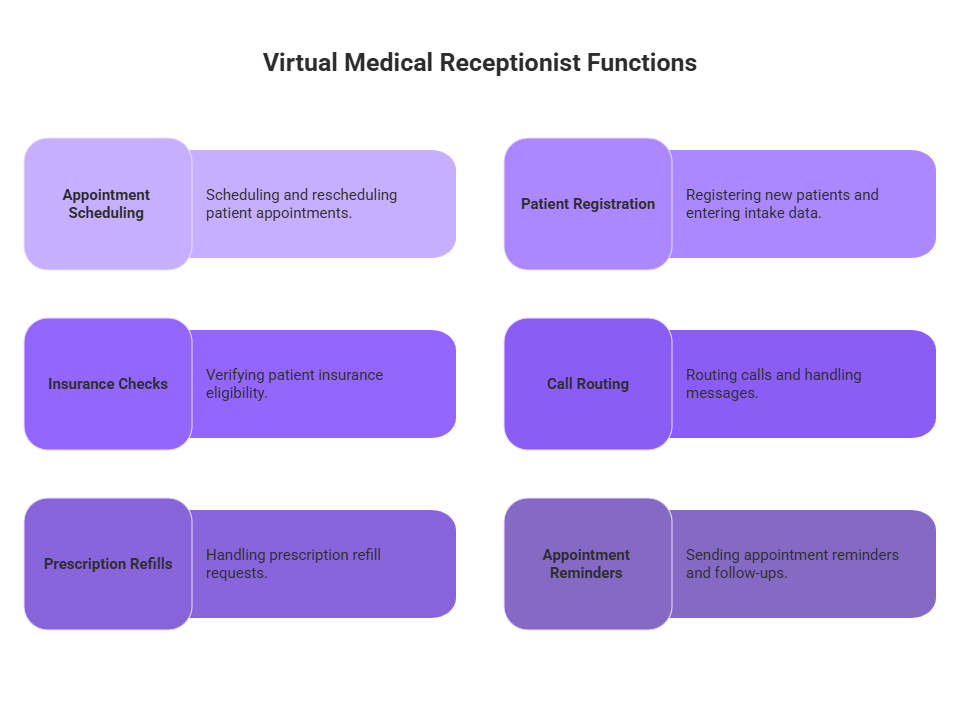
Core Functions of a Virtual Medical Receptionist
Core functions focus on managing patient-facing administrative tasks. These tasks directly affect scheduling accuracy and the quality of billing data.
Key functions include:
- Appointment scheduling and rescheduling
- Patient registration and intake data entry
- Insurance eligibility checks
- Call routing and message handling
- Prescription refill request handling
- Appointment reminders and follow-ups
- Basic billing inquiry support
Types of Virtual Reception Services
Virtual reception services vary based on technology use and staffing models. Healthcare practices select models based on patient volume, budget, and integration needs.
1. Human-Based Virtual Receptionists
These are trained agents handling live patient communication. They support appointment booking, patient queries, and the handling of escalations.
2. AI-Based Virtual Front Desk Systems
These systems use automation for call handling, scheduling, and message processing. They handle high-volume repetitive tasks.
3. Hybrid Reception Models
Hybrid systems combine human agents with AI tools. AI handles routine tasks while humans manage complex or sensitive interactions.
Why Healthcare Practices Use Virtual Front Desk Services
Hybrid systems combine human agents with AI tools. AI handles routine tasks while humans manage complex or sensitive interactions.
Common reasons include:
- High patient call volume
- Staff shortages in front-office roles
- Need for 24/7 appointment access
- Reduction in missed appointments
- Improved intake consistency for billing teams
- Better coordination between scheduling and clinical workflows
How a Virtual Medical Receptionist Supports Healthcare Workflows
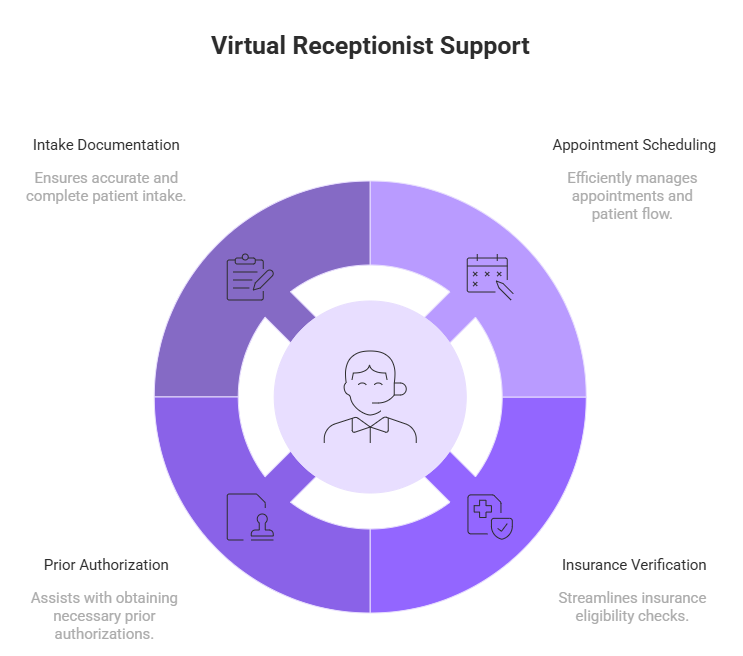
A Virtual Medical Receptionist connects front-office communication with clinical and billing workflows. It manages patient interaction, scheduling, and intake data that directly affects revenue cycle performance.
This section explains how key workflow areas depend on accurate front-desk handling. Each function affects downstream processes like coding accuracy, claim submission, and reimbursement timelines.
Appointment Scheduling and Patient Coordination
Appointment scheduling is the first step in the patient care process. Errors at this stage affect provider utilization and billing timelines.
Key functions include:
- Booking new patient visits
- Managing follow-ups and reschedules
- Sending appointment reminders
- Handling cancellations and waitlists
Insurance Eligibility Verification
Insurance eligibility verification confirms patient coverage before services are delivered. This step directly affects claim acceptance rates.
Core verification tasks:
- Checking active coverage status
- Identifying plan limitations
- Confirming copay and deductible details
- Validating payer network participation
Prior Authorization Support
Prior authorization is required for many procedures and specialty services. Missing approvals often result in denied claims.
- Virtual reception support includes:
- Collecting authorization requirements from payers
- Tracking approval status
- Updating patient records with authorization details
- Coordinating with clinical and billing teams
Intake Documentation Accuracy
Intake documentation sets the foundation for billing and coding accuracy. Errors in this stage affect the entire revenue cycle.
Key intake responsibilities:
- Collecting patient demographics
- Recording insurance details
- Capturing medical history basics
- Updating contact and consent information
Virtual Medical Receptionist and Revenue Cycle Management
A Virtual Medical Receptionist connects front-desk operations with billing and reimbursement systems. It directly influences how patient data moves from scheduling and intake into coding and claims submission. In healthcare operations, Virtual Medical Receptionist workflows affect data accuracy, billing speed, and claim acceptance rates.
This section explains how front-office processes influence revenue cycle performance. Billing teams, coders, and practice managers rely on accurate intake and eligibility data to reduce claim errors and payment delays.
Impact on Medical Billing Workflows
Medical billing workflows depend on accurate patient data captured at the front desk. Any mismatch in demographics or insurance details leads to claim rework and delayed submissions.
A Virtual Medical Receptionist reduces manual entry errors in scheduling and intake. This improves first-pass claim acceptance and lowers administrative corrections in billing systems.
Billing teams get more complete and structured data at the time of claim creation. This reduces delays between patient visits and claim submission.
Connection to CPT, ICD-10, and HCPCS Coding
CPT coding relies on correct procedure scheduling and visit details from intake. Missing or incorrect information leads to coding adjustments and claim corrections.
ICD-10 accuracy depends on a complete patient history and documented complaints.
HCPCS coding requires consistent service-level details from the front desk. Structured intake reduces ambiguity and supports cleaner coding output for coders and HIM teams.
Reduction in Claim Denials
Claim denials often begin with front-end errors such as incorrect insurance or patient data. These issues lead to avoidable rejections at the payer level.
Virtual Medical Receptionist workflows improve eligibility verification and data accuracy. This reduces denial types linked to coverage and demographic mismatches.
With fewer errors at intake, billing teams handle fewer resubmissions. This improves claim acceptance rates and reduces revenue disruption.
Faster Payment Processing
Clean intake data reduces claim corrections and payer holds. This allows claims to move faster through the reimbursement cycle.
Accurate scheduling and insurance details reduce delays in claim acceptance. Billing teams spend less time fixing errors and more time submitting claims.
Faster claim approval helps to improve cash flow for healthcare practices. It also reduces backlog in billing and revenue cycle operations.
Virtual Front Desk for Medical Practice Operations
This section explains how virtual front desk systems support small clinics, multi-location practices, and integrated healthcare networks. The focus is on operational control, communication flow, and coordination with clinical and billing teams.
Support for Small and Mid-Sized Practices
Small and mid-sized practices often face limited staffing and high patient communication issues. Virtual front desk services help manage calls, scheduling, and intake without increasing overhead.
These systems reduce missed calls and improve appointment coverage during peak hours. This helps maintain steady patient flow and reduces scheduling gaps.
Practice managers use these systems to balance workload between staff and improve front-desk consistency. It also reduces pressure on billing teams caused by incomplete intake data.
Multi-Location Practice Support
Multi-location healthcare groups need consistent scheduling and communication across sites. Virtual front desk systems centralize patient coordination and reduce operational variation.
They help standardize appointment booking rules and intake processes across clinics. This reduces duplication and improves coordination between locations.
Administrative teams gain better visibility of patient flow across all sites. This supports better resource planning and reduces scheduling conflicts.
Integration with EHR and Practice Management Systems
Virtual front desk systems often connect with EHR and practice management platforms. This allows real-time updates of patient records, appointments, and billing data.
Integrated systems reduce manual data entry and improve information consistency. This lowers the risk of errors between scheduling and clinical documentation.
Healthcare IT teams use these integrations to improve workflow efficiency and reduce data silos. It also supports smoother coordination between the front office and the billing departments.
Human vs AI Virtual Medical Receptionist
This section compares both these models based on accuracy, operational control, and suitability for healthcare environments. The goal is to help providers, billing teams, and administrators understand where each model fits in daily operations.
Human Reception Services
Human reception services involve trained staff handling patient calls, scheduling, and communication tasks. These staff members can manage complex conversations and patient concerns that require judgment.
They are better suited for sensitive interactions, insurance discussions, and escalation handling. This improves patient communication skills and reduces misunderstandings.
However, human services depend on staffing availability and shift coverage. This can lead to delays during peak hours or after business hours.
AI Reception Systems
AI reception systems handle routine tasks such as call routing, scheduling, and message responses. They process high volumes of patient communication without manual intervention.
These systems enhance reaction time and decrease patient wait times. They also provide after-hours communication support without staff.
Limitations become complex cases where human judgment is required. Misinterpretation of patient requests can affect scheduling accuracy or escalation handling.
Hybrid Reception Models
Hybrid models combine human staff with AI-powered technology to handle shared tasks. AI manages repetitive activities, whereas humans tackle difficult or sensitive issues.
This improves operational balance between speed and communication accuracy. It also reduces staff pressure during high-volume periods.
Healthcare practices use hybrid systems to improve scalability while maintaining human oversight. This supports more stable workflow performance across departments.
Benefits of a Digital Receptionist for Healthcare Providers
A Digital Receptionist supports healthcare providers by handling patient communication, scheduling, and intake tasks outside traditional front-desk workflows.
This section explains how digital reception systems support providers, billing teams, and administrative staff. The focus is on practical outcomes in daily healthcare operations.
Benefits for Providers and Practice Managers
Digital reception systems reduce the workload on front-office staff by managing routine communication tasks. This helps providers focus more on clinical care and patient interaction.
1. Reduces front-desk workload and call handling pressure
2. Improves appointment scheduling consistency
3. Reduces missed calls and delayed responses
4. Improves visibility of daily patient flow
5. Supports better allocation of staff resources
Benefits for Billing and Coding Teams
Billing and coding teams rely on reliable intake data to generate and submit claims. Digital reception systems enhance the quality of demographic and insurance data.
1. Reduces missing or incorrect patient data
2. Improves insurance eligibility accuracy
3. Supports cleaner claim creation workflows
4. Reduces claim rework and corrections
5. Improves coordination between the front desk and the billing teams
Benefits for Patients
Patients benefit from faster appointment scheduling and improved communication response times. Digital receptionist systems reduce waiting time for call handling.
1. Faster appointment booking and confirmations
2. Reduced call waiting time
3. Improved appointment reminder systems
4. Better communication with clinic staff
5. Fewer missed or delayed appointments
They also improve access to appointment reminders and follow-up communication. This reduces missed appointments and improves patient care.
Conclusion
Virtual Medical Receptionist systems are changing how healthcare practices manage scheduling, intake, and patient communication. They support front-office efficiency while improving billing accuracy and workflow coordination across healthcare operations.
These systems also help reduce administrative pressure on providers, billing teams, and practice managers. Better intake accuracy and eligibility verification contribute to fewer claim errors and improved revenue cycle performance.
However, system performance depends on correct implementation, staff training, workflow alignment, and EHR integration. Healthcare organizations must evaluate operational needs carefully to ensure consistent patient communication, compliance, and reimbursement outcomes in 2026.
FAQs
What is a Virtual Medical Receptionist in healthcare?
A Virtual Medical Receptionist manages scheduling, patient communication, insurance verification, and intake tasks remotely. It supports front-desk operations while improving workflow coordination and billing accuracy.
How does a Virtual Medical Receptionist help medical billing?
It improves intake accuracy and insurance verification before claims are submitted.
This reduces claim errors, denials, and administrative corrections for billing teams.
Can a virtual front desk reduce missed appointments?
Yes. Virtual front desk systems send appointment reminders and manage follow-up communication. This improves scheduling consistency and reduces no-show rates in healthcare practices.
What is the difference between AI and human virtual receptionists?
AI systems handle repetitive tasks such as scheduling and call routing, while humans manage complex patient interactions. Many healthcare organizations use hybrid models for better operational balance.
Do Virtual Medical Receptionist systems integrate with EHR platforms?
Many systems integrate with EHR and practice management software for real-time data updates. This improves communication between front-office, clinical, and billing departments.