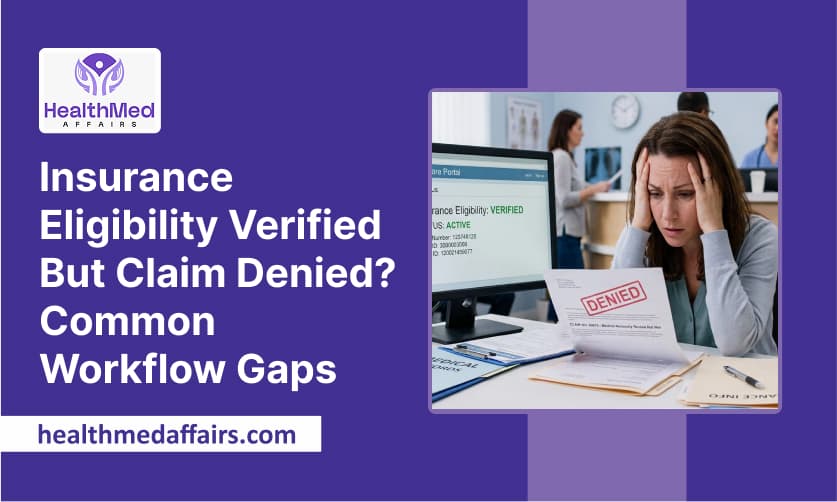
Insurance eligibility verification is a vital first step in the medical billing process, confirming a patient’s active insurance coverage before services are provided. However, verified eligibility alone doesn’t guarantee that a claim will be approved or reimbursed.
Many claim denials occur because of workflow gaps that arise after eligibility verification, including missing authorizations, coding errors, incomplete documentation, referral issues, or payer-specific billing requirements that delay reimbursement and increase administrative workload.
What Does Insurance Eligibility Verification Actually Confirm?
Insurance eligibility verification is the process of confirming a patient’s insurance information before medical services are provided. It helps healthcare organizations determine whether the patient’s policy is active and whether the insurance company recognizes the patient as an eligible member on the date of service.
This verification typically occurs during appointment scheduling or shortly before the patient’s visit. Front-office staff, billing specialists, or medical billing virtual assistants access payer portals or electronic eligibility systems to validate the patient’s insurance information.
A standard insurance eligibility verification process generally confirms the following:
- Active insurance coverage
- Policy effective and termination dates
- Patient and subscriber information
- Insurance carrier details
- Provider network participation
- Primary and secondary insurance information
- Basic benefit eligibility
- Copayment, deductible, and coinsurance information (when available)
Completing these checks allows providers to identify obvious insurance issues before treatment begins. It also enables practices to discuss financial responsibilities with patients and reduce registration-related claim errors.
However, this is where many misconceptions arise.
Many providers believe that verifying insurance eligibility means the claim has been “approved.” In reality, eligibility verification only confirms that the patient has active coverage—it does not guarantee reimbursement for the specific services performed.
Several additional requirements must still be satisfied before a payer approves payment.
Eligibility Verification vs. What It Doesn’t Verify
Understanding the distinction between eligibility verification and other revenue cycle activities is essential for preventing claim denials.
| Insurance Eligibility Verification Confirms | It Does NOT Confirm |
| Active insurance coverage | Medical necessity for services |
| Effective coverage dates | Prior authorization approval |
| Member eligibility | Referral requirements |
| Basic plan information | Correct CPT and ICD-10 coding |
| Insurance carrier details | Complete clinical documentation |
| Provider participation (where available) | Payer-specific billing edits |
| Basic benefit information | Frequency limits or service exclusions |
| Patient demographics | Clean claim readiness |
This distinction explains why a claim may still be denied despite successful eligibility verification. While the patient’s insurance may be active, other requirements that affect claim payment may not have been addressed.
For example, a patient may have active insurance coverage for an outpatient imaging procedure. Eligibility verification confirms that the policy is valid, but it does not determine whether the imaging study requires prior authorization. If authorization is missing, the payer may deny the claim even though the patient’s insurance was active.
Similarly, eligibility verification does not assess whether the provider’s documentation supports medical necessity or whether the submitted diagnosis code justifies the billed procedure. These factors are evaluated later during claim adjudication and can significantly influence reimbursement.
In other words, eligibility verification answers the question, “Can this patient use this insurance today?” It does not answer the more important billing question:
“Will the payer reimburse this specific claim?”
That answer depends on several additional workflow steps, each of which plays a vital role in producing a clean claim.
Why Claims Get Denied Even After Eligibility Is Verified
If insurance eligibility verification confirms that the patient’s coverage is active, why do so many claims still get denied?
The answer lies in the numerous processes that occur after eligibility verification and before claim submission. Healthcare reimbursement is not determined by a single verification step but by the combined accuracy of registration, documentation, coding, authorization, billing, and payer compliance.
Think of eligibility verification as checking that a traveler has a valid passport before boarding an international flight. While the passport confirms identity and citizenship, the traveler may still be denied boarding if they lack the required visa, arrive after check-in closes, or fail to meet other travel requirements. Similarly, active insurance coverage is only one requirement among many that determine whether a claim will ultimately be paid.
Common reasons a claim may still be denied after eligibility verification include:
- Required prior authorization was not obtained.
- Referral requirements were overlooked.
- Benefits were not verified beyond basic eligibility.
- CPT, ICD-10, or modifier coding errors occurred.
- Clinical documentation failed to support medical necessity.
- Patient demographic information changed after verification.
- Claims were submitted after timely filing deadlines.
- Payer-specific billing rules were not followed.
- Claim scrubbing was incomplete or skipped.
Each of these issues can interrupt the revenue cycle even when insurance eligibility verification has been performed correctly.
The good news is that most of these denials are preventable.
By understanding where workflow breakdowns commonly occur, healthcare providers can strengthen their front-end revenue cycle processes, improve first-pass claim acceptance rates, and reduce costly rework.
Here, we’ll examine the eight most common workflow gaps providers overlook and explain how each one contributes to claim denials despite successful insurance eligibility verification. These insights can help practices build a more resilient billing workflow and protect revenue before claims ever reach the payer.
8 Common Workflow Gaps That Cause Claim Denials
Insurance eligibility verification is just the first checkpoint in the revenue cycle. Once a patient’s coverage is confirmed, several additional processes must be completed accurately to ensure a clean claim. A single missed step can lead to claim denials, delayed reimbursements, and increased administrative costs.
Let’s look at the most common workflow gaps providers overlook.
1. Benefits Were Never Verified
One of the biggest misconceptions in medical billing is assuming that eligibility verification and benefits verification are the same thing. They are not.
Eligibility verification confirms that a patient’s insurance policy is active. Benefits verification goes a step further by determining exactly what services are covered under that policy.
Without verifying benefits, providers may overlook:
- Service exclusions
- Deductible status
- Coinsurance responsibilities
- Copayment amounts
- Annual visit limits
- Coverage restrictions
For example, a patient may have active insurance, but their plan may not cover a specific diagnostic test or therapy session. If benefits aren’t reviewed beforehand, the claim could be denied even though eligibility was confirmed.
Best Practice: Always verify patient benefits separately from eligibility, especially for high-cost procedures and specialty services.
2. Prior Authorization Was Missing or Expired
Many insurance plans require prior authorization before certain services can be performed. Eligibility verification does not automatically confirm whether authorization has been obtained.
Claims are commonly denied when:
- Authorization was never requested.
- The approved authorization expired.
- The authorized procedure differs from the service performed.
- The provider used an incorrect authorization number.
This issue frequently affects services such as:
- Advanced imaging (MRI, CT scans)
- Surgical procedures
- Specialty medications
- Physical therapy
- Behavioral health services
Best Practice: Track authorization status throughout the patient journey and verify that it matches the scheduled procedure before the claim is submitted.
3. Referral Requirements Were Overlooked
Patients enrolled in HMO or managed care plans often require a referral from their primary care physician before seeing a specialist.
Although eligibility verification confirms active coverage, it does not always validate whether a referral has been issued or remains valid.
Common referral-related mistakes include:
- Missing referral documentation
- Expired referrals
- Referrals for the wrong specialty
- Incorrect referring provider information
Even when treatment is medically necessary, missing referral requirements can result in denied claims.
Best Practice: Include referral verification as part of your front-end workflow, particularly for specialist visits.
4. Coding Errors Occurred After Verification
Insurance companies evaluate the accuracy of every claim submitted. Even with active insurance coverage, errors in medical coding can trigger denials.
Some of the most common coding issues include:
- Incorrect CPT codes
- Invalid ICD-10 diagnosis codes
- Missing or incorrect modifiers
- Diagnosis and procedure mismatches
- Duplicate billing
Eligibility verification cannot identify these coding errors because they occur later in the billing process.
Best Practice: Conduct coding reviews and claim scrubbing before submission to improve first-pass claim acceptance.
5. Clinical Documentation Didn’t Support Medical Necessity
A payer may acknowledge that a service is covered but still deny reimbursement if the provider’s documentation doesn’t justify why the service was necessary.
Medical necessity denials often occur because:
- Clinical notes are incomplete.
- Documentation lacks supporting evidence.
- Diagnosis codes don’t align with treatment.
- Required physician signatures are missing.
Strong documentation plays a vital role in supporting reimbursement and reducing denials during claim review.
Best Practice: Encourage providers to complete detailed documentation promptly and ensure coding accurately reflects the clinical record.
6. Patient Information Changed Before the Visit
Insurance information can change between appointment scheduling and the actual date of service.
A patient may:
- Switch employers
- Change insurance carriers
- Update dependent coverage
- Correct personal information
- Receive a new member ID
If these updates aren’t captured before claim submission, the payer may reject or deny the claim due to inaccurate member information.
Best Practice: Reconfirm patient demographics and insurance details at every visit, even if eligibility was verified days earlier.
7. Claim Scrubbing Was Skipped
Claim scrubbing is a quality-control process that identifies billing errors before claims are sent to the payer.
Skipping this step increases the likelihood of preventable denials caused by:
- Missing claim fields
- Invalid modifiers
- Incompatible diagnosis and procedure codes
- Duplicate claims
- Payer-specific edit failures
Modern claim-scrubbing tools can detect many of these issues automatically, helping billing teams submit cleaner claims and reduce rework.
Best Practice: Make claim scrubbing a mandatory step before every submission, regardless of payer or specialty.
8. Payer Rules or Timely Filing Deadlines Were Missed
Every insurance payer has its own billing guidelines, documentation requirements, and filing deadlines.
A claim may be denied because:
- It was submitted after the payer’s filing limit.
- The place-of-service code was incorrect.
- Required attachments were missing.
- Payer-specific billing rules weren’t followed.
These denials are often preventable with standardized workflows and regular monitoring of payer updates.
Best Practice: Maintain an up-to-date payer requirements database and routinely train staff on policy changes.
The Common Thread Behind These Denials
Notice that none of these issues are caused by insurance eligibility verification itself. Instead, they occur after eligibility has already been confirmed, highlighting an important reality of the revenue cycle.
Eligibility verification answers one question:
“Is the patient’s insurance active?”
Successful reimbursement depends on many additional questions being answered correctly:
- Are the patient’s benefits sufficient for the service?
- Was prior authorization obtained?
- Is a referral required?
- Does the documentation support medical necessity?
- Are the diagnosis and procedure codes accurate?
- Has the claim been scrubbed for errors?
- Does the submission comply with payer-specific rules?
When even one of these checkpoints is missed, a claim can be denied despite active insurance coverage.
The Hidden Workflow Between Eligibility Verification and Payment
Many providers assume that once insurance eligibility is verified, the claim is ready for submission. In reality, eligibility verification is only the first step in a much larger revenue cycle workflow.
Every stage that follows presents an opportunity for errors, and even one missed task can lead to a denied claim.
A Typical Medical Billing Workflow
Patient Schedules Appointment
↓
Insurance Eligibility Verification
↓
Benefits Verification
↓
Prior Authorization (if required)
↓
Referral Confirmation
↓
Patient Check-in & Demographic Review
↓
Clinical Documentation
↓
Medical Coding
↓
Claim Scrubbing
↓
Claim Submission
↓
Payer Adjudication
↓
Payment or Denial
The key takeaway is simple: eligibility verification confirms coverage, but the remaining workflow determines whether the payer will approve the claim.
A Real-World Example
Consider this common scenario:
- Monday: The patient’s insurance eligibility is verified, and the policy is active.
- Wednesday: The provider changes the scheduled procedure to a more advanced service.
- Thursday: No one updates the prior authorization to match the new procedure.
- Friday: The claim is submitted.
Outcome: The claim is denied—not because the insurance was inactive, but because the authorization didn’t match the service performed.
This example highlights why successful reimbursement depends on every step of the billing workflow, not just eligibility verification.
How Medical Billing Virtual Assistants Help Prevent Workflow Gaps
A skilled Medical Billing Virtual Assistant can strengthen front-end revenue cycle processes by ensuring that critical tasks aren’t overlooked.
They can assist with:
- Real-time insurance eligibility and benefits verification
- Prior authorization and referral tracking
- Patient demographic updates
- Claim scrubbing before submission
- Monitoring payer-specific billing requirements
- Following up on pending claims and denials
At Health Med Affairs, our Medical Billing Virtual Assistants work as an extension of your team, helping providers reduce preventable claim denials, improve clean claim rates, and maintain a more efficient revenue cycle.
Best Practices to Reduce Preventable Claim Denials
Reducing denials starts with a consistent workflow. Consider these best practices:
- Verify eligibility within 24–72 hours of the appointment.
- Confirm benefits separately from eligibility.
- Obtain required authorizations and referrals before treatment.
- Review patient demographics at every visit.
- Perform claim scrubbing before submission.
- Stay current with payer-specific billing guidelines.
- Monitor denial trends to identify recurring workflow issues.
A proactive approach helps improve first-pass claim acceptance and minimizes costly claim rework.
Conclusion
Insurance eligibility verification is a critical first step in the medical billing process, but it is only one part of a successful revenue cycle. A verified insurance policy does not guarantee reimbursement if other workflow requirements—such as benefits verification, prior authorization, accurate coding, and complete documentation—are overlooked.
By strengthening every stage of the billing workflow, healthcare providers can improve clean claim rates, reduce administrative burden, and accelerate reimbursements. Partnering with experienced professionals, such as the Medical Billing Virtual Assistants at Health Med Affairs, can further streamline these processes, helping practices minimize preventable denials while focusing on delivering exceptional patient care.
Frequently Asked Questions
Does insurance eligibility verification guarantee payment?
No. It only confirms that a patient’s insurance is active. Payment also depends on factors such as prior authorization, medical necessity, accurate coding, documentation, and compliance with payer guidelines.
What is the difference between eligibility verification and benefits verification?
Eligibility verification confirms active insurance coverage, while benefits verification determines what services are covered, patient cost-sharing responsibilities, and any coverage limitations.
Why are claims denied even when insurance is active?
Claims may be denied due to missing authorizations, coding errors, incomplete documentation, referral issues, payer-specific rules, or timely filing violations—even if the patient’s insurance is active.
How can providers reduce claim denials?
Implementing standardized workflows, verifying benefits and authorizations, maintaining accurate documentation, and using claim-scrubbing tools can significantly reduce preventable denials.