

Healthcare providers often focus on coding accuracy, claim submission, and denial management, but there’s a silent factor affecting your reimbursements that many overlook: sequestration. If you’ve ever noticed a small but consistent reduction in your Medicare payments, you’ve already encountered it. Sequestration isn’t a billing error, and it’s not a denial you can appeal.
It’s a federally mandated adjustment that directly reduces what you get paid, regardless of how clean your claims are. That’s why billing teams, practice managers, and revenue cycle professionals must clearly understand concepts like sequestration reduction in medical billing, sequestration adjustment, and how they appear on remittance advice.
In this article, you’ll learn exactly how sequestration works, why it exists, and what it means for your bottom line, so you can manage it proactively instead of being caught off guard.
What is Sequestration in Medical Billing?
Sequestration in medical billing is a federally mandated reduction in Medicare payments to healthcare providers. It was introduced under the Budget Control Act to reduce government spending, and it continues to affect reimbursements today.
In practical terms, sequestration does not impact how you bill or code a claim; it only affects the final payment amount issued by Medicare. After a claim is processed and the approved amount is determined, a small percentage is deducted before payment is released.
Key Characteristics of Sequestration
- Applies primarily to Medicare Fee-for-Service (FFS) claims
- Typically results in a 2% reduction in payment
- Calculated after patient responsibility (deductibles and coinsurance)
- Displayed as a separate adjustment on remittance advice
- Not considered a billing error or denial
This means even if your claim is perfectly coded and processed without issues, the final reimbursement will still be slightly reduced due to sequestration.
What is Sequestration Reduction in Medical Billing?
Sequestration reduction in medical billing refers specifically to the percentage cut applied to Medicare payments after claim adjudication. It is a standard, automatic adjustment that providers must account for in their revenue cycle.
How Sequestration Reduction Works?
When Medicare processes a claim, the following steps occur:
- The provider submits a claim with billed charges
- Medicare determines the allowed amount
- Patient responsibility (if any) is calculated
- The remaining payable amount is reduced by the sequestration percentage
Example of Sequestration Reduction
- Allowed amount: $200
- Medicare pays: $160 (after patient responsibility)
- Sequestration reduction (2%): $3.20
- Final payment to provider: $156.80
Important Points to Understand
- The sequestration reduction does not affect what the patient owes
- It only applies to the Medicare-paid portion
- It is consistent across applicable claims
- It cannot be appealed or reversed
For billing teams, recognizing this reduction is essential when reconciling payments and forecasting revenue. Even though the percentage seems small, the cumulative impact over time can be significant.
Sequestration Reduction in Federal Payment
Sequestration reduction in federal payment extends beyond healthcare, but in medical billing, it primarily affects Medicare reimbursements. This automatic budget control measure ensures that federal spending stays within set limits, meaning healthcare providers consistently receive slightly reduced payments from government-funded programs.
Where Sequestration Applies in Healthcare
- Medicare Part B (physician services, outpatient care)
- Medicare Part A (certain institutional payments)
- Durable Medical Equipment (DME) claims
- Other federally funded reimbursement streams tied to Medicare
What This Means for Providers
- Payments are reduced uniformly across applicable claims
- The reduction is non-negotiable and automatic
- It is enforced by the Centers for Medicare & Medicaid Services (CMS)
- It continues unless temporarily suspended by legislation
Even though the percentage is relatively small, the long-term financial effect on high-volume practices can be substantial. That’s why understanding sequestration reduction in federal payment is essential for accurate revenue projections.
What is Sequestration Adjustment in Medical Billing?
A sequestration adjustment in medical billing is the specific deduction line item you see on your Remittance Advice (RA) or Explanation of Benefits (EOB). It represents the actual reduction applied to your Medicare payment.
How Sequestration Adjustment Appears?
- Listed as a separate adjustment entry
- Clearly labeled as “Sequestration Adjustment” or similar wording
- Applied after claim processing is complete
- Reduces only the provider payment, not patient responsibility
Why It Matters
Understanding the sequestration adjustment helps billing teams avoid confusion during payment posting and reconciliation.
- It is not a denial
- It does not require follow-up or appeal
- It should be accounted for in financial reporting
Practical Tip for Billing Teams
When reviewing remittance advice:
- Always identify the sequestration line item
- Ensure the percentage aligns with current federal rates
- Factor this adjustment into your net collection calculations
By recognizing how sequestration adjustment in medical billing works, providers can maintain accurate financial records and avoid misinterpreting these reductions as errors or underpayments.
Sequestration Amount Explained
The sequestration amount is the exact dollar value deducted from a Medicare payment after all other calculations are complete. While the percentage (usually 2%) is fixed, the actual amount varies depending on the claim value.
How is the Sequestration Amount Determined?
The calculation is straightforward and always applied to the Medicare-paid portion of the claim, not the total billed amount.
Step-by-Step Breakdown:
- Identify the Medicare-approved (allowed) amount
- Subtract patient responsibility (deductible + coinsurance)
- Apply the sequestration percentage (typically 2%)
- The result is the sequestration amount deducted
Example Calculation
- Allowed amount: $150
- Patient responsibility: $30
- Medicare payable: $120
- Sequestration (2% of $120): $2.40
- Final payment: $117.60
Key Takeaways
- The sequestration amount varies per claim
- It only affects the provider’s reimbursement
- It is always a predictable percentage-based deduction
For high-volume practices, even small sequestration amounts can accumulate into significant revenue reductions over time.
Sequestration Medicare: What You Need to Know
Sequestration Medicare refers to how sequestration rules specifically apply within the Medicare system. It is one of the most important concepts for providers who rely heavily on Medicare reimbursements.
Where Sequestration Applies in Medicare
- Medicare Part B services (physicians, outpatient care)
- Selected Medicare Part A payments
- Certain supplier and facility reimbursements
Important Facts About Sequestration Medicare
- It applies only to traditional Medicare (Fee-for-Service)
- It does not impact claim approval or eligibility
- It is separate from contractual adjustments and write-offs
- It continues unless modified by federal policy
Financial Impact on Providers
- Reduces overall reimbursement rates
- Requires accurate net revenue forecasting
- Makes efficient billing and collections more critical
What Providers Should Watch
- Consistency of the 2% reduction across claims
- Proper posting of sequestration adjustments
- Monthly financial impact trends
Sequestration Code in Medical Billing
In medical billing, sequestration is not just a concept; it is also reflected through specific adjustment and remark codes on the Remittance Advice (RA). These identifiers help billing teams understand why a payment was reduced.
How is Sequestration Identified?
Sequestration does not usually appear as a traditional denial code. Instead, it is shown as an adjustment tied to federal payment reductions.
Common Indicators:
- Adjustment reason codes linked to federal mandates
- Remark codes explaining reduced reimbursement
- Clear labeling as a sequestration-related deduction
Why Sequestration Codes Matter
- Help differentiate between true denials vs. payment reductions
- Ensure accurate payment posting and reconciliation
- Prevent unnecessary appeals or rework
Best Practice
Billing teams should train staff to quickly recognize sequestration-related codes so they don’t confuse them with underpayments or errors.
CO 253 Denial Code Explained
The CO 253 denial code is one of the most commonly associated codes with sequestration in medical billing.
What CO 253 Means
- Indicates a federally mandated payment reduction
- Specifically tied to sequestration adjustments
- Falls under the Contractual Obligation (CO) category
Important Clarification
Despite being called a “denial code,” CO 253 is not an actual denial.
- The claim has been processed and paid
- The reduction is intentional and required by law
- There is no appeal process for this adjustment
How It Appears on Remittance Advice
- Listed alongside payment details
- Shows the reduced amount due to sequestration
- Often accompanied by explanatory remark codes
What Billing Teams Should Do
- Post the adjustment correctly as a contractual reduction
- Do not resubmit or appeal the claim
- Track the impact as part of revenue analysis
Understanding the CO 253 denial code prevents confusion, reduces unnecessary follow-ups, and keeps your revenue cycle running efficiently.
Does Sequestration Apply to Medicare Advantage?
One of the most common questions providers ask is: Does sequestration apply to Medicare Advantage? The answer is straightforward, but often misunderstood.
Direct vs. Indirect Impact
- Does NOT directly apply to Medicare Advantage plans
- Medicare Advantage is managed by private insurance companies, not traditional Medicare Fee-for-Service
- These plans are paid by the government differently, so standard sequestration rules don’t apply at the claim level
However, There’s an Indirect Effect
Even though providers may not see a sequestration adjustment on Medicare Advantage remittances, the reduction can still influence:
- Payer reimbursement structures
- Contract rates between providers and insurers
- Overall funding levels for Medicare Advantage organizations
What Providers Should Keep in Mind
- Do not expect to see CO 253 denial code for Medicare Advantage claims
- Review payer contracts carefully for any built-in reductions
- Monitor payment patterns to identify indirect financial impacts
In short, while sequestration Medicare rules mainly apply to traditional Medicare, Medicare Advantage plans may still reflect its effects behind the scenes.
How is Medicare Sequestration Calculated?
Understanding how Medicare sequestration is calculated is essential for accurate payment posting and revenue forecasting. The formula itself is simple, but knowing when and where it applies makes all the difference.
Standard Sequestration Formula
Sequestration=Medicare Payment×0.02Sequestration = Medicare\ Payment \times 0.02Sequestration=Medicare Payment×0.02
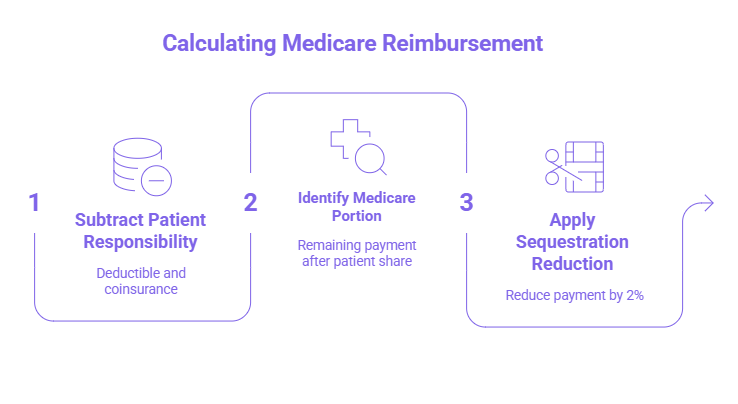
Step-by-Step Calculation Process
- Determine the Medicare-approved (allowed) amount
- Subtract patient responsibility (deductible and coinsurance)
- Identify the remaining Medicare payment portion
- Apply the 2% sequestration reduction
- Arrive at the final reimbursement amount
Example Calculation
- Allowed amount: $250
- Patient responsibility: $50
- Medicare payable: $200
- Sequestration (2%): $4
- Final payment: $196
Key Points to Remember
- The calculation is always based on the Medicare-paid portion, not total charges
- The percentage is typically fixed at 2%
- It is applied after claim adjudication
- It does not affect patient billing amounts
By mastering how Medicare sequestration is calculated, billing teams can maintain financial accuracy and make more informed operational decisions.
Impact of Sequestration on Healthcare Providers
At first glance, a 2% reduction may not seem significant, but over time, the sequestration reduction in medical billing can create a noticeable financial gap, especially for practices with high Medicare patient volume.
Financial Impact
- Consistent revenue reduction across all applicable claims
- Lower overall reimbursement despite clean claims
- Reduced margins for small and mid-sized practices
Operational Impact
- Increased need for accurate financial forecasting
- More attention is required during payment reconciliation
- Greater pressure on billing teams to optimize collections
Long-Term Effects
- Accumulated losses over months and years
- Potential impact on staffing, resources, and growth plans
- Increased reliance on efficient revenue cycle management (RCM) strategies
Even though sequestration adjustment is unavoidable, understanding its impact allows providers to plan ahead, control losses, and strengthen their financial systems.
Best Practices to Manage Sequestration in Medical Billing
While you cannot eliminate sequestration medicare reductions, you can take steps to minimize their impact and maintain financial stability.
1. Monitor Remittance Advice Closely
Always review your RA/EOB to identify:
- Sequestration amount applied
- Correct usage of the sequestration code
- Presence of CO 253 denial code
2. Improve Clean Claim Rate
Since sequestration reduces already approved payments, it’s critical to:
- Submit error-free claims
- Reduce rejections and delays
- Maximize first-pass acceptance rates
3. Track Sequestration Losses
Create monthly reports to:
- Measure total sequestration reduction
- Identify trends over time
- Support financial planning and budgeting
4. Train Your Billing Team
Ensure your team understands:
- What is a sequestration adjustment in medical billing
- Why CO 253 is not a true denial
- How to properly post adjustments
5. Optimize Your Revenue Cycle
Focus on areas you can control:
- Faster claim submissions
- Reduced AR days
- Strong follow-up on real denials
Conclusion
Sequestration may be small per claim, but it’s powerful in its long-term impact. The more clearly you understand concepts like sequestration amount and how Medicare applies reductions, the better equipped you’ll be to protect your bottom line and run a financially healthy practice.
By recognizing how sequestration reduction in federal payment, sequestration adjustment, and CO 253 denial code work, providers can avoid confusion, improve financial accuracy, and make smarter business decisions. The key is not to eliminate sequestration, but to manage it effectively through awareness, training, and strong revenue cycle practices.