
In a healthcare environment, even small gaps in billing can lead to significant revenue loss. That’s where charge capture medical billing becomes essential. It ensures that every service provided, no matter how minor, is accurately recorded, coded, and billed. Without an effective healthcare charge capture system, providers risk missing charges, facing claim denials, and dealing with compliance issues.
The reality is, many practices still rely on outdated or manual systems, making the charge capture process prone to errors and delays. This not only impacts cash flow but also adds unnecessary administrative burden.
The good news? Modern charge capture solutions are transforming how healthcare organizations manage their billing, making it faster, more accurate, and far more efficient.
What is Charge Capture in Medical Billing?
Charge capture is the process of recording all billable services provided to a patient and converting them into claims for reimbursement. In simple terms, it ensures that healthcare providers get paid for every service they deliver. Within charge capture medical billing, this step is the foundation of a healthy revenue cycle.
Unlike general billing, which focuses on submitting claims and collecting payments, healthcare charge capture happens at the very beginning. If this step is inaccurate or incomplete, it directly affects everything that follows, including coding, claim submission, and reimbursement.
Key Components of Charge Capture
Accurate Documentation: Every service, procedure, or treatment must be clearly documented by healthcare providers. Missing details can lead to lost revenue or denied claims.
Timely Data Entry: Charges should be recorded as soon as possible after the patient encounter. Delays can result in forgotten services or billing backlogs.
Correct Coding: Proper use of CPT, ICD, and HCPCS codes ensures that services are billed correctly and comply with regulations.
Integration with Billing Systems: A seamless connection between EHR and billing systems improves accuracy and reduces manual work.
When done correctly, charge capture medical billing ensures that no service goes unbilled and revenue leakage is minimized.
Why is Healthcare Charge Capture Important?
An efficient healthcare charge capture system is critical for maintaining financial stability in any medical practice. Even small inefficiencies in the charge capture process can lead to significant revenue losses over time.
Impact on Revenue Cycle Management
- Prevents Revenue Leakage
Missed charges are one of the most common causes of lost revenue. A strong charge capture process ensures every service is billed. - Improves Cash Flow
Accurate and timely charge capture leads to faster claim submissions and quicker reimbursements. - Reduces Claim Denials
Proper documentation and coding minimize errors that often result in denied or rejected claims. - Enhances Financial Visibility
Providers gain better insights into their revenue streams, helping them make informed decisions.
Compliance and Audit Readiness
- Supports Regulatory Compliance
Accurate charge capture ensures adherence to healthcare regulations and billing standards. - Reduces Audit Risks
Proper documentation makes it easier to handle audits and avoid penalties. - Improves Coding Accuracy
Ensures that all services are coded correctly, reducing the risk of undercoding or overcoding.
In short, charge capture medical billing is not just about getting paid. It is about protecting your practice from financial and legal risks while maximizing revenue.
The Charge Capture Process Explained
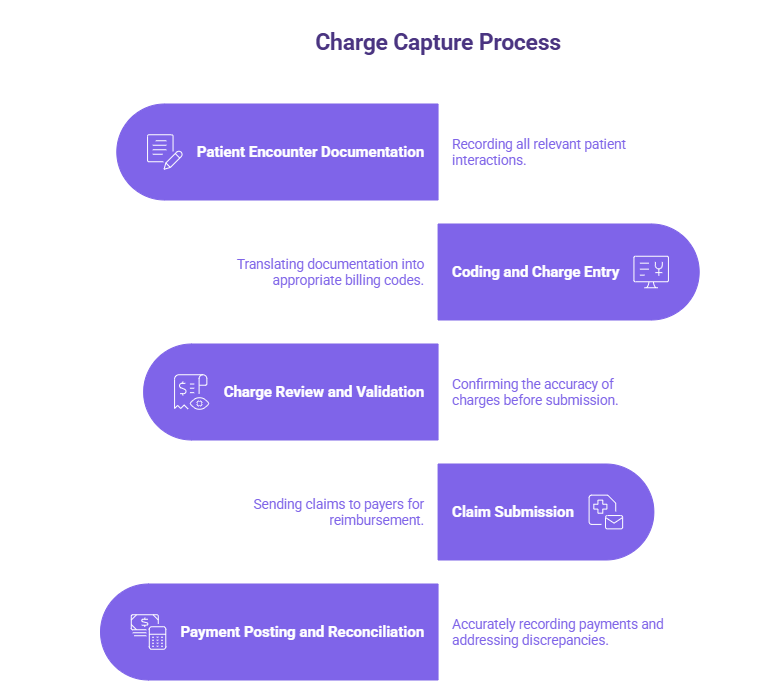
Understanding the charge capture process helps healthcare providers identify gaps and improve efficiency. Each step plays a crucial role in ensuring accurate billing and timely reimbursement.
1. Patient Encounter Documentation
- Record All Services Provided: Physicians and staff must document every procedure, diagnosis, and treatment during the patient visit.
- Ensure Clarity and Completeness: Clear documentation reduces confusion during coding and billing.
This step forms the backbone of healthcare charge capture because incomplete records lead to missed charges.
2. Coding and Charge Entry
- Assign Accurate Medical Codes: Coders translate documentation into standardized codes used for billing.
- Enter Charges into the System: Charges are recorded in the billing software for further processing.
Accuracy at this stage ensures that charge capture medical billing remains compliant and efficient.
3. Charge Review and Validation
- Verify Documentation and Codes: A review process helps identify missing or incorrect entries.
- Check for Compliance Issues: Ensures all charges meet payer and regulatory requirements.
This step reduces errors before claims are submitted, improving approval rates.
4. Claim Submission
- Prepare and Submit Claims: Charges are converted into claims and sent to insurance providers.
- Ensure Timely Filing: Submitting claims on time avoids delays and rejections.
Efficient submission is key to maintaining a smooth charge capture process.
5. Payment Posting and Reconciliation
- Track Payments from Payers: Payments are recorded and matched with submitted claims.
- Resolve Discrepancies: Any underpayments or denials are investigated and corrected.
This final step ensures that all captured charges translate into actual revenue.
Common Challenges in Charge Capture Medical Billing
Even with a structured charge capture process, many healthcare providers face ongoing challenges that impact revenue and efficiency. Identifying these issues is the first step toward improving your charge capture medical billing system.
Frequent Challenges in Healthcare Charge Capture
Missed or Lost Charges
Services that are not documented or entered into the system never get billed. This is one of the biggest causes of revenue leakage in healthcare.
Manual Data Entry Errors
Relying on manual processes increases the risk of incorrect entries, duplicate charges, or missing information.
Delayed Documentation
When providers delay recording patient encounters, important details can be forgotten, leading to incomplete billing.
Lack of System Integration
Disconnected systems between EHR and billing platforms create inefficiencies and increase the chances of errors.
Compliance Risks
Incorrect coding or incomplete documentation can lead to audits, penalties, or claim denials.
How do these challenges affect revenue?
- Increased Claim Denials: Errors in documentation or coding often result in rejected claims, delaying payments.
- Revenue Leakage: Missed charges directly reduce the total revenue generated by the practice.
- Higher Administrative Costs: Staff spend more time correcting errors and resubmitting claims.
- Reduced Operational Efficiency: Inefficient workflows slow down the entire charge capture process.
Addressing these challenges is essential for creating a more reliable and profitable healthcare charge capture system.
What are Charge Capture Solutions?
Charge capture solutions are tools and technologies designed to streamline the process of recording, coding, and billing patient services. These solutions help eliminate manual errors and improve the overall efficiency of charge capture and medical billing.
Types of Charge Capture Solutions
Manual Systems: Traditional paper-based or spreadsheet methods used to track services. These are prone to errors and inefficiencies.
Automated Digital Solutions: Software platforms that capture charges electronically and integrate with billing systems for faster processing.
Mobile Charge Capture Apps: Applications that allow providers to document and submit charges in real time using smartphones or tablets.
Key Features to Look For
- Real-Time Charge Entry: Enables providers to record services instantly, reducing the chances of missed charges.
- EHR Integration: Seamless connection with electronic health records ensures accurate data flow and reduces duplication.
- Automated Coding Assistance: Helps assign correct codes, minimizing errors and improving compliance.
- Compliance Checks: Built-in validation tools ensure that all charges meet regulatory and payer requirements.
- User-Friendly Interface: Easy-to-use systems improve staff adoption and reduce training time.
Implementing the right charge capture solutions can significantly enhance the accuracy and speed of your healthcare charge capture operations.
Benefits of Implementing Charge Capture Solutions
Adopting modern charge capture solutions can transform how healthcare organizations manage their billing processes. These tools not only improve efficiency but also drive better financial outcomes.
Improved Accuracy: Automation reduces human errors in documentation and coding, ensuring more accurate billing.
Faster Billing Cycles: Real-time charge entry speeds up the entire charge capture process, leading to quicker claim submissions.
Reduced Claim Denials: Accurate data and compliance checks minimize the chances of rejected claims.
Increased Revenue: Capturing every billable service ensures that no revenue is left unclaimed.
Better Compliance: Automated systems help maintain proper documentation and coding standards.
Operational Advantages
- Lower Administrative Burden: Staff spend less time on manual data entry and corrections.
- Enhanced Workflow Efficiency: Integrated systems streamline operations across departments.
- Improved Financial Insights: Real-time reporting helps providers track performance and identify gaps.
ROI of Automated Charge Capture
- Time Savings: Faster processes allow staff to focus on higher-value tasks.
- Cost Reduction: Fewer errors and rework lower operational expenses.
- Scalability: Practices can handle more patients without increasing administrative workload.
By leveraging advanced charge capture medical billing tools, healthcare providers can create a more efficient, accurate, and profitable revenue cycle.
Best Practices for an Effective Charge Capture Process
To get the most out of their charge capture medical billing, healthcare providers must adopt proven strategies that improve accuracy, efficiency, and compliance. A well-optimized charge capture process not only prevents revenue loss but also strengthens the overall billing workflow.
Ensure Real-Time Documentation: Providers should document services immediately after patient encounters. This reduces the risk of missing or incomplete charges and improves billing accuracy.
Train Staff Regularly: Ongoing training helps physicians, coders, and billing teams stay updated with coding standards, compliance rules, and system usage.
Use Automated Charge Capture Solutions: Implementing modern charge capture solutions reduces manual errors and speeds up the billing process.
Standardize Workflows: Creating consistent procedures for documentation, coding, and charge entry ensures uniformity and minimizes confusion.
Conduct Regular Audits: Routine audits help identify gaps in the healthcare charge capture system and correct issues before they impact revenue.
Integrate Systems: Seamless integration between EHR, practice management, and billing systems improves data flow and reduces duplication.
Why These Practices Matter
- Improved Accuracy and Compliance: Standardized and automated processes reduce the risk of coding errors and regulatory violations.
- Higher Revenue Capture: Ensures that all billable services are properly recorded and reimbursed.
- Better Team Productivity: Efficient workflows allow staff to focus on patient care rather than administrative corrections.
Implementing these best practices can significantly enhance the performance of your charge capture process and maximize financial outcomes.
Charge Capture vs Medical Billing: Key Differences
Although often used interchangeably, charge capture and medical billing serve different roles within the healthcare revenue cycle. Understanding their differences helps providers optimize both functions effectively.
What is Charge Capture?
- Definition: The process of recording all services provided to a patient for billing purposes.
- Focus Area: Capturing accurate and complete data at the point of care.
- Timing: Occurs immediately after or during the patient encounter.
What is Medical Billing?
- Definition: The process of submitting claims to insurance companies and collecting payments.
- Focus Area: Processing claims, handling denials, and managing reimbursements.
- Timing: Occurs after charges have been captured and coded.
Key Differences Explained
- Function: Charge capture records services, while billing converts those services into revenue.
- Dependency: Medical billing depends entirely on accurate healthcare charge capture.
- Impact on Revenue: Errors in charge capture lead to billing issues, delayed payments, or lost revenue.
How They Work Together
- Seamless Workflow: A strong charge capture process ensures that billing teams receive accurate data.
- Improved Reimbursement Rates: Correctly captured charges lead to fewer denials and faster payments.
- End-to-End Revenue Optimization: Both functions must align to maximize efficiency and profitability.
Future Trends in Healthcare Charge Capture
The landscape of healthcare charge capture is rapidly evolving with advancements in technology. Staying ahead of these trends can help providers improve efficiency and maintain a competitive edge.
Emerging Trends
Artificial Intelligence and Automation: AI-powered tools can automatically capture charges, suggest codes, and detect errors, reducing manual effort.
Real-Time Data Capture: Systems are moving toward instant documentation and billing, improving speed and accuracy.
Cloud-Based Charge Capture Solutions: Cloud platforms offer better scalability, accessibility, and integration with other systems.
Mobile-First Technologies: Mobile apps allow providers to capture charges anytime and anywhere, improving flexibility.
Advanced Analytics and Reporting: Data-driven insights help identify revenue gaps and optimize the charge capture process.
What This Means for Healthcare Providers
- Greater Efficiency: Automation reduces administrative workload and speeds up operations.
- Improved Accuracy: Advanced tools minimize human errors in documentation and coding.
- Enhanced Patient Experience: Faster billing processes lead to clearer and more timely patient communication.
- Stronger Financial Performance: Optimized charge capture and medical billing ensure maximum revenue realization.
Adopting these innovations will be essential for healthcare organizations looking to modernize their charge capture solutions and stay competitive in the evolving healthcare landscape.
Conclusion
Charge capture medical billing plays a critical role in ensuring financial stability and operational efficiency. From accurately documenting patient encounters to leveraging advanced charge capture solutions, every step in the charge capture process directly impacts revenue and compliance.
By addressing common challenges, implementing best practices, and embracing modern technologies, healthcare providers can significantly improve their healthcare charge capture systems. The result is fewer errors, faster reimbursements, and a stronger bottom line.
Now is the time to evaluate your current processes and invest in smarter, more efficient solutions that ensure no revenue is left behind.