
In the healthcare industry, providers cannot bill insurance companies or receive reimbursements without proper credentialing. It is one of the most important processes that verifies a healthcare provider’s qualifications, licenses, certifications, and professional background before they can join insurance networks. Without credentialing, even experienced providers may face delayed payments, rejected claims, and compliance risks.
Credentialing in medical billing not only protects insurance companies and patients but also helps healthcare providers build credibility and maintain a steady revenue cycle.
Whether you are a physician, therapist, clinic owner, or medical billing company, understanding the credentialing process is essential for improving reimbursements, reducing administrative issues, and growing a successful healthcare practice.
What Is Credentialing in Medical Billing?
Credentialing in medical billing is the process of verifying a healthcare provider’s professional qualifications before they can legally provide services and bill insurance companies for reimbursement. Insurance payers use credentialing to confirm that providers meet industry standards, possess valid licenses, and have the required education, training, and certifications to deliver patient care safely.
This process acts as a bridge between healthcare providers and insurance networks. Once credentialed, providers can participate as in-network professionals, submit claims to insurance companies, and receive payments for the services they provide. Without credentialing, claims are often denied, delayed, or rejected entirely.
Credentialing typically involves reviewing:
- Medical licenses
- Board certifications
- Educational background
- Residency and training history
- Work experience
- Malpractice insurance coverage
- DEA registration
- NPI information
Insurance companies perform these checks to reduce fraud, improve patient safety, and ensure that only qualified professionals are treating patients. In modern healthcare, credentialing is not just an administrative requirement; it directly impacts a provider’s reputation, revenue cycle, and long-term practice growth.
Key Facts About Medical Credentialing
- It is required before providers can join insurance networks.
- Credentialing helps providers receive reimbursements faster.
- The process may take several weeks or months, depending on the payer.
- Both individual providers and healthcare facilities require credentialing.
- Recredentialing is usually required every few years.
Another important aspect many providers overlook is the connection between credentialing and revenue generation. Delays in credentialing can result in lost income because providers cannot bill insurance carriers until approval is complete.
This is why healthcare organizations prioritize accurate and timely credentialing management.
Why Credentialing Is Important in Medical Billing
Medical credentialing is one of the most critical components of a successful healthcare practice because it directly affects insurance reimbursements, provider credibility, and regulatory compliance.
Even highly experienced healthcare professionals cannot receive payments from insurance companies until the credentialing process is completed and approved.
Ensures Timely Insurance Reimbursements
One of the biggest benefits of credentialing is smoother claim processing. Insurance companies only pay providers who are properly enrolled and credentialed within their network. Incorrect or incomplete credentialing can lead to:
- Claim denials
- Delayed reimbursements
- Payment interruptions
- Revenue loss
When providers maintain updated credentials, they reduce billing issues and improve the overall efficiency of the revenue cycle.
Builds Trust With Patients and Insurance Companies
Patients are more likely to trust providers who are recognized by reputable insurance networks. Credentialing reassures both patients and payers that the provider has met professional standards and follows healthcare regulations.
Healthcare organizations also benefit because credentialing:
- Improves provider credibility
- Strengthens professional reputation
- Enhances patient confidence
- Supports long-term practice growth
Maintains Regulatory Compliance
Healthcare is a highly regulated industry, and credentialing helps providers remain compliant with insurance policies, state laws, and federal healthcare standards. Insurance companies regularly review provider information to ensure continued eligibility and legal compliance.
Failure to maintain proper credentialing may result in:
- Compliance penalties
- Insurance contract termination
- Legal complications
- Billing restrictions
For healthcare providers, credentialing is not simply paperwork—it is a foundational process that supports financial stability, patient safety, and operational success.
Types of Credentialing in Medical Billing
Healthcare organizations and insurance companies use different types of credentialing depending on the provider’s role, specialty, and stage of enrollment. Understanding these credentialing categories helps providers prepare the correct documentation and avoid delays during approval.
Initial Credentialing
Initial credentialing is the first-time verification process completed when a provider applies to join an insurance network. During this stage, insurance companies review all professional qualifications and verify that the provider meets participation standards.
This process usually includes:
- License verification
- Education confirmation
- Work history review
- Background screening
- Malpractice insurance checks
Initial credentialing is mandatory for new providers entering commercial insurance, Medicare, or Medicaid networks.
Recredentialing
Insurance companies do not approve providers permanently. Recredentialing is a periodic review process that ensures providers continue meeting professional and compliance requirements over time.
Most payers require recredentialing every:
- 2 years
- 3 years
During recredentialing, providers must update expired documents, renew licenses, and confirm that no disciplinary actions have occurred.
Provisional Credentialing
Some insurance companies offer provisional credentialing to allow providers temporary participation while the full review process is still ongoing. This helps practices begin treating patients sooner and minimizes revenue delays.
Provisional credentialing is often used for:
- Newly hired physicians
- Urgent staffing situations
- Expanding healthcare facilities
Delegated Credentialing
Delegated credentialing occurs when insurance companies authorize hospitals or healthcare organizations to handle credentialing responsibilities on their behalf. Large healthcare systems often use this model to speed up provider onboarding.
Benefits of delegated credentialing include:
- Faster approvals
- Reduced administrative burden
- Better provider management
- Streamlined workflows
Facility Credentialing
In addition to individual providers, healthcare facilities also require credentialing. Hospitals, laboratories, imaging centers, and clinics must meet payer standards before they can receive reimbursements.
Facility credentialing may evaluate:
- Operational licenses
- Accreditation status
- Safety standards
- Equipment compliance
- Organizational policies
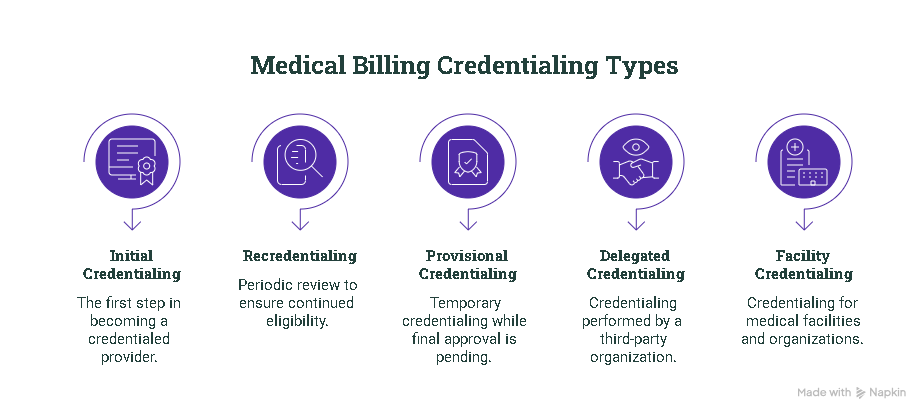
Understanding these credentialing types helps providers choose the right enrollment strategy, reduce approval delays, and maintain uninterrupted insurance participation.
Types of Provider Credentialing
Provider credentialing can vary depending on the healthcare specialty, practice setting, and insurance requirements. Different healthcare professionals must complete specific credentialing procedures before they can legally treat patients and submit insurance claims.
Physician Credentialing
Physicians undergo one of the most detailed credentialing processes because of the complexity of their medical responsibilities. Insurance companies carefully verify their education, residency training, board certifications, and medical licenses before approving network participation.
Key areas reviewed during physician credentialing include:
- Medical school education
- Residency and fellowship training
- Board certification status
- State medical licenses
- DEA registration
- Malpractice insurance history
Physician credentialing is essential for specialists, surgeons, and primary care doctors who want to participate in insurance networks and receive reimbursements.
Nurse Practitioner Credentialing
Nurse practitioners also require credentialing to provide services under commercial insurance, Medicare, and Medicaid plans. Since state regulations vary, credentialing requirements for nurse practitioners may differ based on location and scope of practice.
Insurance companies often verify:
- Nursing licenses
- Advanced practice certifications
- Supervising physician relationships
- Specialty training
Many healthcare practices prioritize fast credentialing for nurse practitioners because they play a major role in improving patient access and reducing physician workload.
Mental Health Provider Credentialing
Mental health professionals such as psychologists, counselors, psychiatrists, and therapists must complete credentialing before offering insured behavioral health services.
This type of credentialing may involve:
- State therapy licenses
- Clinical supervision records
- Behavioral health certifications
- Professional experience verification
Because demand for mental health services continues to grow, insurance companies are increasingly expanding behavioral health provider networks.
Telehealth Provider Credentialing
Telehealth has transformed modern healthcare, but virtual providers still need proper credentialing before treating patients online. In many cases, telehealth providers must meet licensing requirements in multiple states.
Important telehealth credentialing considerations include:
- Multi-state licensing
- Remote care compliance
- Virtual practice regulations
- Insurance-specific telemedicine policies
As telemedicine continues expanding, providers who maintain updated credentialing gain better opportunities to serve patients across broader geographic regions.
Credentialing Process in Medical Billing
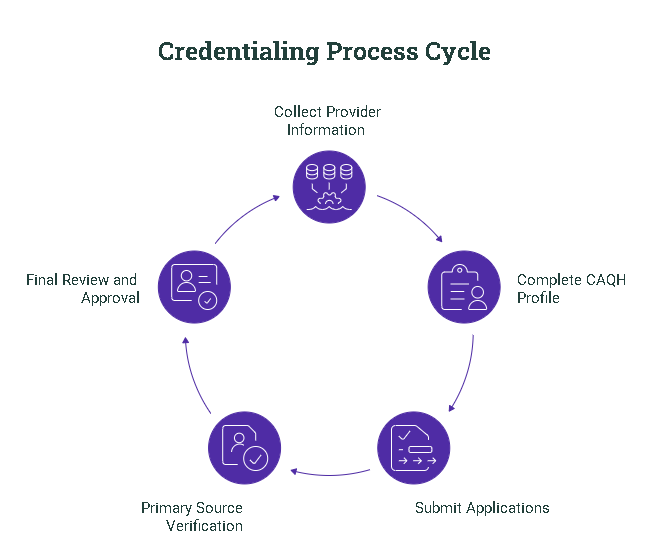
The credentialing process in medical billing involves multiple verification and approval stages designed to confirm that healthcare providers meet payer standards. Although the process may vary slightly between insurance companies, most credentialing workflows follow a similar structure.
Step 1: Collect Provider Information
The first step involves gathering all required provider documents and professional information. Accuracy is critical because even minor errors can delay approval.
Common documents include:
- Medical license
- DEA certificate
- NPI number
- Board certifications
- Resume or CV
- Malpractice insurance
- Tax identification details
Healthcare organizations often create credentialing checklists to ensure no documentation is missing during submission.
Step 2: Complete CAQH Profile
Many insurance companies use CAQH as a centralized database for provider information. Providers must complete and regularly update their CAQH profiles to simplify credentialing applications.
A complete CAQH profile usually contains:
- Education history
- Work experience
- Practice locations
- Insurance information
- Professional references
Outdated CAQH profiles are one of the most common reasons for credentialing delays.
Step 3: Submit Applications to Insurance Payers
Once documents are prepared, applications are submitted to commercial insurance companies, Medicare, Medicaid, and other payer organizations.
At this stage, providers may apply for:
- Individual enrollment
- Group enrollment
- Facility participation
- Specialty network inclusion
Each payer has its own review standards and processing timelines, which can extend the approval period.
Step 4: Primary Source Verification
Insurance companies then verify provider information directly with issuing institutions. This process is known as primary source verification.
Verification may include contacting:
- Medical schools
- Licensing boards
- Certification organizations
- Previous employers
This step ensures the authenticity of all submitted credentials and helps protect patients from fraudulent or unqualified providers.
Step 5: Final Review and Approval
After verification is completed, the payer reviews the provider’s application for final approval. Once accepted, the provider receives participation confirmation and an effective date for billing.
At this point, providers can:
- Join insurance networks
- Treat insured patients
- Submit claims for reimbursements
A properly managed credentialing process helps providers avoid unnecessary delays and maintain a stable revenue cycle.
Credentialing Process for Providers
For healthcare providers, credentialing is more than an administrative task—it is a process that directly impacts patient volume, insurance participation, and cash flow. Providers who actively manage credentialing requirements often experience fewer claim denials and faster reimbursement approvals.
Before Starting the Credentialing Process
Preparation plays a major role in avoiding delays. Providers should organize all professional documents before applying to insurance networks.
Important preparation steps include:
- Renewing expired licenses
- Updating malpractice insurance
- Verifying CAQH information
- Maintaining accurate practice addresses
- Organizing employment history
Healthcare providers who keep their records updated can significantly reduce processing time during payer reviews.
During the Credentialing Process
Once applications are submitted, providers must remain actively involved in the follow-up process. Insurance companies frequently request additional documentation or clarification before approval.
Providers should:
- Respond quickly to payer emails
- Monitor application status regularly
- Keep copies of submitted documents
- Track payer communication records
Consistent follow-up can prevent applications from remaining inactive for weeks or months.
After Credentialing Approval
Credentialing responsibilities continue even after approval. Providers must maintain compliance and prepare for future recredentialing requirements.
Ongoing credentialing tasks include:
- Tracking license expiration dates
- Updating CAQH attestations
- Reporting practice changes
- Renewing insurance contracts
- Preparing for recredentialing reviews
Providers who neglect post-approval credentialing maintenance often experience interrupted reimbursements and insurance participation issues.
Many healthcare organizations now outsource credentialing services to specialized teams because the process requires constant monitoring, detailed documentation management, and ongoing payer communication.
Common Challenges in Medical Credentialing
Medical credentialing is a time-sensitive process, but many healthcare providers experience delays due to documentation errors, payer backlogs, and compliance issues. Even small mistakes can slow down approvals and impact reimbursements for weeks or months.
One of the biggest challenges providers face is incomplete or outdated information. Insurance companies require accurate records at every stage of credentialing, and missing details often force applications back into review.
In highly competitive healthcare markets, these delays can affect patient acquisition and overall revenue growth.
Major Credentialing Challenges Providers Face
Incomplete Documentation: Missing forms, expired certificates, or unsigned applications are among the most common reasons for processing delays.
Slow Insurance Responses: Insurance payers often take longer than expected to review provider applications, especially during high-volume enrollment periods.
CAQH Profile Errors: Incorrect or outdated CAQH information can create inconsistencies between applications and payer databases.
Licensing Delays: State licensing boards sometimes delay verification requests, which slows the overall credentialing timeline.
Frequent Follow-Ups: Many providers underestimate how often they must communicate with insurance companies to keep applications active.
Additional Challenges Modern Providers Face
| Challenge | Impact on Providers |
| Multi-state credentialing | Increases paperwork and compliance requirements |
| Telehealth expansion | Requires additional payer approvals |
| Staff shortages | Delays application management |
| Recredentialing deadlines | Can interrupt insurance participation |
| Payer policy changes | Causes unexpected documentation requests |
Healthcare organizations that proactively monitor credentialing progress are better positioned to reduce delays and maintain uninterrupted reimbursements.
Common Mistakes That Delay Credentialing Approval
Many credentialing applications are delayed not because providers lack qualifications, but because avoidable administrative mistakes create complications during the review process. Insurance companies carefully examine every detail submitted by healthcare providers, and even minor inconsistencies can trigger additional verification requests.
To reduce approval delays, providers should pay close attention to the accuracy and completeness of their applications before submission.
Most Common Credentialing Mistakes
- Using outdated practice addresses
- Submitting expired malpractice insurance
- Entering incorrect NPI information
- Forgetting provider signatures
- Missing supporting documents
- Failing to update CAQH profiles
- Choosing the wrong taxonomy code
- Ignoring payer follow-up emails
- Providing an inconsistent employment history
- Delaying license renewals
Why These Mistakes Matter
Credentialing errors can lead to:
- Rejected applications
- Delayed insurance enrollment
- Payment interruptions
- Claim denials
- Loss of network participation
In many cases, providers lose thousands of dollars in potential reimbursements simply because credentialing approvals were delayed due to preventable administrative issues.
How Providers Can Avoid Delays
Instead of rushing applications, providers should establish a structured credentialing workflow that includes document verification, deadline tracking, and routine follow-ups with payers.
A simple internal review process before submission can dramatically improve approval speed and reduce administrative stress.
Documents Required for Medical Credentialing
Successful credentialing begins with proper documentation. Insurance companies require detailed records to verify a provider’s qualifications, professional history, and legal authority to practice healthcare services.
Because every payer has slightly different requirements, providers should maintain an organized credentialing file containing all essential documents. Having updated records readily available helps reduce processing delays and improve approval efficiency.
Essential Credentialing Documents
| Document | Purpose |
| Medical License | Confirms legal authorization to practice |
| DEA Certificate | Verifies controlled substance authority |
| NPI Number | Identifies the healthcare provider |
| Board Certification | Validates specialty expertise |
| Malpractice Insurance | Confirms liability coverage |
| Resume/CV | Reviews employment history |
| CAQH Profile | Stores centralized provider data |
| Driver’s License | Confirms provider identity |
| Tax ID Information | Required for payer enrollment |
| Hospital Privileges | Verifies facility affiliations |
Additional Documents Some Payers Request
Certain insurance companies may also require:
- Professional references
- Continuing education records
- Background check reports
- Work history explanations
- Immunization records
Providers who prepare these documents in advance often complete credentialing much faster than those gathering information during the application process.
Best Practice for Document Management
Healthcare organizations should regularly review credentialing documents to ensure:
✔ Licenses remain active
✔ Insurance policies are updated
✔ Certifications are renewed on time
✔ Practice information stays consistent
Maintaining accurate documentation not only speeds up credentialing approvals but also protects providers from compliance risks and reimbursement interruptions.
Credentialing vs Enrollment vs Privileging
Many healthcare providers mistakenly believe credentialing, enrollment, and privileging are the same process. While these terms are closely connected, each serves a completely different purpose in healthcare administration and medical billing.
Understanding these differences is essential because confusion between these processes often leads to delayed reimbursements, denied claims, and operational inefficiencies.
| Process | Primary Purpose | Conducted By | Main Outcome |
| Credentialing | Verifies provider qualifications | Insurance companies | Confirms provider eligibility |
| Enrollment | Activates billing participation | Insurance payers | Allows claim submission |
| Privileging | Authorizes specific procedures | Hospitals or facilities | Grants clinical permissions |
Credentialing
Credentialing focuses on verifying a provider’s professional background and qualifications. Insurance companies review licenses, certifications, education, training, and malpractice history before approving participation in their network.
Without credentialing:
- Providers cannot join insurance panels
- Claims may be denied
- Reimbursements can be delayed
Enrollment
Enrollment happens after credentialing approval. This process officially connects the provider to the insurance payer’s billing system so they can begin submitting claims and receiving payments.
Enrollment generally includes:
- Signing payer contracts
- Assigning billing details
- Activating provider participation dates
A provider may be credentialed but still unable to bill insurance if enrollment has not been completed.
Privileging
Privileging is commonly handled by hospitals and healthcare facilities rather than insurance companies. It determines which procedures or treatments a provider is authorized to perform within a specific facility.
For example, a surgeon may be credentialed with an insurance company but still require hospital privileges before performing surgeries at a medical center.
Why Providers Must Understand All Three
Healthcare practices that clearly separate credentialing, enrollment, and privileging processes experience:
- Faster onboarding
- Fewer billing interruptions
- Better compliance management
- Reduced administrative confusion
Proper coordination between these processes helps providers maintain uninterrupted patient care and stable cash flow.
How Long Does Medical Credentialing Take?
The medical credentialing timeline varies depending on the insurance payer, provider specialty, state regulations, and the accuracy of submitted documentation. While some approvals may take only a few weeks, others can extend for several months if additional verification is required.
For healthcare providers, credentialing delays can directly affect revenue because insurance claims cannot usually be processed until approval is finalized.
Average Credentialing Timelines
Medicare Credentialing: Typically takes between 60 and 120 days, depending on provider type and application accuracy.
Medicaid Credentialing: Usually completed within 30 to 90 days, although timelines vary by state.
Commercial Insurance Credentialing: Private insurance companies often require 90 to 180 days for full approval.
Hospital Privileging: May extend beyond 180 days because facilities perform extensive internal reviews.
Factors That Affect Credentialing Speed
Several issues can slow down the credentialing process, including:
- Missing documentation
- Incomplete CAQH profiles
- Delayed payer responses
- State licensing verification delays
- High application volumes
- Inaccurate provider information
Providers who submit clean and organized applications often receive approvals much faster than those requiring repeated corrections.
Ways to Speed Up Credentialing
To improve approval timelines, healthcare organizations should:
- Maintain updated provider documents
- Review applications before submission
- Monitor payer communications regularly
- Track credential expiration dates
- Follow up consistently with insurance companies
Some providers also use credentialing software or outsourcing services to streamline administrative tasks and reduce processing delays.
Benefits of Outsourcing Credentialing Services
As credentialing requirements continue to become more complex, many healthcare providers are choosing to outsource credentialing responsibilities to specialized service providers. Outsourcing to a reputable company like Health Med Affairs helps practices reduce administrative burdens while improving accuracy and approval speed.
For busy healthcare organizations, managing credentialing internally can consume significant time and resources. Outsourcing allows providers to focus more on patient care and less on paperwork.
Key Advantages of Outsourced Credentialing
Faster Application Processing: Experienced credentialing specialists understand payer requirements and can reduce common application errors that delay approvals.
Reduced Administrative Workload: Healthcare staff no longer need to spend hours managing forms, follow-ups, and document tracking.
Better Compliance Management: Credentialing companies help providers stay compliant with payer regulations, licensing renewals, and recredentialing deadlines.
Improved Revenue Cycle Performance: Faster credentialing approvals allow providers to begin billing insurance companies sooner, improving cash flow and reducing revenue loss.
Practices That Benefit Most From Outsourcing
Outsourced credentialing is especially valuable for:
| Healthcare Organization | Why Outsourcing Helps |
| Solo practices | Limited administrative staff |
| Multi-provider clinics | High credentialing volume |
| Telehealth companies | Multi-state compliance needs |
| New healthcare startups | Faster payer onboarding |
| Expanding practices | Easier network participation |
Signs Your Practice Needs Credentialing Support
You may benefit from outsourcing if your practice experiences:
- Frequent claim denials
- Delayed payer approvals
- Expired provider credentials
- Staff overload
- Difficulty tracking recredentialing dates
By outsourcing credentialing services, healthcare providers can improve operational efficiency, reduce costly mistakes, and maintain smoother insurance participation across multiple payer networks.
Best Practices for Successful Provider Credentialing
A well-organized credentialing strategy can help healthcare providers avoid delays, reduce claim denials, and maintain uninterrupted insurance participation. Since credentialing directly impacts reimbursements and compliance, providers should treat it as an ongoing operational priority rather than a one-time administrative task.
Healthcare organizations that follow structured credentialing practices often experience faster approvals and fewer payer-related issues.
Create a Centralized Credentialing System
One of the most effective ways to improve credentialing efficiency is by storing all provider documents in a centralized and easily accessible system. This reduces the risk of missing paperwork and helps staff respond quickly to payer requests.
Important records to organize include:
- Medical licenses
- DEA certificates
- Board certifications
- Malpractice insurance
- CAQH information
- Employment history
Digital document management systems can also help practices track renewals and expiration dates automatically.
Keep CAQH Profiles Updated
Many providers experience unnecessary delays because their CAQH profiles contain outdated information. Insurance companies frequently compare credentialing applications with CAQH data, and inconsistencies may trigger additional reviews.
Providers should regularly verify:
- Practice locations
- Contact details
- License renewals
- Insurance information
- Professional history
Maintaining an accurate CAQH profile improves approval speed and reduces administrative complications.
Start Recredentialing Early
Recredentialing deadlines can arrive quickly, especially for providers participating in multiple insurance networks. Waiting until the last minute increases the risk of expired credentials and reimbursement interruptions.
Best practice recommendations include:
✔ Begin renewal preparation several months early
✔ Monitor payer expiration dates regularly
✔ Assign credentialing responsibilities to dedicated staff
✔ Maintain communication logs with insurance companies
Proactive credentialing management helps providers maintain uninterrupted participation and stable revenue flow.
Future Trends in Medical Credentialing
The healthcare industry is rapidly evolving, and credentialing processes are becoming more technology-driven than ever before. Insurance companies and healthcare organizations are investing in automation tools to improve verification speed, reduce administrative costs, and strengthen compliance monitoring.
As provider networks continue expanding, traditional credentialing methods are gradually being replaced by faster and more efficient digital systems.
Emerging Trends Shaping Credentialing
Artificial Intelligence (AI) Integration
AI-powered systems can automatically verify provider information, identify missing documentation, and reduce manual processing errors.
Automated Credential Tracking
Modern software platforms now monitor license renewals, certifications, and recredentialing deadlines in real time.
Digital Provider Databases
Centralized provider databases allow insurance companies to access updated provider information more efficiently.
Blockchain Verification Technology
Blockchain systems are being explored as a secure method for storing and verifying provider credentials across healthcare networks.
Faster Telehealth Credentialing
As virtual healthcare expands, insurance companies are streamlining credentialing processes for remote providers and multi-state practices.
How These Trends Benefit Providers?
Modern credentialing innovations may help healthcare organizations:
- Reduce approval timelines
- Improve data accuracy
- Minimize claim denials
- Lower administrative costs
- Simplify multi-state credentialing
Providers who adopt updated credentialing technologies early can gain a competitive advantage and improve overall operational efficiency.
The Growing Importance of Credentialing Automation
Healthcare organizations are increasingly realizing that manual credentialing processes are difficult to manage at scale. Automation not only improves efficiency but also reduces compliance risks associated with human error.
In the coming years, credentialing will likely become more integrated with:
- Revenue cycle management systems
- Electronic health records (EHRs)
- Insurance verification platforms
- Provider enrollment software
These advancements will continue transforming how healthcare providers manage insurance participation and compliance.
Final Thoughts
Credentialing in medical billing is far more than a routine administrative process—it is a critical foundation for successful healthcare operations. From insurance reimbursements and compliance management to provider credibility and patient trust, proper credentialing affects nearly every aspect of a healthcare practice.
Providers who maintain organized documentation, monitor credentialing deadlines, and stay proactive with payer requirements are better positioned to reduce delays, avoid claim denials, and maintain steady cash flow. As healthcare systems continue evolving, efficient credentialing processes will become even more important for providers seeking long-term growth and operational stability.
Whether handled internally or through outsourced credentialing services, investing in accurate and timely credentialing can help healthcare organizations improve financial performance, strengthen payer relationships, and deliver uninterrupted patient care.