Have you ever noticed why a certified doctor or healthcare provider cannot begin treating patients immediately upon joining a hospital? Hospital credentialing is the process that fills this gap. Healthcare facilities apply it to check a provider’s education, training, licensing, job history, and clinical background before conferring clinical privileges and patient care tasks. It also ensures that the supplier meets billing criteria set by regulators and payers.
Credentialing delays continue to be a major issue in healthcare systems in 2026. According to the industry standards, the procedure normally takes between 60 and 180 days, depending on documentation quality, verification speed, and payer requirements. Financial implications are also substantial. Healthcare companies may lose between $7,000 and $12,000 per provider per month due to credentialing or enrollment delays that slow down billing activation. These losses are due to claim holds, delayed payer enrollment, and missed patient billing opportunities.
This blog explains what hospital credentialing is, how it works, and why it matters across healthcare operations. You will see both the benefits and the operational challenges.
What is hospital credentialing? and why it matters in healthcare systems
Hospital credentialing is the structured verification process used by healthcare organizations to confirm that a provider is qualified to deliver patient care. It includes validation of education, training, licensing, and clinical history before granting practice rights within a hospital system. This process directly supports patient safety, regulatory compliance, and payer requirements.
In healthcare operations, this process also affects onboarding speed and billing readiness. In 2026, credentialing delays continue to impact provider start dates and reimbursement cycles.
Purpose of hospital credentialing in healthcare delivery
Hospital credentialing exists to confirm that every provider meets minimum qualification standards before treating patients. It ensures verification of education, clinical training, and licensure before clinical access is granted. This reduces risk in patient care delivery.
It also supports structured clinical governance inside hospitals. Credentialing data helps medical staff committees make approval decisions based on verified records. This process supports consistent quality standards across departments and specialties.
Who requires hospital credentialing?
Hospital credentialing applies to all healthcare professionals who provide direct or supervised patient care in a facility setting. This includes physicians, surgeons, nurse practitioners, physician assistants, therapists, and other licensed clinical staff. Each provider must be verified before receiving clinical privileges.
It also applies to professionals in outpatient and specialty settings linked to hospital systems. In many cases, even telehealth providers and contract clinicians must complete credentialing. This ensures uniform compliance across all service delivery models.
How hospital credentialing connects to billing and compliance
Hospital credentialing is directly linked to billing eligibility and insurance participation. A provider cannot submit claims or receive reimbursement without active credentialing and enrollment status. This creates a direct connection between clinical approval and revenue cycle performance.
It also supports compliance monitoring across healthcare systems. Credentialing records are used during audits, payer reviews, and regulatory checks. Inaccurate or incomplete credentialing can result in claim denials, payment delays, and compliance risks for healthcare organizations.
Hospital credentialing process (step-by-step workflow)
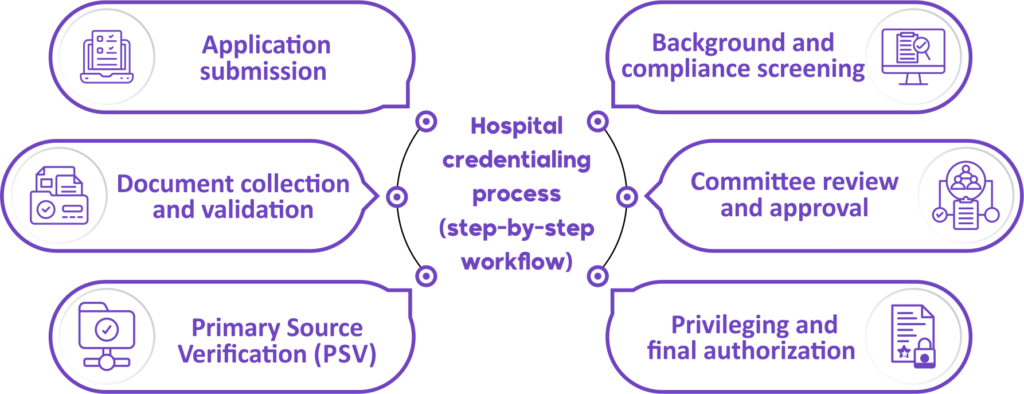
The hospital credentialing process is a structured sequence used to verify provider qualifications before clinical approval. It ensures that every provider meets licensing, training, and compliance standards before patient care begins.
This section explains the complete workflow from application to final authorization. It also connects the hospital credentialing process to verification steps, committee review, and clinical privileging decisions. The goal is to show how each stage affects onboarding speed and compliance accuracy.
Step 1: Application submission
The credentialing process begins with provider application submission. This includes personal details, education history, training records, and work experience. Accuracy at this stage reduces delays in later verification steps.
Common submission components include:
- Provider application form
- Medical education records
- State license details
- Work history (5–10 years)
- Malpractice history disclosure
Step 2: Document collection and validation
After submission, credentialing teams collect and validate supporting documents. This stage confirms that all required records are complete and consistent with application data.
Delays often occur when documents are missing or outdated. Validation ensures data accuracy before formal verification begins.
Key documents reviewed:
- Medical license copies
- Board certification certificates
- DEA registration (if required)
- Malpractice insurance records
- Identity verification documents
Step 3: Primary Source Verification (PSV)
Primary Source Verification confirms provider credentials directly from issuing authorities. Hospitals contact schools, licensing boards, and training institutions for validation.
This step ensures that the submitted information is authentic and current. It is a core requirement in most healthcare accreditation standards.
Verification includes:
Medical school confirmation
Residency and fellowship validation
State licensing board checks
Board certification confirmation
Step 4: Background and compliance screening
This stage evaluates provider compliance status and professional background. It helps identify risks before granting clinical access.
Screening ensures alignment with regulatory requirements and patient safety standards.
Key checks include:
- National Practitioner Data Bank (NPDB) review
- OIG exclusion list screening
- State disciplinary actions
- Criminal background checks
- Malpractice claim history
Step 5: Committee review and approval
After verification, the credentialing file is reviewed by hospital committees. These committees evaluate provider eligibility based on verified data.
Approval is required before clinical privileges are granted. This stage often involves multiple levels of review.
Review process includes:
- Credentialing committee evaluation
- Medical staff committee review
- Medical Executive Committee approval
- Hospital board authorization (if required)
Step 6: Privileging and final authorization
Privileging defines the specific clinical services a provider is allowed to perform. It is the final step before full clinical practice approval.
This stage links credentialing results with actual patient care responsibilities. It also confirms the scope of practice within the hospital system.
Final authorization includes:
- Assignment of clinical privileges
- Scope of practice definition
- Department-level approval
- Final system onboarding clearance
Hospital credentialing requirements that providers must meet
Hospital credentialing requirements define the minimum qualifications a provider must meet before gaining clinical access in a hospital or healthcare system. These requirements ensure patient safety, regulatory compliance, and correct billing eligibility.
Core documentation requirements
Providers must submit verified core documents that confirm identity, education, and clinical qualifications. These documents form the base of the credentialing file and are reviewed before verification begins.
Incomplete documentation is one of the most common reasons for credentialing delays in healthcare systems.
Required documents include:
- Medical degree certificates (MBBS/MD or equivalent)
- State medical license (active and unrestricted)
- Board certification documents (if applicable)
- Curriculum vitae with full work history (usually 5–10 years)
- Valid government-issued ID
- Malpractice insurance coverage details
Compliance and background requirements
Credentialing teams conduct compliance checks to confirm that providers meet regulatory and safety standards. These checks help identify risks before clinical approval is granted.
This step ensures that providers meet federal and state healthcare requirements before patient care begins.
Compliance requirements include:
- National Practitioner Data Bank (NPDB) report review
- Office of Inspector General (OIG) exclusion screening
- State licensing board verification
- Criminal background check (as required by the facility)
- Malpractice claim history review
- Drug enforcement registration (DEA) verification, where applicable
Facility-specific requirements
Hospitals may apply additional requirements based on specialty, internal policies, and accreditation standards. These requirements vary across institutions, but are mandatory for final approval.
They help maintain consistent clinical quality and align provider qualifications with hospital services.
Common facility-specific requirements include:
- Proof of continuing medical education (CME) credits
- Peer reference letters or professional recommendations
- Immunization and health screening records
- Specialty-specific training certifications
- Hospital bylaws acknowledgment and agreement
- Prior hospital affiliation or privilege history (if applicable)
Common delays in the hospital credentialing process
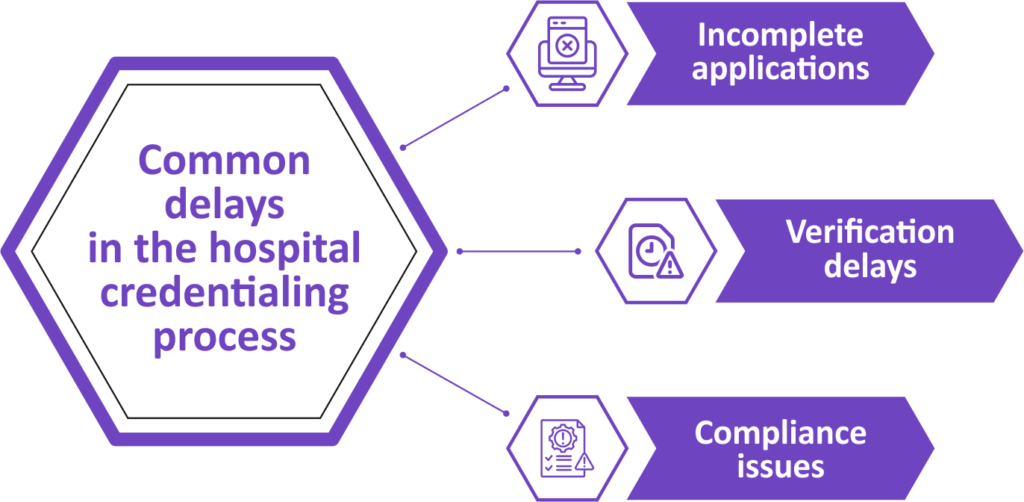
This section explains the hospital credentialing process delays that frequently occur in healthcare systems. It also highlights how incomplete data, slow verification responses, and compliance checks affect overall turnaround time.
Incomplete applications
Incomplete applications are one of the most frequent causes of credentialing delays. Missing details or inconsistent information require rework and additional follow-ups from credentialing teams.
These gaps often occur during initial submission when provider data is not fully verified.
Common issues include:
1. Missing signatures on application forms
2. Incomplete work history records
3. Incorrect license numbers or expiration dates
4. Unverified education details
5. Missing malpractice disclosure information
Verification delays
Primary source verification depends on external institutions such as schools, licensing boards, and certification bodies. Delays in response from these sources slow down the entire process.
These delays are outside hospital control and vary by institution’s response time.
Common verification delays include:
1. Slow response from medical schools or training programs
2. Licensing board backlog
3. Board certification verification delays
4. Malpractice insurance confirmation delays
5. Third-party database processing lag
Compliance issues
Compliance-related delays occur when credentialing teams identify risks or inconsistencies during screening. These issues require additional review before approval can proceed.
Even small discrepancies can extend the credentialing timeline significantly.
Common compliance issues include:
1. OIG exclusion list flags or matches
2. Expired or inactive licenses
3. Discrepancies in work history records
4. Malpractice claim red flags
5. Background check inconsistencies
Hospital credentialing timeline and expected duration
The hospital credentialing timeline defines how long it takes to verify a provider’s qualifications before approval for clinical practice. It varies based on documentation quality, verification speed, and payer or hospital requirements.
Average processing time breakdown
Hospital credentialing does not follow a fixed duration. Most cases fall within a standard industry range depending on facility size and verification workload.
Delays often increase when external organizations take longer to respond or when provider data is incomplete.
Common timeline ranges:
- Application review and intake: 1–2 weeks
- Document collection and validation: 1–3 weeks
- Primary Source Verification (PSV): 2–6 weeks
- Background and compliance screening: 2–4 weeks
- Committee review and approval: 2–4 weeks
- Final privileging and onboarding: 1–2 weeks
Factors that affect credentialing duration
Several operational and compliance factors directly impact how fast credentialing is completed. These factors vary between hospitals, payers, and provider types.
Even small inconsistencies in provider data can extend the timeline significantly.
Key factors include:
- Completeness of the submitted application
- Response time from licensing boards and schools
- Malpractice history review requirements
- Volume of applications in the credentialing department
- State-specific licensing rules
- Payer-specific enrollment requirements
Delays that extend the credentialing timeline
Certain issues consistently cause extended credentialing cycles. These delays are often avoidable but require strong coordination between providers and credentialing teams.
They can also affect provider onboarding, billing readiness, and revenue cycle performance.
Common delay triggers:
- Missing or outdated credentialing documents
- Slow primary source verification responses
- OIG or NPDB flag investigations
- Credentialing committee scheduling gaps
- Incomplete payer enrollment information
- Errors in provider history or licensing data
Conclusion
Hospital credentialing is a structured process that verifies provider qualifications before clinical approval. It supports patient safety, regulatory compliance, and accurate billing across healthcare systems.
Understanding each stage, requirement, and delay helps healthcare organizations improve onboarding efficiency and reduce revenue cycle disruptions. Strong credentialing practices also support compliance, stability, and consistent care delivery.
FAQs
What is hospital credentialing?
Hospital credentialing is the process of verifying a healthcare provider’s education, training, licenses, and clinical background before granting permission to treat patients in a hospital. It ensures providers meet clinical, regulatory, and payer requirements.
How long does the hospital credentialing process take?
The hospital credentialing process typically takes 60 to 180 days. The timeline depends on document accuracy, verification speed, payer requirements, and how quickly external institutions respond during primary source verification.
What documents are required for hospital credentialing?
Common documents include medical degrees, active state licenses, board certifications, a CV with work history, malpractice insurance proof, and government-issued identification. Additional documents may be required based on hospital policies.
Why does hospital credentialing get delayed?
Delays usually happen due to incomplete applications, slow primary source verification, compliance issues, or missing documents. Errors in work history, expired licenses, or background check flags can also extend the process.
How does hospital credentialing affect billing and reimbursement?
Hospital credentialing directly impacts billing eligibility. Providers cannot submit claims or receive reimbursement without active credentialing and enrollment, which can lead to claim denials or payment delays.