
Every healthcare provider depends on accurate medical billing to maintain a steady cash flow and ensure timely reimbursements. However, even minor errors in a healthcare claim, such as incorrect patient information, coding mistakes, missing modifiers, or insurance discrepancies, can lead to costly claim denials, payment delays, and increased administrative workload.
This is where medical scrubbing plays a critical role. Medical scrubbing is a proactive process that identifies and corrects billing errors before claims are submitted to insurance payers, helping healthcare organizations improve claim acceptance rates and maximize revenue collection.
Whether you’re a healthcare provider, medical biller, coder, or practice manager, understanding how medical scrubbing works can help you reduce revenue leakage, strengthen your revenue cycle management process, and ensure cleaner claims that get paid faster.
What Is Medical Scrubbing in Healthcare?
Medical scrubbing in healthcare is the process of reviewing and validating medical claims before they are submitted to insurance companies for reimbursement. The primary goal of medical scrubbing is to identify errors, inconsistencies, missing information, and coding issues that could result in claim rejections, denials, or delayed payments.
In the healthcare revenue cycle, claim scrubbing acts as a quality control checkpoint between medical coding and claim submission. During this process, billing professionals or automated claim scrubbing software analyze every element of a claim, including patient demographics, insurance details, diagnosis codes, procedure codes, modifiers, and payer-specific requirements.
Why Is It Also Called Claim Scrubbing?
Medical scrubbing is commonly referred to as claim scrubbing because the process focuses specifically on healthcare insurance claims. Just as cleaning removes unwanted dirt and impurities, claim scrubbing removes errors and discrepancies from medical claims before they reach insurance payers.
The term “claim scrubbing” is widely used in medical billing and revenue cycle management because it accurately describes the process of thoroughly reviewing claims to ensure they meet payer requirements.
A properly scrubbed claim is often called a “clean claim,” meaning it contains all required information and has a higher likelihood of being accepted on the first submission.
How Does Medical Claim Scrubbing Work?
Medical claim scrubbing follows a structured process designed to verify the accuracy and completeness of every claim before submission. Whether performed manually or through automated software, the objective remains the same: identify and resolve issues that could lead to claim denials or payment delays.
Step 1: Verify Patient Information
The process begins by reviewing patient demographic information, including:
- Full name
- Date of birth
- Address
- Contact details
- Insurance policy information
Even minor errors, such as a misspelled name or incorrect insurance ID number, can cause claim rejections. Verifying patient information ensures that the claim is linked to the correct individual and insurance plan.
Step 2: Validate Medical Codes
Next, the claim undergoes coding validation to ensure that all diagnosis and procedure codes are accurate and compliant.
This includes reviewing:
- ICD-10 diagnosis codes
- CPT procedure codes
- HCPCS codes
- Medical modifiers
The scrubber checks whether the selected codes accurately represent the services provided and whether they comply with payer-specific billing rules.
Step 3: Review Compliance Requirements
Healthcare payers often have unique billing requirements that must be met before claims can be processed.
The scrubbing process evaluates:
- Insurance-specific billing rules
- Medicare and Medicaid requirements
- Prior authorization requirements
- National Correct Coding Initiative (NCCI) edits
- HIPAA compliance standards
This step helps ensure that claims meet all applicable regulatory and payer standards.
Step 4: Detect Errors and Missing Information
Once the claim data has been validated, the scrubbing system searches for common billing issues, including:
- Missing diagnosis codes
- Invalid procedure codes
- Incorrect modifiers
- Duplicate claims
- Incomplete documentation
- Gender or age-related coding conflicts
Any identified errors are flagged for correction before the claim proceeds further.
Step 5: Submit a Clean Claim
After all issues have been resolved, the claim is considered a clean claim and is submitted to the payer through a clearinghouse or directly to the insurance company.
Because the claim has already undergone extensive validation, it has a greater chance of being accepted on the first submission, reducing delays and improving reimbursement efficiency.
Why Is Medical Scrubbing Important in Healthcare?
Medical scrubbing plays a critical role in maintaining financial stability for healthcare organizations. Without an effective claim scrubbing process, providers face increased claim denials, delayed payments, higher administrative costs, and unnecessary revenue loss.
As insurance regulations become more complex, healthcare providers rely on medical scrubbing to improve billing accuracy and protect their revenue streams.
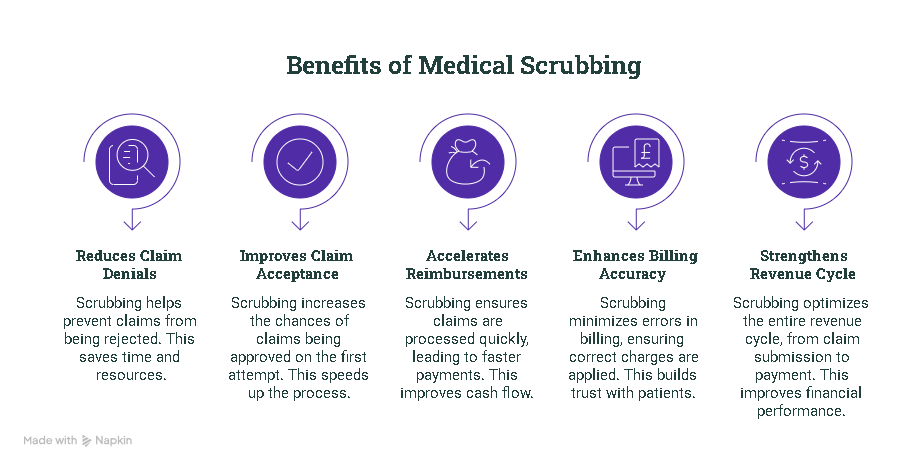
Reduces Claim Denials: One of the biggest benefits of medical scrubbing is its ability to reduce claim denials. Many denied claims result from preventable errors such as incorrect patient information, coding mistakes, or missing documentation.
Improves First-Pass Claim Acceptance Rates: The first-pass acceptance rate measures how many claims are approved without requiring corrections or resubmissions.
Accelerates Reimbursements: Claims that contain errors often experience payment delays while corrections are made. Clean claims move through the payer’s adjudication process much faster.
Enhances Billing Accuracy: Accurate billing is essential for maintaining compliance and reducing financial risk. Medical scrubbing helps eliminate inconsistencies and ensures that diagnosis codes, procedure codes, and patient information align correctly.
Strengthens Revenue Cycle Management: Medical scrubbing directly supports revenue cycle management by improving claim quality at one of the most critical stages of the billing process.
When fewer claims are denied or delayed, healthcare organizations can:
- Increase collections
- Reduce accounts receivable days
- Lower administrative costs
- Improve financial performance
- Enhance operational efficiency
Common Errors Found During Medical Scrubbing
Medical claims can contain a wide range of errors that impact reimbursement outcomes. Identifying these issues before submission is the primary purpose of the scrubbing process.
Below are some of the most common claim errors detected during medical scrubbing.
Incorrect Patient Information: Simple mistakes such as misspelled names, incorrect dates of birth, or outdated addresses can cause claims to be rejected immediately.
Invalid Insurance Details: Errors in insurance policy numbers, coverage dates, or payer information often result in claim denials and payment delays.
Coding Errors: Incorrect ICD-10, CPT, or HCPCS codes are among the most frequent reasons for claim rejection. Coding errors may occur due to outdated codes, incorrect code selection, or documentation mismatches.
Missing Modifiers: Medical modifiers provide additional information about services performed. Missing or incorrect modifiers can lead to underpayments, denials, or reimbursement disputes.
Duplicate Claims: Submitting the same claim more than once can trigger automatic rejection by insurance payers. Scrubbing systems help identify duplicate submissions before they occur.
Missing Prior Authorization: Certain procedures require prior authorization from insurance companies. If authorization information is missing, the claim may be denied regardless of medical necessity.
Diagnosis and Procedure Code Mismatches: Insurance payers evaluate whether the diagnosis code supports the medical necessity of the procedure performed. Mismatches between diagnosis and procedure codes are commonly flagged during claim scrubbing.
Incomplete Documentation: Claims supported by incomplete clinical documentation often fail payer reviews. Scrubbing systems help identify documentation gaps before submission, reducing the risk of denials and audits.
Claim Scrubber vs. Clearinghouse: What’s the Difference?
Many healthcare professionals mistakenly believe that a claim scrubber and a clearinghouse perform the same function. While both are important parts of the medical billing process, they serve entirely different purposes.
Understanding the difference helps healthcare organizations build a more efficient revenue cycle.
| Feature | Claim Scrubber | Clearinghouse |
| Primary Purpose | Identifies and corrects claim errors | Transmits claims to payers |
| Function | Quality control | Electronic claim routing |
| Timing | Before claim submission | After claim preparation |
| Focus | Claim accuracy | Claim delivery |
| Outcome | Clean claims | Claims sent to insurance companies |
What Does a Claim Scrubber Do?
A claim scrubber examines claims for:
- Coding errors
- Missing information
- Invalid modifiers
- Insurance discrepancies
- Compliance violations
- Payer-specific edits
Its objective is to ensure the claim is accurate before submission.
What Does a Clearinghouse Do?
A healthcare clearinghouse acts as an intermediary between healthcare providers and insurance payers.
Its responsibilities include:
- Receiving claims from providers
- Converting claim data into standardized formats
- Performing basic validation checks
- Routing claims to insurance companies
- Returning claim status updates
While some clearinghouses offer built-in scrubbing capabilities, their primary role remains claim transmission rather than comprehensive error correction.
Which Is More Important?
Both are essential.
A claim scrubber helps create clean claims, while a clearinghouse ensures those claims reach the correct payer efficiently. Together, they reduce denials, improve reimbursement speed, and support a healthier revenue cycle.
Manual vs. Automated Medical Scrubbing
Healthcare organizations can perform medical scrubbing manually, automatically, or through a combination of both methods.
As claim volumes increase and payer requirements become more complex, understanding the strengths and limitations of each approach becomes increasingly important.
1. Manual Medical Scrubbing
Manual scrubbing involves healthcare billing professionals reviewing claims individually before submission.
The reviewer checks:
- Patient information
- Coding accuracy
- Documentation completeness
- Payer requirements
- Compliance issues
Advantages of Manual Scrubbing
- Human judgment can identify unusual claim scenarios.
- Greater flexibility when handling complex cases.
- Useful for smaller practices with low claim volumes.
Disadvantages of Manual Scrubbing
- Time-consuming process.
- Higher risk of human error.
- Difficult to scale for large healthcare organizations.
- Increased labor costs.
While manual review remains valuable, relying solely on human reviewers often limits efficiency and increases operational expenses.
2. Automated Medical Scrubbing
Automated claim scrubbing uses specialized software to review claims against thousands of billing rules within seconds.
The software automatically checks for:
- Coding inconsistencies
- Missing claim information
- Payer-specific requirements
- Compliance violations
- Duplicate claims
- Medical necessity conflicts
Advantages of Automated Scrubbing
- Faster claim processing.
- Improved accuracy.
- Reduced administrative workload.
- Lower denial rates.
- Better scalability for growing organizations.
Disadvantages of Automated Scrubbing
- Initial software investment.
- Ongoing maintenance and updates.
- May still require human oversight for complex claims.
Which Approach Is Better?
For most healthcare organizations, a hybrid approach delivers the best results.
Automated scrubbing handles routine validation and high-volume claims, while experienced billing professionals review complex cases that require clinical judgment.
This combination maximizes efficiency while maintaining accuracy.
How AI Is Transforming Medical Scrubbing?
Artificial intelligence is reshaping healthcare billing by making claim scrubbing more intelligent and predictive.
Modern AI-powered scrubbing systems can:
- Predict claim denial risks before submission.
- Identify coding patterns that lead to reimbursement issues.
- Recommend corrections automatically.
- Learn from historical payer responses.
- Improve billing accuracy over time.
As healthcare organizations continue to adopt AI-driven revenue cycle solutions, medical scrubbing is becoming more proactive rather than reactive, helping providers prevent problems before they occur.
Key Benefits of Medical Scrubbing for Healthcare Providers
Medical scrubbing offers far more than error detection. It directly impacts financial performance, operational efficiency, and patient satisfaction.
Healthcare organizations that implement effective scrubbing processes often experience measurable improvements across their entire revenue cycle.
Faster Payments
Clean claims move through payer systems more efficiently than claims containing errors.
By reducing claim rejections and requests for additional information, providers receive reimbursements faster and maintain healthier cash flow.
Fewer Claim Denials
Claim denials are among the most expensive challenges in medical billing.
Medical scrubbing helps prevent avoidable denials by identifying issues before claims are submitted, reducing the need for appeals and resubmissions.
Lower Administrative Costs
Correcting denied claims requires significant staff time and resources.
When claims are accurate from the beginning, billing teams spend less time resolving issues and more time focusing on productive revenue-generating activities.
Improved Cash Flow
Consistent reimbursement timelines contribute to stronger financial stability.
Healthcare providers that maintain high clean claim rates often experience fewer payment disruptions and more predictable revenue streams.
Increased Revenue Collection
Every denied or delayed claim represents potential revenue loss.
Medical scrubbing helps maximize reimbursement opportunities by ensuring claims are complete, compliant, and properly coded before submission.
Better Staff Productivity
Automation and proactive claim review reduce repetitive manual work for billing teams.
As a result, staff members can focus on higher-value tasks such as denial prevention, compliance monitoring, and revenue optimization.
Enhanced Patient Experience
Billing errors can create confusion, delay insurance processing, and result in unexpected patient balances.
Accurate claims contribute to a smoother billing experience, improving patient trust and satisfaction.
Stronger Revenue Cycle Performance
Ultimately, medical scrubbing strengthens every stage of the revenue cycle by:
- Increasing clean claim rates
- Reducing denial rates
- Accelerating reimbursement timelines
- Lowering operational costs
- Improving overall financial outcomes
For healthcare providers seeking to optimize billing operations and improve profitability, medical scrubbing is no longer optional; it is a critical component of modern revenue cycle management.
Medical Scrubbing and Revenue Cycle Management (RCM)
Medical scrubbing is one of the most important functions within Revenue Cycle Management (RCM). While many healthcare organizations focus on coding, billing, and collections, the quality of claims submitted to insurance payers ultimately determines how efficiently revenue flows into the organization.
A single billing error can disrupt the entire revenue cycle, leading to claim denials, payment delays, additional administrative work, and lost revenue. Medical scrubbing helps prevent these issues by ensuring claims are accurate before they leave the provider’s system.
Where Does Medical Scrubbing Fit in the Revenue Cycle?
Medical scrubbing occurs after medical coding and before claim submission.
A typical healthcare revenue cycle follows this sequence:
- Patient Registration
- Insurance Verification
- Medical Documentation
- Medical Coding
- Medical Scrubbing
- Claim Submission
- Claim Adjudication
- Payment Posting
- Patient Billing
- Revenue Collection
Since claim scrubbing takes place immediately before submission, it serves as the final quality assurance checkpoint in the billing process.
How Medical Scrubbing Improves Revenue Cycle Performance
An effective scrubbing process strengthens the entire revenue cycle by reducing preventable errors that interfere with reimbursement.
Key improvements include:
- Higher clean claim rates
- Faster reimbursement cycles
- Lower denial rates
- Reduced rework costs
- Improved billing accuracy
- Better financial forecasting
When claims are submitted correctly the first time, healthcare organizations spend less time correcting mistakes and more time collecting revenue.
Reducing Accounts Receivable (A/R) Days
Accounts Receivable (A/R) Days measure how long it takes a provider to receive payment after services are delivered.
Poor claim quality often increases A/R days because denied claims require investigation, correction, and resubmission.
Medical scrubbing helps reduce A/R days by:
- Preventing claim rejections
- Eliminating common billing errors
- Increasing first-pass claim acceptance
- Accelerating payer processing times
Shorter A/R cycles improve cash flow and provide greater financial stability.
Increasing Clean Claim Rates
A clean claim is a claim that passes through the payer’s system without requiring corrections or additional information.
Healthcare organizations often track clean claim rates as a key revenue cycle performance metric.
Effective medical scrubbing improves clean claim rates by ensuring:
- Accurate coding
- Complete documentation
- Correct patient information
- Compliance with payer rules
The higher the clean claim rate, the greater the likelihood of receiving timely reimbursements.
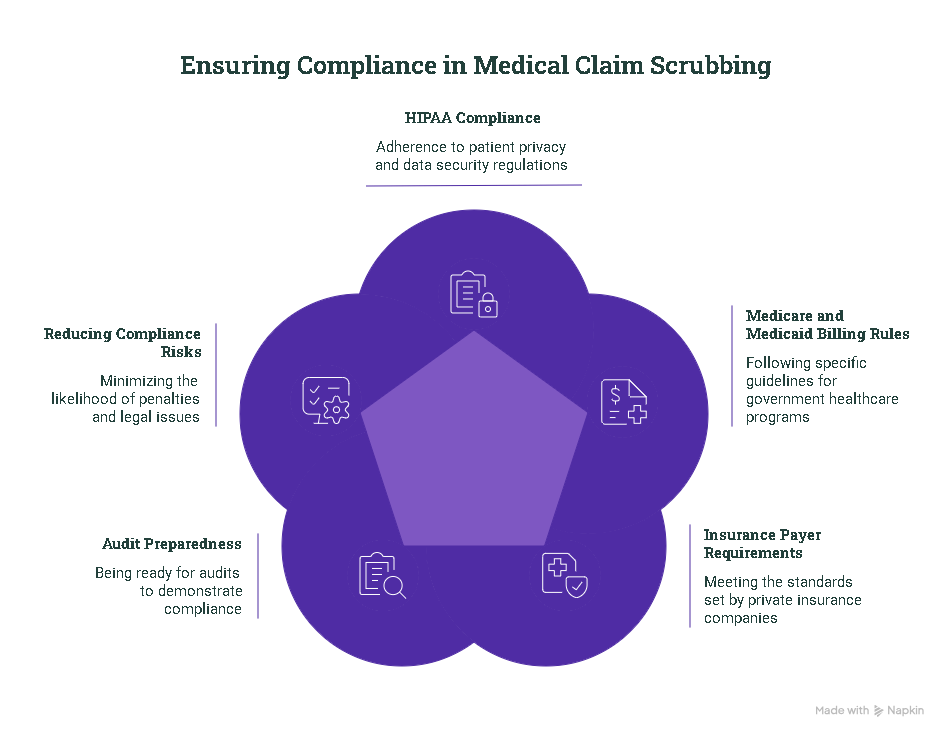
Compliance Requirements in Medical Claim Scrubbing
Medical claim scrubbing is not solely about improving reimbursement speed. It also plays a critical role in ensuring compliance with healthcare regulations and payer requirements.
Failure to comply with billing standards can result in denied claims, audits, financial penalties, and legal consequences.
HIPAA Compliance
The Health Insurance Portability and Accountability Act (HIPAA) establishes standards for healthcare data privacy and electronic transactions.
During claim scrubbing, healthcare organizations must ensure that:
- Protected health information (PHI) is handled securely.
- Electronic claims follow HIPAA transaction standards.
- Patient data is accurate and protected.
- Billing records remain compliant with privacy regulations.
Compliance with HIPAA requirements helps reduce legal risks while maintaining patient trust.
Medicare and Medicaid Billing Rules
Government healthcare programs have strict billing guidelines that providers must follow.
Medical scrubbing helps identify issues related to:
- Coverage limitations
- Medical necessity requirements
- Documentation standards
- Modifier usage
- National Correct Coding Initiative (NCCI) edits
Because Medicare and Medicaid audits can result in significant financial consequences, accurate claim validation is essential.
Insurance Payer Requirements
Every insurance company has unique claim submission rules.
These requirements may include:
- Specific coding standards
- Prior authorization requirements
- Documentation criteria
- Modifier usage guidelines
- Frequency limitations
Claim scrubbing software often contains payer-specific edits that automatically identify violations before submission.
Audit Preparedness
Healthcare providers face increasing scrutiny from both government agencies and private payers.
A strong scrubbing process helps maintain audit readiness by ensuring:
- Claims are properly documented.
- Services are medically necessary.
- Coding accurately reflects patient care.
- Billing records remain consistent.
Organizations that prioritize claim accuracy are generally better prepared for audits and compliance reviews.
Reducing Compliance Risks
Medical scrubbing reduces compliance risks by identifying potential problems before claims are submitted.
Examples include:
- Upcoding errors
- Unbundling violations
- Duplicate billing
- Unsupported diagnoses
- Missing documentation
Addressing these issues proactively helps protect healthcare organizations from penalties, repayment demands, and reputational damage.
How Much Does Medical Scrubbing Software Cost?
The cost of medical scrubbing software varies depending on factors such as practice size, claim volume, software features, integration requirements, and whether the solution is purchased as a standalone tool or as part of a larger Revenue Cycle Management (RCM) platform.
Cost for Small Practices
Small medical practices typically require basic claim scrubbing functionality with lower claim volumes.
Costs may include:
- Monthly subscription fees
- Per-claim processing charges
- Setup and implementation fees
- Software training costs
Many cloud-based solutions offer affordable pricing models that make claim scrubbing accessible for independent providers and small clinics.
Cost for Mid-Sized Healthcare Organizations
Mid-sized healthcare organizations often need more advanced capabilities, including:
- Payer-specific claim edits
- Automated eligibility verification
- Reporting and analytics
- Integration with EHR and billing systems
As claim volume increases, organizations may choose enterprise-level solutions that provide greater automation and scalability.
Enterprise-Level Solutions
Hospitals and large healthcare systems typically require comprehensive revenue cycle platforms that include:
- Advanced claim scrubbing
- Denial management
- Predictive analytics
- Compliance monitoring
- Artificial intelligence capabilities
- Multi-location support
Although enterprise solutions involve higher upfront costs, they often deliver significant financial benefits through improved reimbursement performance and operational efficiency.
Factors That Influence Pricing
Several factors affect the total cost of claim scrubbing software:
- Number of monthly claims
- Practice size
- Number of providers
- Integration complexity
- Custom payer edits
- Reporting requirements
- Artificial intelligence features
- Vendor support services
Healthcare organizations should evaluate software based on long-term value rather than price alone.
Summary
Medical scrubbing has become an essential component of modern healthcare billing and revenue cycle management. By reviewing claims for errors before submission, healthcare organizations can reduce claim denials, improve clean claim rates, accelerate reimbursements, and strengthen overall financial performance.
As payer requirements continue to evolve and healthcare regulations become increasingly complex, relying solely on manual claim reviews is no longer sufficient. Advanced claim scrubbing solutions help providers identify coding issues, compliance risks, and documentation gaps before they impact revenue.
Whether performed manually, through automated software, or with the support of artificial intelligence, medical scrubbing plays a critical role in creating cleaner claims and more efficient billing operations. Organizations that invest in effective scrubbing processes are better equipped to improve cash flow, reduce administrative burdens, and maximize reimbursement opportunities.