
Why do so many credentialing applications face avoidable delays? Missing or outdated documents are a leading cause of enrollment and reimbursement delays. In 2026, commercial payer credentialing commonly takes 60 to 120 days, and incomplete applications often extend the process.
Which documents do healthcare organizations require? This guide explains what documents are required for medical credentialing, why each document is requested, and how it supports provider verification. It also covers Medicare, Medicaid, commercial payer, and hospital credentialing requirements.
How can you avoid credentialing delays? By the end of this article, you’ll have a complete medical credentialing documents checklist, understand provider credentialing requirements, and learn which documents require Primary Source Verification (PSV). You’ll also discover how to organize records and keep your CAQH profile updated with the required 120-day re-attestation.
Why Medical Credentialing Documents Matter
What Documents Are Required for Medical Credentialing? Every credentialing application depends on accurate, current, and verifiable records. Understanding why these documents matter helps providers prepare complete applications and avoid unnecessary enrollment delays.
What medical credentialing verifies
Medical credentialing verifies that a healthcare provider meets professional, legal, and clinical qualifications. It confirms that the provider is eligible to deliver patient care under accepted standards.
The review includes professional licenses, education, residency training, board certifications, work history, and other Healthcare Provider Credentialing Documents. Each record helps validate the provider’s qualifications.
Credentialing also checks sanctions, disciplinary actions, malpractice history, and other compliance records. This process protects patients and supports healthcare quality and regulatory requirements.
Why do payers require supporting documents?
Insurance companies, Medicare, Medicaid, and hospitals request supporting documents to verify provider information. Every submitted record must match the details in the credentialing application.
Many credentials undergo Primary Source Verification (PSV), where licensing boards, educational institutions, and certifying organizations confirm their authenticity. This reduces the risk of inaccurate or outdated information.
Complete documentation also helps payers determine provider eligibility for network participation. Missing or inconsistent records can delay credentialing decisions and reimbursement.
How documentation affects provider enrollment
Provider enrollment depends on accurate and current documentation. Credentialing teams review each document before approving participation with government or commercial health plans.
Incomplete records often require additional follow-up, increasing review time. Differences between applications, CAQH profiles, and supporting documents may also delay approval.
Preparing a current Medical Credentialing Documents Checklist before submission helps reduce avoidable delays. It also supports faster enrollment and fewer requests for additional information.
How incomplete records delay approval
Missing or expired documents frequently slow the credentialing process. Applications with incomplete information are often returned for corrections or additional verification.
Common issues include expired licenses, outdated malpractice insurance, employment history gaps, missing signatures, and incomplete CAQH profiles. Each issue can postpone payer approval.
Keeping a complete Medical Credentialing Checklist and reviewing documents before submission helps prevent unnecessary delays. Regular updates also support smoother recredentialing and continued payer participation.
What Documents Are Required for Medical Credentialing?
What Documents Are Required for Medical Credentialing? Healthcare organizations review specific records to verify a provider’s identity, qualifications, licensure, and compliance before approving enrollment. Preparing these documents in advance helps reduce delays and supports a faster credentialing process.
Government-issued photo identification: A valid government-issued ID confirms the provider’s identity and legal name. It must match all credentialing and enrollment records.
National Provider Identifier (NPI): NPI is a unique 10-digit identifier required for billing, claims processing, and provider enrollment. Every healthcare provider must maintain an active NPI.
State professional license: An active, unrestricted state license confirms legal authority to practice. Credentialing organizations verify their status directly with the licensing board.
DEA registration (when applicable): Providers who prescribe controlled substances must submit a current DEA registration. The registration must remain active throughout the credentialing process.
Controlled Substance Registration (if required): Some states require extra controlled drug registrations. This document confirms state authorization to prescribe scheduled medications.
Medical school diploma: The diploma verifies completion of medical education from an accredited institution. It supports the provider’s educational qualifications.
Internship, residency, and fellowship certificates: These certificates confirm successful completion of postgraduate clinical training. They also verify specialty preparation.
Board certification: Board certification demonstrates specialty qualifications and clinical competence. Many payers and hospitals request the current certification status.
Curriculum Vitae (CV): A current CV should include complete education, training, employment history, and professional activities. Unexplained gaps may delay review.
Work history: Credentialing organizations review employment history to verify clinical experience and identify any unexplained gaps. Dates should remain consistent across all records.
Professional references: References provide independent confirmation of clinical competence, ethics, and professional conduct. Many organizations require peer references within the same specialty.
Malpractice insurance certificate: Proof of professional liability insurance confirms current coverage. Payers review policy limits and effective dates during credentialing.
Professional liability claims history: Claims history helps evaluate previous malpractice cases or settlements. Some payers require loss-run reports from insurance carriers.
Continuing Medical Education (CME) records: CME records demonstrate ongoing professional education and compliance with licensing requirements. Current documentation may be requested during credentialing or recredentialing.
Hospital privileges (when applicable): Providers seeking hospital participation may need documentation of current clinical privileges. Hospitals also verify privilege status during review.
Immunization and health screening records: Healthcare facilities may require immunization records, tuberculosis screening, and other occupational health documentation. These records support workplace safety requirements.
Basic Life Support (BLS), ACLS, or PALS certifications: Current life support certifications may be required based on specialty and clinical responsibilities. Expired certifications can delay credentialing.
CAQH profile: Many commercial insurers use the CAQH profile to collect and verify provider information. Providers should keep documents current and complete the required 120-day re-attestation.
PECOS enrollment: Medicare providers must maintain an active PECOS enrollment to bill Medicare. Credentialing teams often verify enrollment before approving participation.
W-9: The W-9 confirms the provider’s tax reporting information. Health plans use this document during contracting and payment setup.
Tax Identification Number (TIN): The TIN identifies the individual or practice for tax and reimbursement purposes. It must match enrollment, billing, and tax records.
CLIA certificate (if applicable): Practices performing laboratory testing must submit a valid CLIA certificate. The certificate confirms compliance with federal laboratory testing requirements.
Medical Credentialing Documents Checklist
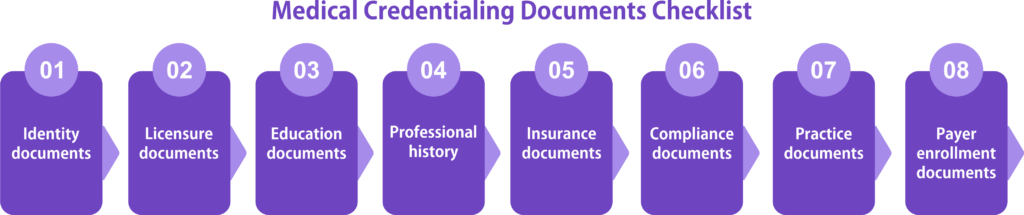
What Documents Are Required for Medical Credentialing? A complete Medical Credentialing Documents Checklist helps providers gather the required records before submitting an application. Organizing documents in advance reduces follow-up requests and supports a more efficient credentialing review.
Identity documents: Include a government-issued photo ID, Social Security Number (if requested), and legal name documentation. All identity records should match your licenses, NPI, and enrollment applications.
Licensure documents: Keep current copies of your state professional license, DEA registration, Controlled Substance Registration (if applicable), and board certification. Verify that none of these credentials have expired before submission.
Education documents: Maintain medical school diplomas, internship, residency, fellowship certificates, and other training records. Credentialing organizations use these documents to verify educational qualifications.
Professional history: Prepare a current CV, complete employment history, and professional references. Explain any employment gaps to avoid additional credentialing review.
Insurance documents: Include your malpractice insurance certificate and professional liability claims history. Health plans review these records to confirm active coverage and assess prior claims.
Compliance documents: Keep Continuing Medical Education (CME) records, BLS, ACLS, or PALS certifications, immunization records, and required health screenings current. These documents support regulatory and facility compliance.
Practice documents: Depending on your practice, gather your W-9, Tax Identification Number (TIN), CLIA certificate (if applicable), and hospital privilege documentation. These records support practice verification and participation.
Payer enrollment documents: Maintain an updated CAQH profile, active PECOS enrollment for Medicare, NPI confirmation, and payer-specific enrollment forms. Current records help meet Provider Credentialing Requirements and reduce enrollment delays.
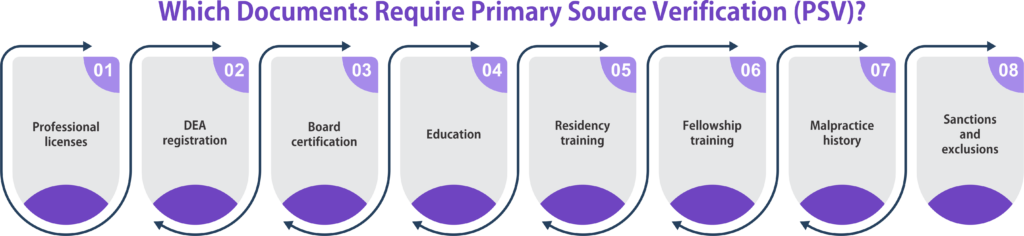
Which Documents Require Primary Source Verification (PSV)?
Primary Source Verification (PSV) confirms that credentialing documents are accurate by verifying them directly with the original issuing organization. This process helps healthcare organizations validate provider qualifications, meet accreditation standards, and reduce credentialing risks.
Professional licenses: Credentialing organizations verify active and unrestricted state licenses directly with the appropriate licensing board. This confirms the provider is legally authorized to practice.
DEA registration: DEA registration is verified through the U.S. Drug Enforcement Administration to confirm prescribing authority. Expired or inactive registrations may delay credentialing.
Board certification: Board certification is verified with the issuing specialty board to confirm certification status and expiration dates. Many hospitals and health plans require current certification.
Education: Medical school degrees are verified directly with the educational institution or an approved verification service. This confirms completion of the provider’s professional education.
Residency training: Residency programs verify successful completion of accredited clinical training. Credentialing teams use this information to confirm specialty preparation.
Fellowship training: Fellowship certificates are verified with the training institution to confirm advanced specialty education. This step is common for providers practicing subspecialties.
Malpractice history: Credentialing organizations review malpractice claims history through insurance carriers, loss-run reports, or the National Practitioner Data Bank (NPDB), when applicable. This helps evaluate previous professional liability issues.
Sanctions and exclusions: Providers are screened against federal and state exclusion databases, including the Office of Inspector General (OIG) List of Excluded Individuals and Entities (LEIE) and applicable state programs. This confirms the provider is eligible to participate in federally funded healthcare programs.
Medicare, Medicaid, Commercial Insurance, and Hospital Credentialing Requirements
Credentialing requirements vary by payer and healthcare organization, although many core documents remain the same. Understanding these differences helps providers submit complete applications and avoid unnecessary processing delays.
Medicare
Medicare providers must enroll through PECOS and meet CMS enrollment requirements before receiving Medicare billing privileges. CMS verifies provider qualifications and supporting documents before approving participation.
Common Medicare credentialing documents include:
1. National Provider Identifier (NPI)
2. Active PECOS enrollment
3. State professional license
4. DEA registration (if applicable)
5. W-9 and Tax Identification Number (TIN)
6. Malpractice insurance certificate
7. Board certification (if applicable)
Medicaid
Each state’s Medicaid program establishes its own credentialing and enrollment requirements. Providers should review state-specific rules before submitting an application.
Common Medicaid credentialing documents include:
1. National Provider Identifier (NPI)
2. Active state professional license
3. Medicaid enrollment application
4. DEA registration (when applicable)
5. Malpractice insurance certificate
6. W-9 and Tax Identification Number (TIN)
7. Additional state-required forms
Commercial Insurance
Commercial health plans conduct credentialing before adding physicians to their networks. Although requirements vary by payer, most insurers request similar supporting documents.
Common commercial insurance credentialing documents include:
1. Updated CAQH profile
2. State professional license
3. Board certification
4. Current Curriculum Vitae (CV)
5. Professional references
6. Malpractice insurance certificate
7. DEA registration (if applicable)
8. Continuing Medical Education (CME) records
Hospital Credentialing
Hospitals evaluate provider qualifications before granting clinical privileges. The review focuses on education, training, clinical competence, and compliance with hospital policies.
Common hospital credentialing documents include:
1. Medical school diploma
2. Residency and fellowship certificates
3. Board certification
4. Professional references
5. Hospital privilege history (if applicable)
6. Immunization and health screening records
7. BLS, ACLS, or PALS certifications
8. Professional liability insurance documentation
Common Documents That Delay Credentialing Approval
Many credentialing delays result from incomplete or outdated records rather than payer processing times. Reviewing documents before submission helps reduce avoidable setbacks and supports faster application processing.
Expired licenses
An expired professional license prevents credentialing organizations from confirming a provider’s legal authority to practice. Renew licenses before submitting your application.
Common issues include:
- Expired state license
- Pending license renewal
- License restrictions or disciplinary actions
Expired DEA
Providers who prescribe controlled substances must maintain an active DEA registration. An expired DEA certificate may delay credentialing and payer enrollment.
Common issues include:
- Expired DEA registration
- Incorrect DEA information
- DEA expiration during credentialing review
Missing malpractice insurance
Most payers require proof of active professional liability insurance before approving credentialing. Missing or expired coverage often results in application delays.
Common issues include:
- Missing insurance certificate
- Expired malpractice policy
- Insufficient coverage documentation
Employment gaps
Credentialing teams review work history to verify continuous professional experience. Unexplained employment gaps frequently require additional documentation.
Common issues include:
- Missing employment dates
- Unexplained career breaks
- Inconsistent work history
Different legal names
The provider’s legal name should remain consistent across all credentialing records. Name differences often require additional verification before approval.
Common issues include:
- Marriage or divorce name changes
- Different names on licenses and identification
- Missing legal name change documents
Missing signatures
Unsigned applications and forms are considered incomplete by most credentialing organizations. Every required signature should be reviewed before submission.
Common issues include:
- Unsigned enrollment forms
- Missing provider attestations
- Incomplete authorization forms
Outdated CV
A current Curriculum Vitae (CV) helps verify education, training, and employment history. An outdated CV may trigger requests for updated information.
Common issues include:
- Missing recent employment
- Incomplete education history
- Unexplained gaps in the CV
Incomplete CAQH profile
Many commercial insurers rely on CAQH to verify provider information. Incomplete or outdated profiles commonly delay credentialing decisions.
Common issues include:
- Missing supporting documents
- Expired CAQH attestation
- Information that does not match the credentialing application
Conclusion
Preparing complete and accurate Healthcare Provider Credentialing Documents is essential for timely provider enrollment, payer approval, and uninterrupted reimbursement. Reviewing each requirement before submission helps reduce delays, supports regulatory compliance, and improves the overall credentialing process.
Using a current Medical Credentialing Documents Checklist, maintaining updated records, and completing regular CAQH re-attestations can help providers stay credentialing-ready throughout their careers. Organized documentation also simplifies recredentialing and supports continued participation with Medicare, Medicaid, commercial insurers, and healthcare organizations.