
Which documents are required for medical credentialing, and why do so many applications stall? Missing or outdated paperwork is one of the most common causes of enrollment and payment delays. Commercial payer credentialing often takes 60 to 120 days, and an incomplete file can stretch that further.
Quick answer: Most payers and hospitals ask for a photo ID, NPI, state license, DEA registration if you prescribe, diplomas and training certificates, board certification, a CV with full work history, references, malpractice coverage and claims history, a current CAQH profile, a W-9 and, for Medicare, PECOS enrollment.
This guide explains the required documents for medical credentialing, why each one matters and which ones go through primary source verification (PSV). It also covers Medicare, Medicaid, commercial and hospital differences, plus the paperwork problems that delay provider credentialing and enrollment most often.
Why Medical Credentialing Documents Matter
Every application depends on records that are accurate, current and verifiable. In fact, the required documents for medical credentialing are what payers use to judge whether a file is complete. Knowing why payers want them helps you prepare a complete file the first time.
What Medical Credentialing Verifies
In short, credentialing confirms that a provider meets professional, legal and clinical standards. The review covers licenses, education, residency, board certification and work history. In addition, it checks sanctions, disciplinary actions and malpractice history to protect patients and meet regulatory rules.
Why Payers Ask for Supporting Documents
Insurers, Medicare, Medicaid and hospitals use these records to confirm what the application says. Many credentials then go through PSV, where the issuing board, school or certifying body confirms them directly. As a result, any mismatch between the application, the CAQH profile and the documents slows approval.
How Incomplete Records Delay Approval
Files with missing or expired items are often returned for corrections. Typical problems include expired licenses, lapsed malpractice coverage, unexplained work gaps, missing signatures and incomplete CAQH profiles. Each one can push back the payer’s decision, so a checklist pays for itself.
What Documents Are Required for Medical Credentialing?
The table below lists the documents required for medical credentialing by most payers and facilities, along with why each one is requested. Requirements vary by payer, specialty and state, so always confirm the final list with each plan.
| Document | Why it is required |
|---|---|
| Government-issued photo ID | Confirms identity and legal name; must match every other record. |
| National Provider Identifier (NPI) | Unique 10-digit ID used for enrollment, billing and claims. |
| State professional license | Shows active, unrestricted authority to practice; verified with the board. |
| DEA registration (if you prescribe) | Confirms federal authority to prescribe controlled substances. |
| State controlled substance registration | Required in some states in addition to the DEA. |
| Medical school diploma | Verifies completion of professional education. |
| Internship, residency and fellowship certificates | Confirm postgraduate training and specialty preparation. |
| Board certification | Shows specialty qualification; many payers and hospitals require it. |
| Curriculum vitae and work history | Lists education and employment by month and year; gaps need explanation. |
| Professional references | Peers confirm competence and conduct, often within the same specialty. |
| Malpractice insurance certificate | Proves current coverage, limits and effective dates. |
| Claims history or loss runs | Shows past malpractice claims or settlements. |
| CME records | Show ongoing education for licensing and re-credentialing. |
| Hospital privileges (if applicable) | Confirm current admitting or clinical privileges. |
| Immunization and health screening | Often required by hospitals and facilities, including TB screening. |
| BLS, ACLS or PALS cards | Required for some specialties and facilities. |
| CAQH ProView profile | Used by many commercial plans; must be complete and attested. |
| PECOS enrollment | Needed to bill Medicare. |
| W-9 and Tax ID (TIN) | Set up contracting and payment; must match IRS records. |
| CLIA certificate (if applicable) | Required when the practice performs lab testing. |
Medical Credentialing Documents Checklist
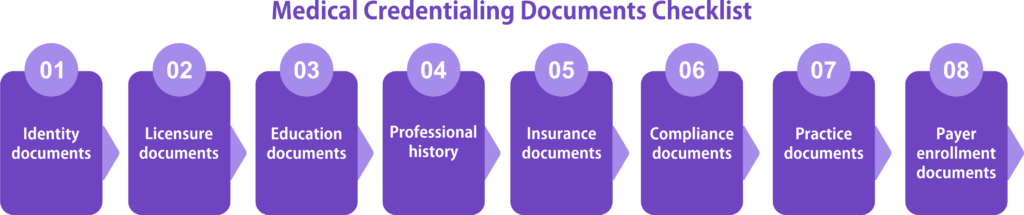
Grouping your records also makes them easier to gather and update. Use these categories to build a reusable folder for each provider:
- Identity: photo ID, Social Security number if requested and any legal name change records.
- Licensure: state license, DEA, state controlled substance registration and board certification, all checked for expiration dates.
- Education: diploma plus internship, residency and fellowship certificates.
- Professional history: current CV, complete work history with gap explanations and references.
- Insurance: malpractice certificate and claims history.
- Compliance: CME, life support cards, immunizations and health screenings.
- Practice: W-9, TIN, CLIA certificate and hospital privilege letters, as applicable.
- Payer enrollment: CAQH profile, PECOS record, NPI confirmation and payer-specific forms.
Keep the CAQH profile current, because many commercial plans pull directly from it and expect re-attestation every 120 days. If that schedule is hard to keep, CAQH profile management can handle uploads and attestations for you.
Which Documents Require Primary Source Verification?
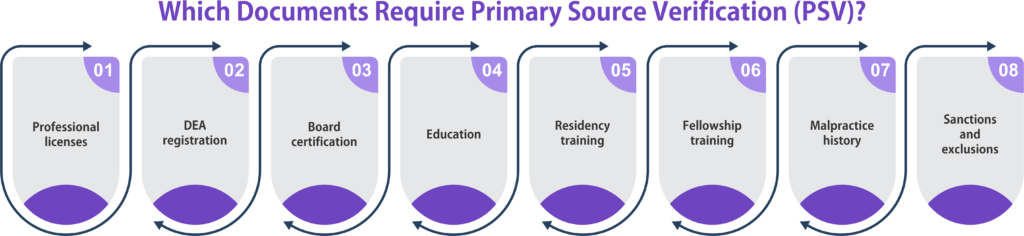
PSV confirms a credential directly with the organization that issued it. It helps organizations meet accreditation standards and lowers credentialing risk. Our guide to primary source verification in healthcare covers the process in more depth. Items usually verified at the source include:
- Licenses: checked with the state licensing board for active, unrestricted status.
- DEA registration: confirmed through the DEA.
- Board certification: confirmed with the specialty board, including expiration dates.
- Education and training: verified with the school, residency or fellowship program, or an approved service.
- Malpractice history: reviewed through carriers, loss runs and the National Practitioner Data Bank.
- Sanctions and exclusions: screened against the OIG exclusion list and state programs.
Medical Credentialing Documents by Payer and Facility
Core documents stay the same. However, each payer type adds its own items. Knowing the differences helps you submit complete applications.
Medicare
Medicare providers enroll through PECOS and must meet CMS requirements before billing. Typically, you need your NPI, state license, DEA if applicable, W-9 and TIN, board certification if applicable and banking details for EFT. A PECOS enrollment specialist can file the CMS forms for you.
Medicaid
The required documents for medical credentialing with Medicaid vary by state, because each program sets its own rules. So review them before applying. Most ask for your NPI, state license, the state enrollment application, DEA if applicable, malpractice certificate, W-9 and TIN, and any state-specific forms.
Commercial Insurance
Commercial plans credential providers before adding them to their networks. For these plans, the required documents for medical credentialing center on CAQH. Although each plan differs, most rely on an attested CAQH profile plus your license, board certification, CV, references, malpractice certificate, DEA and CME records.
Hospital Credentialing
Hospitals review qualifications before granting privileges. Like payers, they focus on education, training, competence and policy compliance, so expect to provide diplomas, training certificates, board certification, references, prior privilege history, immunizations, life support cards and liability coverage. See our hospital credentialing guide for the full process.
Medical Credentialing Documents That Cause Delays
Many delays come from paperwork, not payer processing. Therefore, check for these issues before you submit:
- Expired licenses: an expired, pending or restricted license stops verification until it is resolved.
- Expired or incorrect DEA: a registration that lapses mid-review causes rework.
- Missing malpractice proof: a missing certificate or lapsed policy holds the file because payers need current coverage.
- Employment gaps: missing dates or unexplained breaks trigger follow-up questions.
- Different legal names: after a marriage or divorce, name changes need supporting documents so all records match.
- Missing signatures: unsigned forms or attestations make the application incomplete.
- Outdated CV: missing recent jobs or training leads to requests for updates.
- Incomplete CAQH profile: missing uploads, an expired attestation or data that does not match the application slow every commercial plan.
Bottom Line
Knowing the required documents for medical credentialing is the fastest way to avoid delays. First, build one organized folder per provider. Next, check expiration dates before every submission. Finally, keep CAQH attested so each new payer can pull clean data. As a result, re-credentialing becomes routine instead of a scramble.