
The claim went out clean, got paid, and posted to the ledger. Four months later an audit letter arrives asking for the note behind it. That note, dictated at nine that night from memory, reads thinner than the visit actually was. The revenue was earned in the exam room and lost in the chart. That gap is where the real virtual medical scribe benefits for physicians begin, because correct billing alone does not stop revenue from slipping. A visit handled well gets documented thin when charting happens hours later, and thin documentation invites lower payment, slower payment, or a clawback.
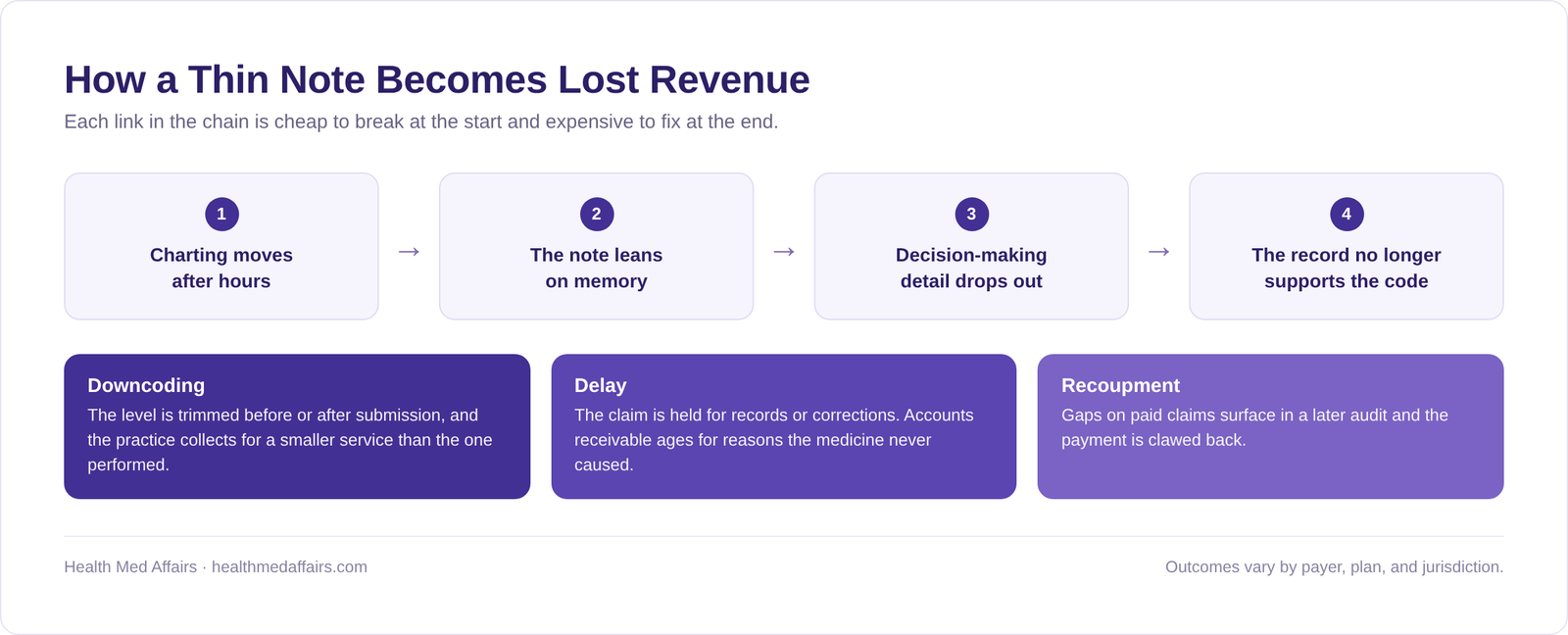
Moving charting back into the visit itself is what a virtual medical scribe does, and it does most of the work. The virtual medical scribe benefits for physicians that matter most are not the hours returned but the revenue those hours were quietly costing. The chain is short. Charting done after hours leans on memory, memory drops detail, dropped detail weakens the code, and a weakened code invites a downcode, a delayed payment, or a recoupment. Real-time charting cuts that chain at its first link.
Quick answer: A virtual medical scribe joins the visit remotely and writes the note while it happens. Real-time charting preserves the decision-making detail the billed code depends on, protects against downcodes and recoupments, and returns the physician’s charting hours.
Where the Charting Hours Actually Go
A 2016 observational study published in Annals of Internal Medicine followed 57 physicians across four specialties and found they spent 49.2% of the office day on EHR and desk work against 27.0% in direct clinical face time — close to two administrative hours for every patient hour, with one to two more at home in the evening. It is a single study of a small sample, but a decade of practice experience has not contradicted it.
The clinic closes. The charting does not. By then the visit is a memory, and memory is a poor source. What was discussed, what was ruled out, which studies were reviewed and why the plan followed from them, all of it gets reconstructed, and the parts that do not come back never make the record.
This matters more now than it used to. For office and outpatient visits since January 1, 2021 — and for most other evaluation and management (E/M) categories since the 2023 CPT revisions — levels are selected by medical decision-making (MDM) or by total time on the date of the encounter, not by how long the history and exam read. Exceptions remain: emergency department visits, for instance, are MDM-only and offer no time path. In every case, neither basis counts unless the record shows it.
How Incomplete Documentation Turns Into Lost Revenue
The first leak is downcoding. A note that reads one level under what the visit involved gets its code trimmed, before submission or after, and the practice collects for a smaller service than the one performed. Across a full panel, that shortfall becomes a monthly habit.
Then come the delays. When a note lacks elements the billed code needs, edits at the clearinghouse or the payer hold the claim for records, corrections, another submission. Accounts receivable ages for reasons the medicine never caused.
Worth separating the two things that happen here. A rejection never reaches adjudication — a front-end edit at the clearinghouse or the payer bounces the claim before it is processed, and a corrected resubmission fixes it. A denial is an adjudicated decision, and undoing it means a corrected claim or a formal appeal with records attached. Thin documentation produces both, but the clock and the workflow are different, and practices that treat them as one thing lose appeal deadlines on claims they could have won.
| Rejection | Denial | |
|---|---|---|
| Where it happens | Front-end edit at the clearinghouse or payer, before adjudication | Payer decision after the claim is adjudicated |
| What you receive | Clearinghouse report or 277CA acknowledgement | Remittance advice with a denial reason code |
| How it is fixed | Correct the error and resubmit as a new claim | Corrected claim, or a formal appeal with records attached |
| The clock that matters | Payer timely-filing deadline | Appeal deadline, which is shorter and payer-specific |
| Documentation role | Rarely the cause; usually data or format | Often the cause, when the note does not support the code |
When Documentation Gaps Become Recoupments
The third cost arrives last and cuts deepest. Documentation gaps on paid claims become recoupment demands later. Where a pattern suggests the practice knew, or recklessly disregarded, that the records did not support what was billed, Medicare matters can escalate beyond recoupment to False Claims Act exposure — the statute turns on that knowledge standard, not on sloppy charting alone. A note that never explained why a test was ordered looks, a year on, like a test that had no reason to exist.
Watch out: A note that every visit seems to fill out identically is itself an audit flag. Templates invite boilerplate, and boilerplate is what records reviewers read as evidence of copy-paste coding.
Where Documentation Gaps Hit the Practice
| Gap in the note | What it causes | Where the money goes |
|---|---|---|
| Missing decision-making detail | Downcoded E/M level | Reimbursed below the visit performed |
| No medical necessity statement | Denial or records request | Staff hours in rework and appeals |
| Vague plan or follow-up | Post-payment recoupment | Clawed-back payments on old claims |
| Unsigned or incomplete entries | Claim hold at the payer | Delayed cash and aging A/R |
What a Virtual Scribe Captures in Real Time
A virtual scribe joins the visit remotely and writes while it happens. History, findings, the differential, studies reviewed, risk weighed, orders, plan: the chart fills in the same hour, and the physician signs it before the day is out.
Medical decision-making is where this pays. MDM is the element practices most often underdocument, because it is the hardest to rebuild after the fact. A scribe trained to prompt for it — what did you review, what did you consider, what risk drove the plan — captures the specificity that separates a defensible note from a vague one. Real-time EHR charting is the mechanism; the specificity is the point.
CMS’s compliance tips on E/M documentation spell out what a record has to show at each billed level. Build the scribe workflow around that list and charting becomes evidence instead of a liability. For practices that would rather not manage this in-house, our virtual medical scribe service pairs trained scribes with physician oversight and same-day sign-off.
Key point: The scribe’s entry is not the author’s. The physician reviews, edits, and signs, and that signature is what a payer reads as the record’s voice.
Virtual Scribes Compared With In-House Hires
Money settles most of these decisions, so look at it plainly. An in-house scribe means salary, benefits, desk space, and coverage for absence. A virtual scribe is staffed by session, grows with volume, and never calls in sick with a full shift’s notes behind it.
Virtual Scribe vs. Physical Scribe at a Glance
| Factor | Virtual scribe | In-house scribe |
|---|---|---|
| Cost structure | Per-visit or per-provider pricing, no benefits overhead | Full salary, benefits, and coverage gaps |
| Availability | Coverage across sessions and time zones | Limited to one schedule and one site |
| EHR fluency | Trained on documentation templates and payer expectations | Varies by hire |
| Scaling | Adds coverage as provider volume grows | Requires new hires for each added provider |
| Turnover risk | Backfilled by the vendor | Gap and retraining on exit |
None of this makes in-house scribes the wrong choice. Large systems with trained scribe programs run them well. For independent practices and small groups, though, the virtual model usually buys the same real-time charting at a fraction of the fixed cost.
Pro tip: Judge scribes on cost per completed, same-day-signed note, not per hour. Vendors quote the figure, and it prices the model against what the practice actually buys.
Building a Compliant Scribe Workflow
A scribe does not make a chart compliant by existing. Structure does.
Step 1: Train the scribe before the first visit
Training comes before anything else: the practice’s templates, its documentation priorities, the payer rules the charts will be judged against.
Step 2: Scope EHR access and keep the signature discipline
EHR access controls come next. Every entry stays attributable, and the physician’s signature remains the last act on each note: scribes document under the physician’s direction, the physician reviews and signs, and the record carries both names.
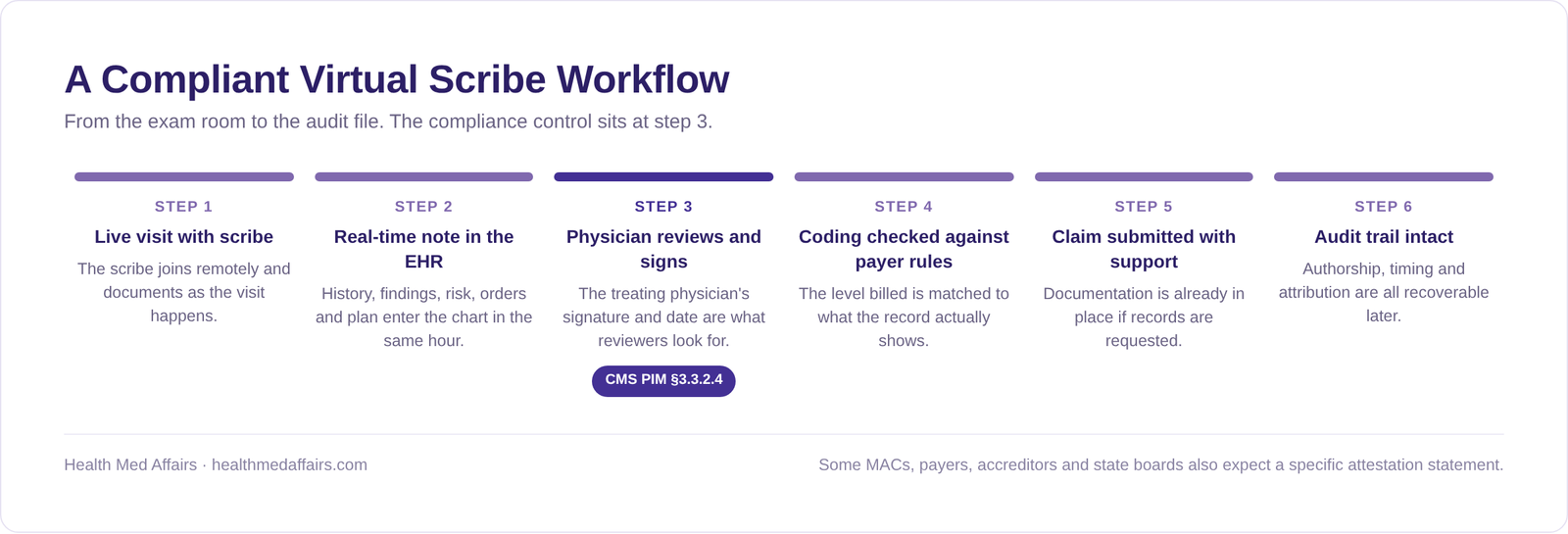
Medicare’s baseline is narrower than many practices assume. CMS states in the Medicare Program Integrity Manual (Pub. 100-08, Ch. 3 §3.3.2.4) that scribes are not providers of items or services, that it does not require the scribe to sign or date the documentation, and that reviewers shall not deny claims because a scribe has not signed a note. What reviewers look for is the treating physician’s or non-physician practitioner’s signature and date. Several MACs, commercial payers, accrediting bodies, and state medical boards do expect a specific attestation statement, so confirm your own jurisdiction’s and payers’ requirements rather than assuming the federal floor is the ceiling.
Step 3: Review a monthly sample against payer rules
A monthly sample review against payer requirements closes the loop. Charts that have drifted get caught while the correction is still cheap — and if the sample keeps surfacing the same gap, a formal medical billing and coding audit is the cheaper answer than discovering it in a records request.
The workflow in sequence: the scribe documents the live visit, the note enters the EHR in real time, the physician reviews and signs the same day, coding is checked against payer rules, the claim is submitted with supporting documentation, and the audit trail stays intact.
Run this way, scribing deepens clinical documentation integrity — the completeness and accuracy of the clinical record — rather than handing it off. Notes get more specific, and authorship stays with the physician.
The Virtual Medical Scribe Benefits for Physicians That Move Revenue
Three numbers show whether the virtual medical scribe benefits for physicians are reaching the ledger. Watch them in the first months.
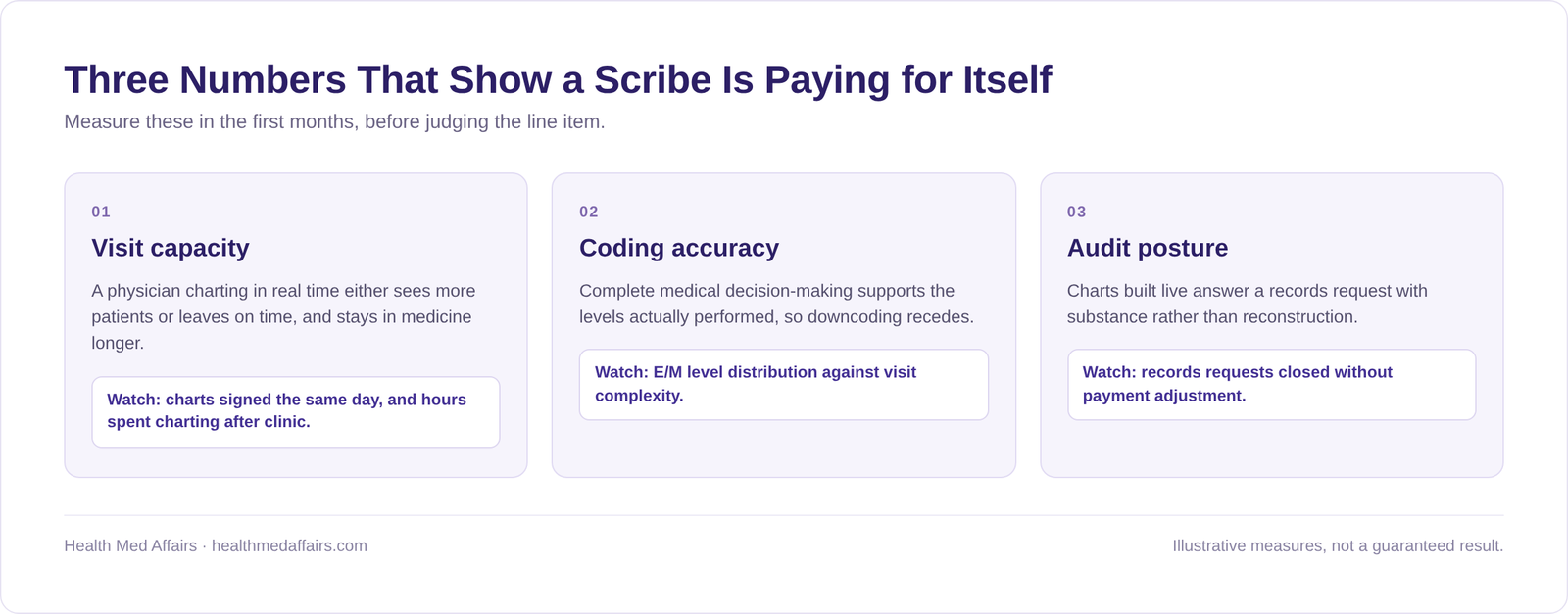
Visit capacity, since a physician charting in real time sees more patients or leaves on time and stays in medicine longer. Reducing physician charting burnout is not a soft benefit in this calculation — pajama-time charting is one of the most consistently cited drivers of physician attrition, and replacing a departing physician costs a practice far more than a year of scribe coverage.
Then coding accuracy, because complete MDM supports the levels actually performed and downcoding recedes.
Then audit posture: charts built live answer a records request with substance, and that is the line between a clean file and a recoupment.
A scribe is not a line item to shave. Priced against recovered visits, preserved coding specificity, and physician retention, it behaves like insurance on the practice’s largest revenue stream, which is the documented work of its clinicians.
The Bottom Line
Virtual scribes give physicians their evenings back, but that is the smaller half of the case. Real-time documentation protects revenue the practice has already earned: complete notes code correctly, pay faster, and hold up under audit.
Practices seeing the downstream cost of thin notes — held claims, downcoded levels, appeals that eat staff hours — can look at how our denial management services work alongside documentation support.
Frequently Asked Questions
Do virtual scribes need access to the full EHR?
No, and they should not have it. Access scoped to documentation functions is the standard most practices apply, consistent with HIPAA’s minimum-necessary principle: every entry carries the scribe’s identity, the physician’s signature closes the note, and billing and ordering functions stay out of reach. A vendor-supplied scribe is a business associate, so a signed BAA belongs in place before the first visit.
Will a payer accept a note drafted by a scribe?
Yes, provided the physician reviews and signs. Who documented and who authored the visit both show in the chart, and payers read the finished note rather than the typing history. The physician’s signature is what carries it; some payers and MACs additionally expect a specific attestation statement, so check yours.
What does a virtual scribe cost compared with an in-house hire?
Pricing models differ too much for a single number to be useful: virtual scribes are typically quoted per provider-hour, per session, or per completed note, while an in-house scribe carries salary plus benefits, payroll taxes, workspace, and coverage for absence. Compare them on fully loaded cost per completed, same-day-signed note rather than on hourly rate, and ask any vendor what happens to the price when a provider’s volume moves.
How is a virtual scribe different from ambient AI documentation tools?
Both run during the visit. Ambient tools generally turn the conversation into a draft that a human cleans up afterward. A virtual scribe writes and structures in real time and can be steered mid-visit, which helps when the details decide the code. Capabilities in this category are changing quickly, so evaluate any specific tool on its current behavior rather than the category label.
| Live virtual scribe | Ambient AI documentation | |
|---|---|---|
| When the note is built | During the visit, structured as it happens | From a recording or transcript, drafted after the visit |
| Who can redirect it mid-visit | The physician, by speaking to the scribe | No one; the draft is reviewed afterward |
| MDM capture | Prompted for in the room, where the reasoning is fresh | Captured only if the reasoning was spoken aloud |
| Review burden on the physician | Read and sign | Read, correct, and sign |
| Who signs the note | The physician, in every case | The physician, in every case |
How long does onboarding a virtual scribe take?
One to two weeks for most practices. The scribe learns the templates, the documentation priorities, the specialty vocabulary, then runs supervised briefly before working alone.
What should a practice measure to judge scribe value?
Charts signed the same day, E/M level distribution against visit complexity, and hours spent charting after clinic. Movement in those three inside the first months answers whether the model is paying for itself.
Published by the Health Med Affairs editorial team. Health Med Affairs provides medical billing, coding, credentialing, and clinical documentation support to U.S. physician practices. Published October 25, 2026.