
Zero dollars on the line. Five digits beside them. CO-234, and a single sentence of explanation: this procedure is not paid separately.
Two different situations hide inside that sentence. The service may genuinely belong inside another procedure’s payment. Or the claim never told the payer what made it distinct, one missing modifier, and a clean claim goes down with it. Guess wrong the first way and you are appealing an adjustment that was never winnable. Guess wrong the second way and you have handed back recoverable money. The remark code on the remittance usually tells you which world you are in. That code is where this guide starts.
What CO-234 says on the remittance
CARC 234 belongs to the Claim Adjustment Reason Code list, the vocabulary every payer stamps onto an 835 remittance. The official entry reads “This procedure is not paid separately.” The same entry carries a rule with real weight on live remittances. Every 234 adjustment must travel with at least one remark code, either a Remittance Advice Remark Code or an NCPDP reject reason. NCPDP belongs to pharmacy claims. On a medical claim, the companion you want is a RARC. A CO-234 Remark Code that reads N20, M15, N390, or N122 is pointing at the edit that fired. When CO-234 lands bare, no remark anywhere, the payer has skipped its own requirement. Request one before the write-off or the appeal begins. That code picks the path, and everything else in this post hangs on it.
Then the prefix. CO is a group code, and group codes assign the money. Contractual Obligation puts the adjustment on the practice, per contract, with none of it reachable by a patient statement. Sending that bill anyway violates the contract, plain and simple. The same 234 also arrives under PR, PI, or OA, and each of those flips the playbook.
CO-234 and the codes it gets confused with
Reason 234 travels under several group codes. Codes that look like CO-234. CO-234: procedure not paid separately, bundled under the contract, provider written off. PR-234: 234 under patient responsibility, patient owes, though rare with this code. PI-234: payer-initiated reduction, frequently appealable. OA-234: other adjustment, usually coordination of benefits, depends on the contract. CO-97: benefit included in the payment for another service already adjudicated, provider written off.
| Code | Who pays | What it means |
| CO-234 | Provider | Bundled under the contract, written off |
| PR-234 | Patient | Rare here; the service sat outside plan coverage |
| PI-234 | Provider, appealable | Payer-initiated reduction, not a contract term |
| OA-234 | Depends on contract | Coordination of benefits |
| CO-97 | Provider | Included in payment for another already-adjudicated service |
CO-234 is the version you will see most, because NCCI edits and contract bundling both land under Contractual Obligation. Check the prefix before anything gets written off, though. PI-234, a cut the payer made on its own authority rather than from a contract term, is often appealable. Writing it off within the hour it arrives is money handed away for nothing. PR-234 rarely appears with this reason code. When it does, the service usually sat outside plan coverage from day one, and the patient statement is legitimate. OA-234 means coordination of benefits has entered the picture. One field, four destinations.
The remark codes that travel with CO-234
CARC 234 leaves the explaining to the remark code beside it. Four cover most of the queue. N20 is the workhorse. “Service not payable with other service rendered on the same date.” That is NCCI procedure-to-procedure language, and it points at a code pair rather than at your documentation. M15 marks a component bundled into another procedure on the same date. The incidental pattern. Same incision, same operative field, no value of its own.
N390 reports a missing or invalid modifier, and honestly, it is the best news a denial can carry. The service may be separately payable. The claim just never said so. N122 attaches to an add-on code billed without its parent. Add-ons wear a plus sign in the CPT manual. Not one of them pays alone. Medicare’s DME contractor guidance even gives N20 and 234 a shared denial-resolution page, which tells you how often this pairing reaches real remittances.
What actually triggers CO-234
“Not paid separately” is the label. Seven situations sit behind it. The NCCI edits lead. The National Correct Coding Initiative publishes a table of CPT pairs where one code counts as a component of the other. Bill both on one date, and the payer reimburses the comprehensive code while the component zeroes out. Take a therapy claim carrying 97110, therapeutic exercise, and 97140, manual therapy, with no modifier 59 between them. 97110 gets paid. 97140 returns with CO-234 and N20. The tables turn over four times a year, on January 1, April 1, July 1, and October 1. A pair that sailed through in March can deny in April, and nobody changed a thing. The second pattern comes from global surgical packages. Every operation carries a post-operative window, 0, 10, or 90 days under CMS rules, and visits inside that window are treated as already paid for by the surgery’s own fee. Book a 99213 for a follow-up visit two weeks after an operation with a 90-day window, and the denial posts itself. Modifier 24 exists for the rare visit inside the window that had nothing to do with the operation, though the record has to carry that story before anyone attaches the modifier.
Incidental work is the third pattern. Suppose a surgeon opens the abdomen and clears adhesions along the way. Billing 44005 as its own line beside the operation earns a CO-234, because the work happened inside the same incision and the same payment. The missing modifier is pattern four, and it is the one most worth fixing fast. When a 99214 lands on the same day as a minor procedure and the claim carries no modifier 25, the payer sees no evidence that the visit stood on its own, and the edit does the rest. Fixing it takes care. Modifier 59 is CMS’s last resort, reserved for cases where nothing more specific applies, and the X modifiers (XE, XS, XP, XU) exist precisely for the specific situations. A bare 59 attached just to beat an edit, with no documentation behind it, upgrades a nuisance denial into an audit finding. Orphaned add-ons make up the fifth pattern. An add-on code cannot stand alone, and +99417 for prolonged services that arrives without its 99205 or 99215 parent comes back as CO-234 with N122 beside it.
Commercial editing engines sit sixth. Medicare can pay two codes side by side while a private plan’s proprietary bundling logic refuses the same pair, so the identical encounter clears one payer and trips another. Overlapping components come seventh. Cardiology gives a clean example: 93000 covers the full ECG with its interpretation, while 93005 covers the tracing alone. Submit both and the payment lands on 93000 while 93005 zeroes out, because the tracing work already sits inside the higher code.
Resolving CO-234, step by step
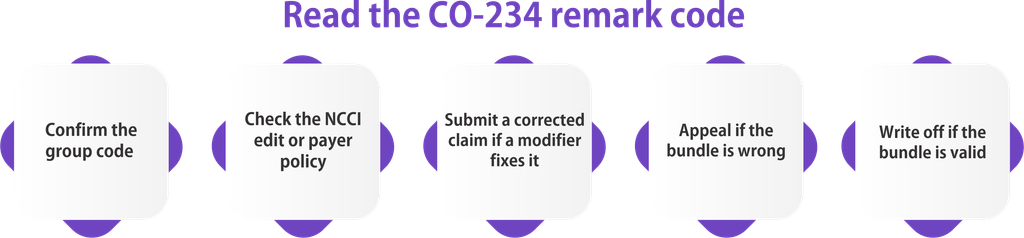
CO-234 denial code resolution in medical billing is mostly a sequencing problem. Take the steps in the right order and the adjustment closes inside a week; take them out of order and it can sit in AR for a quarter.
| Remark code | What it points to | First action |
| N20 | An NCCI code pair | Check this quarter’s PTP edit, corrected claim with a modifier if the pair splits |
| M15 | An incidental component | Read the operative note, appeal only if the work stood apart |
| N390 | A missing or invalid modifier | Corrected claim with 25, 24, or the specific X modifier |
| N122 | An add-on billed without its parent | Bill the parent, or append the add-on to the claim that has it |
The sequence starts at the remark code. N20 sends you to the edit tables, M15 to the operative note, N390 to the modifier box, and N122 to the parent code. The group code comes next, because the balance’s destination hangs on it. CO writes off or appeals. PI opens the appeal question. PR confirms a plan exclusion. OA routes into coordination of benefits. From there, check the edit yourself in CMS’s public NCCI PTP lookup or the payer’s own bundling policy, because ten minutes there settles validity before anyone drafts a letter. If a modifier repairs the claim, whether 25, 24, 79, or the specific X modifier, a corrected claim closes it faster than any appeal. Appeal only when the payer’s edit genuinely misfired, records attached. When the bundle is valid, write the balance off and move on. Rebilling it to the patient was never available under a CO code.
Stopping CO-234 before the claim goes out
Nearly every CO-234 is built at charge entry. A code-pair check against the current edit tables catches the 97140 situation before the claim leaves, and because the tables turn over four times a year, the check needs this quarter’s version. Modifier discipline covers the rest. Append 25, 24, and 79 only when the chart supports them, and prefer the X-family over 59 wherever a specific modifier fits. A monthly denial-trend review catches what slips through, because a CO-234 spike right after a quarterly update signals a process gap, and a process gap gets fixed once.
Conclusion
The CO-234 denial code is a pointer. It marks a bundling decision that the remark code either validates or overturns. Read it first, check the edit, correct what a modifier can correct, appeal with evidence, and let the valid write-offs go quickly. Practices that want the whole cycle handled by one team can put a medical billing company on it.
FAQs
What does the CO-234 denial code mean?
CARC 234 reads “This procedure is not paid separately.” The payer folded the service into another code’s payment on the same claim. Under the CO prefix, the adjustment stays with the provider.
Can a patient be billed under CO-234?
No. A Contractual Obligation adjustment belongs to the provider by contract. PR-234 is the patient-responsibility version of the same number, and it rarely appears with this reason code.
What is remark code N20?
“Service not payable with other service rendered on the same date.” It is NCCI procedure-to-procedure language, so it points at a code pair rather than at your documentation.
How do you fix a CO-234 denial?
CO-234 denial code resolution starts at the remark code, then the group code, then check the NCCI edit or the payer’s bundling policy. A corrected claim with the right modifier closes most cases. Appeal only when the edit misfired, and write off when the bundle is valid.
What is the difference between CO-234 and CO-97?
Both leave the balance on the provider. CO-97 says the service was already included in the payment for another adjudicated service, while CO-234 covers NCCI pairs, global surgical packages, and every other not-paid-separately decision.
How often do NCCI edits change?
Four times a year, on January 1, April 1, July 1, and October 1. Recheck any code pair that bills together after each quarterly update, because a pair that cleared in March can deny in April.