

Your practice can be busy every day and still struggle to maintain healthy cash flow. The problem may not be the number of patients you see it may be the amount of revenue sitting unpaid after those visits.
What happens when claims remain unresolved for weeks? A rejected claim waits for correction. A denied claim waits for review and appeal. A payer request goes unanswered. Meanwhile, your practice continues paying staff, rent, technology, supplies, and other operating expenses.
That is where disciplined accounts receivable management matters. A medical billing virtual assistant can take on the repetitive work behind A/R follow-up, from reviewing aging reports and checking claim status to documenting payer responses and escalating unresolved accounts. The goal is not simply to “work old claims.” It is to create a consistent process that moves legitimate claims toward resolution and gives your practice better visibility into its revenue cycle.
What Aging A/R Really Means for Your Practice
Accounts receivable represents money owed to the practice for services already provided but not yet collected. A/R becomes a problem when unpaid claims continue to age without a clear next action. The longer an account remains unresolved, the more work may be required to determine why payment has not arrived and what needs to happen next.
A healthy medical practice therefore needs more than a billing system that shows outstanding balances. It needs an active process for identifying:
- Claims that have not been adjudicated
- Claims rejected because of submission errors
- Denied claims requiring correction or appeal
- Underpaid claims that need review
- Claims awaiting medical records or other information
- Patient balances requiring follow-up
- Accounts approaching payer filing or appeal deadlines
The AMA identifies accounts receivable and revenue-cycle performance as important parts of medical practice financial management. Its guidance also emphasizes monitoring measures such as days in A/R, denial rates, first-pass resolution, insurance verification, and patient collections.
Why Aging Claims Are So Difficult to Clean Up
A/R follow-up is rarely one simple task. An unpaid claim can have a completely different cause from another claim in the same aging bucket. For example, one claim may simply be pending with the payer. Another may have been rejected because of incorrect information. A third may have been denied because documentation, coding, authorization, or coverage requirements were not satisfied.
CMS explains that electronic Medicare claims pass through multiple levels of edits. Claims can be rejected for errors or denied based on applicable coverage and payment requirements. That means an effective A/R process must answer three questions for every unresolved account:
- What happened?
- What needs to happen next?
- Who is responsible for completing it?
Without those answers, aging reports can become lists of unpaid balances rather than actionable work queues.
How a Medical Billing Virtual Assistant Helps Reduce Aging Claims
A medical billing virtual assistant for accounts receivable can provide dedicated support for the repetitive, time-sensitive work required to keep unpaid claims moving. Instead of allowing A/R follow-up to compete with daily front-office and billing responsibilities, practices can assign defined workflows to a trained virtual billing professional.
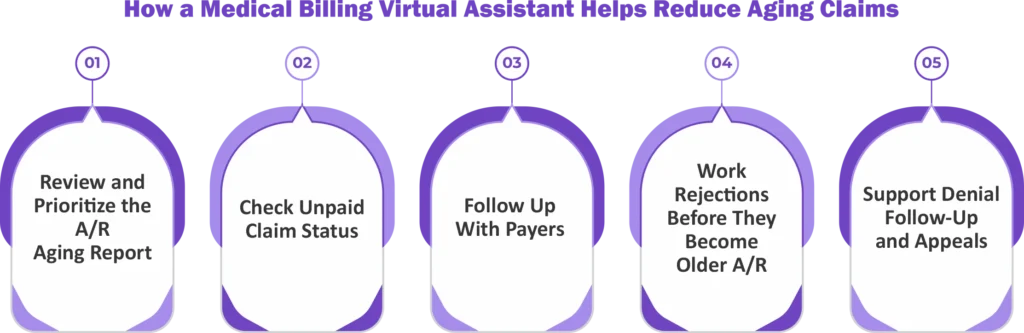
1. Review and Prioritize the A/R Aging Report
Not every account deserves the same follow-up approach. A VA can organize outstanding accounts by factors such as:
- Age of the claim
- Outstanding balance
- Payer
- Claim status
- Denial or rejection reason
- Previous follow-up activity
- Filing or appeal deadlines
- Missing information
- Required next action
This creates a more useful work queue than simply sorting accounts by age. For example, a high-dollar claim approaching a payer deadline may require immediate attention, while a recently submitted claim that is still within the payer’s normal processing period may not.
2. Check Unpaid Claim Status
A billing VA can regularly review payer portals, clearinghouse information, and available claim-status tools to determine whether an unpaid claim is:
- Still processing
- Rejected
- Denied
- Pending additional information
- Paid but not yet posted
- Returned for correction
- Requiring an appeal or reconsideration
The purpose is to replace passive waiting with documented follow-up.
3. Follow Up With Payers
Outsource AR follow-up when your internal team does not have enough time to consistently contact payers and document the results. Depending on the claim, follow-up may involve:
- Checking payer status
- Identifying the reason for nonpayment
- Confirming whether documentation was received
- Determining whether a corrected claim is required
- Confirming appeal or reconsideration requirements
- Recording reference numbers
- Documenting payer representatives and responses
- Scheduling the next follow-up date
A useful follow-up process does not end with “called insurance.” It records what was learned and what happens next.
4. Work Rejections Before They Become Older A/R
Rejected claims can often require correction and resubmission before they can proceed through adjudication.
CMS notes that electronic claims are subject to initial edits and other requirements, with responses identifying errors or denial reasons that may require correction.
A VA can help identify rejected claims, determine the correction required, route coding or documentation questions to the appropriate team member, and track resubmission. The objective is simple: do not let an easily correctable claim sit untouched.
5. Support Denial Follow-Up and Appeals
A denial should trigger an action plan, not simply a status update. Depending on the denial, the next step may involve:
- Reviewing the payer’s explanation.
- Identifying the underlying issue.
- Checking the original claim and supporting documentation.
- Correcting information when appropriate.
- Gathering required records.
- Preparing the appropriate appeal or reconsideration materials.
- Submitting the response through the required channel.
- Tracking the payer’s decision.
CMS publishes standardized review reason codes and statements for certain Medicare claim-review processes, which can help providers understand why a claim was denied or not affirmed.
The Importance of Timely A/R Follow-Up
Waiting too long to work an unpaid claim can create additional problems. For Medicare fee-for-service claims, CMS states that claims generally must be submitted no later than one calendar year after the date of service, subject to applicable exceptions. Commercial and other payer requirements can differ, so practices should maintain payer-specific rules rather than assume that one deadline applies to every claim.
This is one reason a structured A/R workflow matters. The billing team should know which accounts require immediate attention and which are still within an appropriate processing window.
A medical billing virtual assistant can support that workflow by maintaining follow-up dates, documenting payer responses, and escalating accounts that require additional action.
How Better A/R Management Supports Practice Cash Flow
Medical practice cash flow management is not only about reducing expenses. It also depends on how efficiently earned revenue moves from completed services to collected payments.
MGMA describes financial management in medical practices as encompassing revenue cycle management, accounts receivable, cash-flow projections, billing, claims, and payment processes. Consider the difference between these two workflows:
Passive workflow
Claim submitted → no immediate issue identified → claim ages → staff eventually checks status → problem discovered → correction or appeal begins.
Active workflow
Claim submitted → status monitored → exception identified → responsible person assigned → correction or follow-up completed → next action scheduled → payment tracked.
The second workflow gives practice leadership greater visibility into what is happening to unpaid revenue.
Which A/R Tasks Can a Medical Billing VA Handle?
The exact scope should be defined during onboarding, but a medical billing VA may support tasks such as:
| A/R Task | VA Support |
| A/R aging review | Identify accounts requiring action |
| Claim-status checks | Verify current payer status |
| Payer follow-up | Document calls, portal activity, and responses |
| Rejection management | Identify correction and resubmission needs |
| Denial tracking | Categorize and monitor unresolved denials |
| Appeal coordination | Track required documentation and submission status |
| Underpayment review | Flag discrepancies for appropriate review |
| Payment posting support | Assist with posting and reconciliation workflows |
| Follow-up scheduling | Set next-action dates |
| A/R reporting | Summarize aging, payer, and status trends |
The key is not simply adding another person to the billing process. It is assigning clear ownership to work that otherwise remains unfinished.
When Should You Consider Revenue Cycle Virtual Support?
A virtual billing resource can make sense when your practice experiences one or more of these situations:

Your A/R Reports Keep Growing
If the aging report repeatedly gets pushed aside because staff are busy with current claims, patient calls, eligibility, or other administrative work, older accounts may continue accumulating.
Your Billers Are Constantly Switching Tasks
Frequent interruptions make it difficult to maintain consistent follow-up. A dedicated resource can take ownership of defined A/R queues while your core billing staff focus on other responsibilities.
Claims Are Being Worked Inconsistently
If one person follows up aggressively while another rarely touches older claims, the practice may not have a standardized process.
You Have Limited In-House Staffing
Hiring another full-time employee is not always the only way to increase billing capacity. Virtual support can provide additional administrative capacity without requiring another person to work physically inside the practice.
Leadership Lacks Visibility Into A/R
If management cannot quickly determine which payers, denial categories, or aging groups are responsible for outstanding balances, reporting needs improvement.
What to Measure After Outsourcing A/R Follow-Up
Do not judge an A/R support program simply by the number of phone calls made. Track outcomes and workflow performance instead. Useful measures include:
- Total A/R balance
- A/R by aging bucket
- Days in A/R
- Percentage of A/R over 90 days
- Claim denial rate
- First-pass claim acceptance or resolution
- Number of unresolved claims
- Average time from denial to action
- Amount recovered from previously unresolved accounts
- Underpayment volume
- Follow-up completion rate
The AMA specifically recommends monitoring first-pass resolution, coding accuracy, days in A/R, denial rates, insurance verification, and patient collections as part of stronger revenue-cycle management.
The purpose of these metrics is not to create a complicated dashboard. It is to determine whether the practice is identifying revenue problems early and acting on them consistently.
A Practical Workflow for Reducing Aging A/R
A medical billing virtual assistant can follow a repeatable workflow rather than treating every account as a separate problem.
Step 1: Segment the A/R
Separate accounts by age, payer, balance, claim status, and issue.
Step 2: Identify the Reason for Nonpayment
Determine whether the account is pending, rejected, denied, underpaid, awaiting information, or otherwise unresolved.
Step 3: Assign the Correct Action
Every account should have a defined next step—status check, correction, resubmission, documentation request, appeal, payment posting, or escalation.
Step 4: Complete and Document Follow-Up
Record the payer response, reference number, date, action taken, and next follow-up date.
Step 5: Escalate Exceptions
Claims involving coding questions, medical documentation, contractual disputes, compliance concerns, or clinical issues should be routed to the appropriate qualified team member.
Step 6: Review Trends
If the same payer or denial reason repeatedly appears, do not keep treating every claim individually. Investigate the underlying workflow problem.
Step 7: Report Results
Use regular A/R reporting to show where outstanding revenue is concentrated and whether corrective actions are working.
Why the VA Needs More Than Basic Billing Skills
A virtual billing assistant is only useful when the workflow around that person is well designed. Your practice should evaluate:
- Medical billing experience
- Understanding of payer workflows
- A/R follow-up experience
- Denial-management knowledge
- Familiarity with your practice management system
- Documentation standards
- Escalation procedures
- HIPAA and security practices
- Communication processes
- Reporting capabilities
Technology can help automate portions of revenue-cycle work, but it does not eliminate the need for organized processes and knowledgeable staff. The AMA notes that practice-management systems can automate and streamline administrative and billing functions, including billing, eligibility-related workflows, reporting, and other revenue-cycle activities.
The best setup combines technology with accountable human follow-up.
How Health Med Affairs Supports A/R Follow-Up
Health Med Affairs provides medical billing virtual assistants who can support insurance verification, claims submission, denial follow-up, payment posting, prior authorization, patient billing, and other revenue-cycle workflows. Its A/R service specifically focuses on proactive follow-up and payer tracking to address aging balances and support cash flow.
Explore Health Med Affairs’ Medical Billing Virtual Assistant service
For practices looking for broader support, Health Med Affairs also provides accounts receivable, denial management, payment posting, medical billing and coding, claims processing, and other revenue-cycle services.
View Health Med Affairs’ medical billing and RCM services
Final Takeaway
Aging A/R rarely improves by itself. Claims need owners. Denials need documented next steps. Payer follow-up needs consistency. And practice leaders need visibility into where outstanding revenue is getting stuck.
A medical billing virtual assistant can provide that additional operational capacity by taking ownership of defined A/R and revenue-cycle tasks. When the role is supported by clear workflows, appropriate escalation, accurate documentation, and meaningful performance tracking, your practice can spend less time chasing unresolved billing issues and more time managing the business of patient care.
Frequently Asked Questions
What does a medical billing virtual assistant do for A/R?
A medical billing virtual assistant can help review aging reports, check claim status, follow up with payers, document claim activity, track denials, coordinate appeals, and maintain follow-up schedules. The exact responsibilities should be defined according to the practice’s workflow and the VA’s qualifications.
Can a medical billing VA reduce aging claims?
A VA can help reduce aging claims by giving unpaid accounts consistent attention and ensuring that unresolved claims have documented next actions. Results depend on the quality of the underlying billing process, payer requirements, claim accuracy, staffing, and follow-up discipline.
What is A/R follow-up in medical billing?
A/R follow-up is the process of monitoring unpaid accounts, determining why payment has not been received, contacting the appropriate payer or responsible party, taking corrective action, and tracking the account until it is resolved or appropriately escalated.
When should a practice outsource AR follow-up?
Practices may consider outsourcing when internal staff cannot consistently work aging accounts, follow-up is delayed, A/R reporting lacks visibility, or billing employees are overloaded with competing responsibilities.
What A/R metrics should a medical practice monitor?
Common measures include total A/R, days in A/R, aging by time period, denial rate, first-pass resolution or acceptance, unresolved claims, and recovery from outstanding accounts. The right metrics depend on the practice’s payer mix, specialty, size, and revenue-cycle workflow.