

A CO-50 denial code can leave a medical practice wondering what actually went wrong. Was the service unnecessary, was the diagnosis insufficient, or did the claim fail to demonstrate that the service met the payer’s coverage requirements?
The answer is not always found in CARC 50 alone. The remittance advice, accompanying remark code, claim details, medical record, and payer policy can reveal what caused the denial and what action makes sense.
Knowing how to interpret CO-50 before correcting or appealing a claim can help your billing team avoid repeated submissions and focus on the issue that actually caused the denial.
What Is the CO-50 Denial Code?
CO-50 means the payer determined that the service was not covered because it was not considered medically necessary. CARC 50 is the Claim Adjustment Reason Code associated with this determination.
The two parts of the code provide different information:
| Code | Meaning |
| CO | Contractual Obligation |
| 50 | The service is not covered because the payer does not deem it medically necessary |
The distinction is important. CARC 50 explains the reason for the adjustment, while CO identifies the adjustment group.
For Medicare, CMS explains that remittance advice can use a Group Code, CARC, and RARC together to explain how a claim was adjusted. The Group Code identifies financial responsibility, while the CARC provides the general reason for the adjustment and a RARC can provide additional detail.
What Causes a CO-50 Denial?
The CO-50 denial code reason depends on the payer, service, diagnosis, documentation, and applicable coverage policy. Several situations can lead to this type of denial.
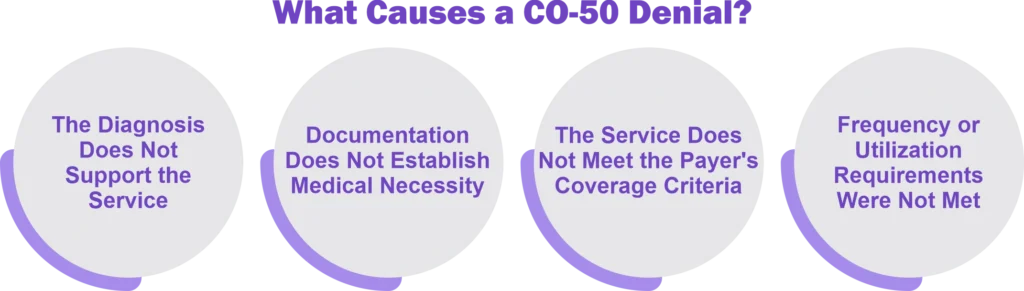
The Diagnosis Does Not Support the Service
A diagnosis reported on the claim may not establish the clinical reason for the service under the payer’s coverage policy.
For example, a procedure may be appropriate for a particular condition, but the diagnosis submitted on the claim may not meet the policy’s requirements. In other cases, the diagnosis may have been entered incorrectly or an applicable diagnosis may not have been reported.
The solution is not to select a different diagnosis simply to obtain payment. Compare the claim with the medical record and determine whether the reported diagnosis accurately reflects the patient’s documented condition.
Documentation Does Not Establish Medical Necessity
A service can be clinically appropriate but still be denied when the available documentation does not establish why it was necessary.
Depending on the service and payer, relevant documentation may include clinical findings, symptoms, diagnoses, treatment history, test results, or other information supporting the service.
CMS guidance also demonstrates that documentation issues can be associated with CARC 50. In certain medical review situations, CMS has instructed contractors to use CARC 50 with a RARC identifying missing medical records.
The Service Does Not Meet the Payer’s Coverage Criteria
Medical necessity is determined within the payer’s coverage framework. For Medicare, coverage requirements may be established through sources such as National Coverage Determinations and Local Coverage Determinations. A service can appear clinically reasonable while still failing a specific coverage requirement.
Before appealing a denial code CO-50, identify the policy that applies to the service and compare its requirements with the claim and medical record.
Frequency or Utilization Requirements Were Not Met
Some services have coverage limitations involving frequency, units, timing, or other utilization requirements. If the service exceeds an applicable limitation or does not satisfy a required condition, the payer may determine that the service is not covered.
This is why reviewing the payer’s policy and claim history can be more useful than simply resubmitting the original claim.
CO-50 Denial Code and Action: What Should You Do?
The right CO-50 denial code and action depends on what caused the denial. Do not automatically send the same claim back to the payer. Start by determining what the payer actually communicated.

Step 1: Read the Complete Remittance Advice
Look beyond CARC 50. Review the associated RARC, payer message, denial letter, and claim-level information. A RARC or payer message may provide the additional detail needed to identify the next step.
Step 2: Review the Claim
Check the procedure or service code, diagnosis codes, modifiers, units, dates of service, and other relevant claim information. The goal is to determine whether the submitted claim accurately represents the service documented in the medical record.
Step 3: Review the Medical Record
Confirm that the documentation supports the service and establishes the patient’s clinical circumstances. If the payer’s denial relates to medical necessity, the record should provide evidence that can be connected to the applicable coverage requirement.
Step 4: Check the Payer’s Policy
Identify the coverage policy applicable to the service. For Medicare claims, the Medicare Coverage Database can help identify applicable coverage policies. Commercial payers may have their own medical policies and utilization criteria.
Step 5: Choose the Correct Resolution
Once the cause is established, determine whether the claim needs:
- A correction
- Additional documentation
- A reconsideration or appeal
- No further action because the service does not meet the applicable coverage requirements
This decision is more effective than treating every CO-50 denial as an appeal.
How to Fix a CO-50 Denial
The best CO-50 denial code solution depends on the underlying problem.
Correct an Inaccurate Claim
If the claim contains inaccurate information and the medical record supports the service, follow the payer’s process for correcting the claim. For example, if the submitted diagnosis does not accurately represent the documented condition, the claim may need to be corrected according to payer requirements.
The correction must reflect the medical record. A diagnosis should never be changed simply because another diagnosis is more likely to produce payment.
When recurring coding or documentation issues are contributing to denials, a structured review can identify problems before they affect additional claims. Health Med Affairs provides medical billing and coding audit services designed to identify billing and documentation issues that can affect reimbursement and compliance.
Provide Requested Documentation
If the payer indicates that supporting documentation is missing or insufficient, determine exactly what the payer requires. Send relevant records that address the denial rather than overwhelming the payer with unrelated documentation.
The documentation should make it easier for the reviewer to understand the patient’s condition, the service performed, and the clinical rationale for the service.
Appeal the Denial When the Record Supports Coverage
An appeal may be appropriate when the claim was submitted accurately and the available evidence demonstrates that the service satisfies the applicable coverage requirements. A strong appeal should connect three things:
The patient’s clinical circumstances → the payer’s coverage criteria → the supporting documentation.
CO-50 Denial Code Appeal Process
The CO-50 denial code appeal process varies by payer, so always follow the instructions and deadline stated in the denial notice. For Original Medicare, the first level of appeal is a redetermination by the Medicare Administrative Contractor (MAC). CMS states that a party has 120 days from receipt of the initial determination to request a redetermination.
What Should a CO-50 Appeal Include?
A practical appeal package may include:
- Patient and claim information
- Date of service and denied service
- The CO-50 denial information
- The applicable coverage requirement
- A concise clinical explanation
- Relevant medical records
- Diagnostic findings or treatment history when applicable
- A clear explanation connecting the evidence to the coverage criteria
- A specific request for reconsideration
The strongest argument is usually the simplest: show what requirement the payer applied, explain how the patient met it, and point the reviewer to the evidence.
If your practice is dealing with a high volume of unresolved denials, Health Med Affairs’ denial management services focus on identifying root causes, correcting claim issues, preparing appeals, and following claims through resolution.
How to Avoid CO-50 Denials
Preventing recurring CO-50 denial code problems requires more than fixing individual claims after payment is denied.
Verify Coverage Requirements Before Billing
For services subject to medical necessity criteria, review the applicable payer policy before the claim is submitted. For Medicare, check whether an NCD, LCD, or other applicable coverage guidance affects the service.
Strengthen Documentation
Documentation should accurately describe the patient’s condition, clinical findings, and reason for the service. The record should reflect the care that was actually provided. It should not be altered simply to satisfy a payer’s requirements after a denial occurs.
Check Diagnosis and Procedure Alignment
Before submission, confirm that the diagnosis codes accurately represent the patient’s documented condition and appropriately support the service under the applicable payer policy.
Analyze Recurring CO-50 Denials
A single CO-50 denial may be isolated. Repeated denials involving the same payer, provider, procedure, or diagnosis can point to a process problem. Track recurring patterns and investigate their root causes.
CO-50 vs. Corrected Claim vs. Appeal
Not every CO-50 denial requires an appeal.
| Finding | Most appropriate direction |
| Claim information is inaccurate | Correct the claim according to payer rules |
| Relevant documentation was requested or missing | Provide the required documentation when permitted |
| Claim is accurate and coverage criteria are satisfied | Consider an appeal |
| Service does not meet applicable coverage requirements | Review the denial and determine whether further action is warranted |
| Denial reason is unclear | Review the RARC, payer instructions, policy, and claim before acting |
The key distinction is simple:
A corrected claim fixes inaccurate claim information. An appeal challenges the payer’s determination.
Can a CO-50 Denial Be Billed to the Patient?
A provider should not automatically transfer a CO-50 balance to the patient. For Medicare, CMS explains that the Group Code identifies financial responsibility. CO indicates contractual obligation assigned to the provider, while PR indicates patient responsibility. CMS also states that Medicare beneficiaries may be billed when Group Code PR is used with an adjustment.
Patient billing can also depend on applicable Medicare requirements, including rules concerning an Advance Beneficiary Notice in circumstances where Medicare is expected to deny a service as not reasonable and necessary.
Therefore, review the complete remittance advice and applicable payer requirements before assigning a denied amount to the patient.
CO-50 Denial Code Example
Consider a patient who receives a diagnostic service because of persistent clinical symptoms. The provider’s medical record documents the patient’s condition and the reason for the service. However, the claim is submitted with diagnosis information that does not satisfy the payer’s applicable coverage criteria. The payer returns the claim with CO-50.
The billing team should not immediately send the same claim again. First, compare the submitted diagnosis with the medical record. Then review the payer’s coverage requirements. If the claim contains inaccurate information, the appropriate response may be a corrected claim.
If the claim accurately reflects the record and the patient’s circumstances satisfy the payer’s requirements, an appeal may be appropriate. The appeal should explain how the documentation meets the applicable criteria.
The important question is not:
“How do we get CO-50 paid?”
It is:
“What requirement did the payer determine was not met, and does the claim record demonstrate that the requirement was actually satisfied?”
That question leads the billing team toward the appropriate resolution instead of another unnecessary resubmission.
Final Takeaway
The CO-50 denial code indicates that the payer determined the service was not covered because it was not deemed medically necessary. However, CARC 50 alone does not always explain the complete reason for the denial.
Start with the full remittance advice, including any RARC or payer message. Then review the claim, medical record, and applicable coverage policy.
From there, determine whether the appropriate response is to correct the claim, provide documentation, appeal the determination, or take no further action.
For recurring CO-50 denials, look beyond individual claims. Tracking patterns in coding, documentation, payer policies, and billing workflows can help identify the underlying problem and prevent the same denial from continuing to affect revenue.
Frequently Asked Questions
What does CO-50 mean in medical billing?
CO-50 means the payer determined that the service was not covered because it was not considered medically necessary. CO is the Claim Adjustment Group Code, while 50 is CARC 50, the Claim Adjustment Reason Code.
What is the reason for code 50?
CARC 50 indicates that the service is not covered because the payer does not deem it medically necessary. The specific reason behind an individual denial should be investigated using the accompanying remittance information, payer policy, and claim documentation.
Is CO-50 always caused by incorrect coding?
No. A CO-50 denial can involve coverage criteria, documentation, coding, medical necessity, utilization requirements, or other payer-specific conditions. The denial should be investigated before deciding how to correct it.
What is the best CO-50 denial code solution?
There is no single solution for every CO-50 denial. Review the remittance advice, claim, medical record, and payer policy first. Then determine whether a corrected claim, additional documentation, or appeal is appropriate.
Can Medicare CO-50 denials be appealed?
Yes. Original Medicare has a formal appeals process. The first level is a redetermination by the Medicare Administrative Contractor. CMS states that the request generally must be filed within 120 days from receipt of the initial determination.
Should a CO-50 claim be corrected or appealed?
It depends on the cause. If the claim contains inaccurate information, a corrected claim may be appropriate. If the claim is accurate and the medical record supports the payer’s coverage requirements, an appeal may be appropriate.