
Make Every 1% Improvement in Collections Count
In Utah, even a 1% collections gap can mean thousands in revenue left behind. Health Med Affairs helps independent providers, specialty groups, and growing practices tighten every stage of their revenue cycle. From cleaner claims to aggressive denial and A/R follow-up, we turn billing friction into stronger cash flow. Keep treating Utah patients while we make every collectible dollar count.















Utah practices can encounter different billing pathways across traditional Medicaid, Accountable Care Organizations, Healthy U, Molina, Select Health Community Care, and other coverage arrangements. Eligibility, plan enrollment, authorization, and billing requirements can vary, making medical billing and coding in Utah especially unforgiving when the wrong payer pathway is followed.
Utah Medicaid specifically instructs providers to verify eligibility and the member’s health-plan enrollment before providing services, while certain services require prior authorization. For practices already balancing patient volume and lean administrative teams, one missed payer-specific requirement can create rework, delayed reimbursement, and preventable A/R.

Health Med Affairs builds medical billing in Utah around the payer attached to each patient, not a one-size-fits-all workflow. Our team handles eligibility checks, payer-specific claim preparation, coding review, authorization-related billing checks, denial resolution, payment posting, and A/R follow-up, helping Utah physicians, specialty groups, and practices move claims toward payment with fewer administrative detours. Your team stays focused on care while we keep the right claim moving through the right Utah payer channel.
Health Med Affairs brings payer-aware billing support to Utah physicians, specialty groups, independent clinics, and expanding practices. Every workflow is built to catch revenue obstacles earlier and move each account from patient intake to final reimbursement.
Coverage and plan enrollment are verified before claims move forward, reducing avoidable payer-routing and eligibility problems.
Utah Medicaid claims are handled with attention to PRISM-related enrollment, submission, and reimbursement requirements.
Claims are routed according to the patient's applicable Medicaid coverage and managed-care arrangement to prevent unnecessary payment detours.
Authorization details are checked against the service and payer requirements before they become expensive post-claim problems.
Documentation, CPT, HCPCS, ICD-10-CM, and modifier selection are aligned with the services Utah specialists actually provide.
Denials are investigated by root cause, corrected quickly, and tracked to uncover recurring issues affecting practice collections.
Aging accounts are segmented and pursued according to payer status, claim history, and outstanding action rather than sitting untouched.
Payments, adjustments, underpayments, and remaining balances are reviewed so Utah practices can see what was billed, paid, and still collectible.

Stop letting payer complexity, aging A/R, and preventable billing gaps decide how much revenue reaches your practice. Put Health Med Affairs behind your revenue cycle and start turning more billable care into collected revenue.

A multi-provider clinic along the Wasatch Front does not operate like an independent practice serving a smaller Utah community, and its revenue cycle should not be treated like one.
Health Med Affairs supports physicians, specialty groups, clinics, and growing healthcare organizations across Salt Lake City, Provo, Ogden, Orem, St. George, Logan, Layton, and surrounding Utah communities with billing workflows shaped around their specialty, size, locations, patient mix, and operational structure.
From high-volume urban practices to providers serving rural communities, the goal stays focused: capture the revenue behind every properly billable patient encounter without adding more administrative pressure to the practice.
Confirm applicable enrollment and billing setup
Review location-specific provider
information
Connect rendering and billing relationships correctly
Prepare payer and claim workflows for smooth billing operations
Help establish the payment workflow for timely payment processing
Get claims moving without preventable setup delays
A new physician or office can start generating appointments immediately, but that does not automatically mean every service is ready to be billed. For Utah Medicaid, enrollment is handled through PRISM, and Utah’s provider directory notes that Medicaid agreements are location-specific. Before the first patient hits the schedule, Health Med Affairs helps align:
Grow the practice first. Don’t let billing readiness become the bottleneck.
| What Needs Attention | What Health Med Affairs Checks |
|---|---|
| Rendering provider | Correct clinician attached to the service |
| Provider associations | Billing and rendering relationships aligned |
| Provider type | Setup matches applicable service requirements |
| Service location | Claim reflects the appropriate practice location |
| Claim details | Provider data carries through accurately |
Your group may be enrolled. Your billing provider may be correct. But what about the clinician who actually performed the service?
Utah Medicaid’s PRISM guidance describes claim edits involving the servicing/rendering provider and whether that provider is authorized to perform the billed service. That makes individual provider setup an important part of protecting reimbursement within group practices.
One overlooked provider-level detail can hold up an otherwise billable encounter.
Managing multiple clinics often creates isolated billing stories. HealthMed Affairs brings them together into a single, actionable dashboard.
Collections moving, but A/R climbing?
Strong volume, but unresolved balances growing?
More denials appearing after expansion?
Revenue increasing at the same pace as visits?
Health Med Affairs brings those separate billing stories into one measurable revenue picture. Practice leadership can track collections, aging A/R, outstanding claims, denial patterns, payment activity, and provider performance across locations instead of relying on one blended number that hides where revenue is getting stuck. See which locations generate revenue and which need attention.

Utah Medicaid provides a Coverage and Reimbursement Code Lookup that allows coverage and reimbursement information to be reviewed by procedure code. The state also notes that the lookup does not replace additional requirements contained in provider manuals and other Medicaid resources.
That is why the billing process cannot stop at asking, “Is this patient eligible?” Health Med Affairs helps connect eligibility, service information, coding, applicable authorization requirements, provider details, and claim preparation so potential reimbursement problems can be identified earlier rather than discovered after care has already been delivered.
A covered patient does not automatically mean every service is payable.
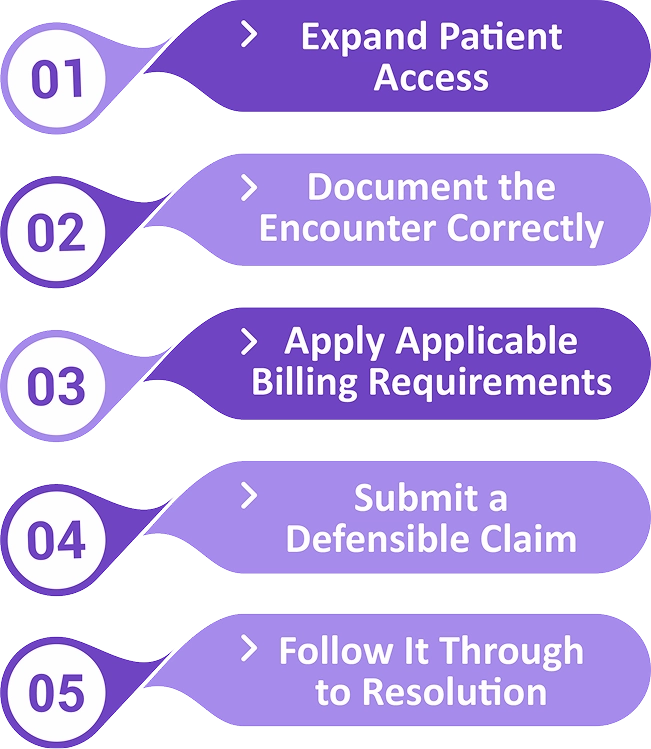
Utah Medicaid’s provider directory allows members to identify providers offering telehealth services, reflecting virtual care as part of the state’s care-delivery landscape. For practices delivering virtual care, Health Med Affairs reviews the billing details surrounding the encounter, including coverage, service eligibility, coding, place-of-service information, applicable modifiers, rendering-provider information, documentation, and payer requirements.
Telehealth should extend your reach across Utah, not extend your unpaid A/R.
Specialty billing should start with the clinical service, not a generic claim template. HealthMed Affairs adapts billing workflows around documentation, procedures, coding patterns, and reimbursement challenges.
High-volume visits, preventive services, chronic-care billing, and recurring patient eligibility require consistency without slowing claim flow.
Service type, documentation, benefits, authorization requirements, and behavioral-health arrangements demand closer attention throughout the claim lifecycle.
Procedures, imaging, injections, modifiers, and authorization-sensitive services create multiple points where reimbursement can break down.
Diagnostic testing, procedures, professional services, and coding combinations require accurate translation from documentation to claim.
Maternity care, global services, procedures, and changing patient coverage create a revenue cycle that needs encounter-level attention.
High patient turnover makes real-time eligibility, accurate coding, and rapid claim preparation critical to protecting collections.
Different clinicians, services, locations, and billing rules require one coordinated revenue workflow without treating every department the same.
HealthMed Affairs helps practices navigate the billing distinctions surrounding behavioral services while keeping documentation and claim requirements aligned.
| In-House Consideration | Outsourced With Health Med Affairs |
|---|---|
| Recruiting experienced billing staff | Dedicated billing resources without building another department |
| Training around changing workflows | Ongoing billing expertise built into service |
| Coverage during absences or turnover | Continuity beyond one employee |
| Internal denial workload | Dedicated denial investigation and follow-up |
| Aging A/R competing with daily claims | Separate attention for current and older balances |
| Managing billing performance internally | Reporting that exposes revenue-cycle movement |
| Scaling when providers are added | Billing support that grows with the practice |
| Multiple administrative responsibilities | Focused RCM accountability |
The question is not simply “Which costs less?” It is whether your current billing model gives the practice enough capacity to protect its revenue.
For some Utah practices, keeping billing in-house makes operational sense. For others, growth, staff turnover, specialty complexity, or increasing A/R makes outsourcing worth evaluating.Health Med Affairs can assess the current workflow and show where outsourced support could remove pressure without forcing the practice into a one-size-fits-all model.
No mystery handoff. No disappearing after onboarding. A defined path from transition to revenue-cycle control.
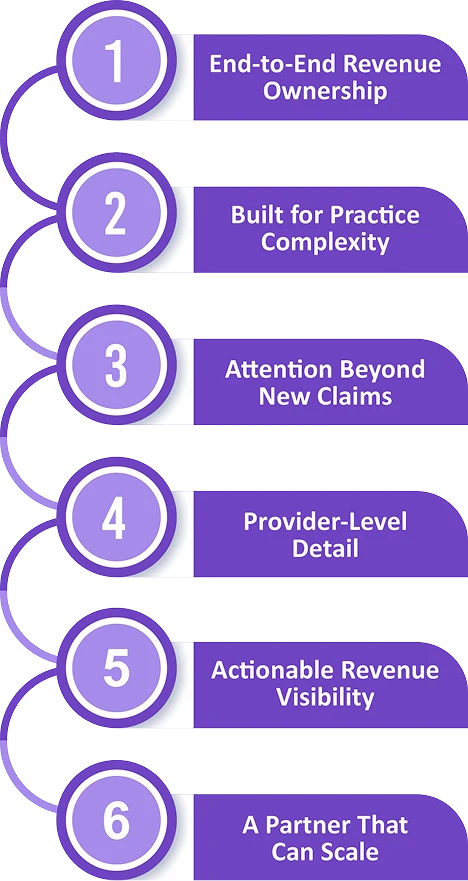
Because “claims submitted” isn’t the result you’re paying for!
Support extends from front-end billing checks through claims, payments, denials, and A/R follow-up.
Independent physicians, specialty groups, multi-provider organizations, and multi-location practices receive workflows matched to how they operate.
Older A/R and unresolved balances receive attention instead of being forgotten while today's claims pile up.
Rendering providers, locations, coding, documentation, and claim information are reviewed as connected parts of reimbursement.
Reporting helps leadership understand what was billed, what was collected, what remains outstanding, and where intervention is needed.
Adding providers, specialties, or Utah locations does not have to mean rebuilding the billing operation from scratch.
Health Med Affairs is not here just to process your billing. The goal is to help turn the care your practice delivers into revenue your business can actually use.
Every unresolved claim, aging balance, billing gap, and overlooked account puts distance between care delivered and cash collected. Put Health Med Affairs behind your Utah revenue cycle and discover where money is getting stuck, what needs fixing, and how your billing can work harder for the practice.