
The CO-119 denial code means the patient has used up the benefit maximum for that service for the time period or occurrence. In other words, the payer will not pay the line, and because the group code is CO, you cannot bill the patient either. Billers see it most often on therapy and durable medical equipment (DME) claims.
Quick answer: CO-119 means “benefit maximum for this time period or occurrence has been reached.” First read the remark codes, then check usage in the payer portal. Appeal if the payer miscounted or ignored a valid KX modifier, bill any secondary payer if the limit is real, and write off what remains. Never bill the patient under a CO code.
The balance stays with the provider unless something changes it. So the order of your next steps matters: appeal, secondary claim, or write-off. Our denial management services work these steps every day, and this guide explains each one.
What the CO-119 Denial Code Says
CARC 119 is part of the Claim Adjustment Reason Code list that payers use on the 835 remittance. The official wording is short: “Benefit maximum for this time period or occurrence has been reached.” Put simply, the patient used up a cap, and this claim arrived after it.
Also note that the CO-119 denial code is a line-level adjustment. It attaches only to the procedure that crossed the limit. As a result, the same remittance often pays other lines in full right next to the denied one, which shows you exactly which service drained the benefit.
CO-119 vs Codes That Look Similar
Reason 119 can appear under more than one group code. However, each version sends the money to a different place.
| Code | What It Says | Who Owes the Balance |
|---|---|---|
| CO-119 | Benefit maximum for the period or occurrence reached | Provider, under the contract |
| PR-119 | Same reason under patient responsibility | Patient |
| CO-97 | Benefit included in payment for another service | Provider, bundled |
| CO-50 | Service not deemed medically necessary | Provider, unless PR-50 applies |
The prefix decides everything. A CO-119 denial code stays with the provider. PR-119, by contrast, moves the balance to the patient because the plan limit was met. Medicare’s guidance on remittance advice group codes explains that you can bill beneficiaries only under PR. So if you read the prefix wrong, you either write off money a patient owed or send a bill Medicare does not allow.
Remark Codes That Travel With the CO-119 Denial Code
CARC 119 rarely arrives alone. Instead, the remark codes beside it narrow down the problem:
- M86: “Service denied because payment already made for same/similar procedure within set time frame.” With M86, the payer is usually pointing at a frequency or duplicate issue, not a dollar cap.
- N435: the service exceeds the number or frequency allowed within the time period without supporting documentation.
- N130: consult plan benefit documents for restrictions on this service.
Read the remarks before you appeal anything. Otherwise, you may spend a week appealing a valid cap that no appeal can overturn.
What Causes the CO-119 Denial Code
In almost every case, the cause behind a CO-119 denial code is benefit exhaustion. The real question is what used the benefit up.
1. Plan Visit Caps
Many commercial plans cap physical, occupational, and speech therapy visits per year. Once the count runs out, the next claim denies. For therapy practices, unit counting matters too, so our guide to the 8-minute rule for therapy units is worth a review.
2. Medicare Therapy Threshold and the KX Modifier
Medicare keeps paying outpatient therapy above an annual threshold, but only when the claim carries the KX modifier with documentation behind it. For 2026, the threshold is $2,480 for physical therapy and speech-language pathology combined. A separate $2,480 threshold applies to occupational therapy for 2026. In addition, targeted medical review can begin at $3,000. CMS updates these amounts each year, so confirm the current figure before you bill.
If a claim crosses the threshold without KX, it denies automatically. Therefore, a missing modifier is the most common Medicare trigger for this denial, and also the easiest to fix.
3. DME Replacement Schedules
Durable medical equipment follows replacement rules instead. Medicare and most private payers apply a reasonable useful lifetime (RUL) to items such as wheelchairs, walkers, and CPAP machines. If you replace an item too early, the claim denies, unless the record documents loss, theft, or irreparable damage with the right modifier, or a change in the patient’s condition.
4. Front-End and Process Gaps
Other triggers come from workflow gaps rather than true caps:
- Another provider already used the same benefit bucket.
- The claim went out without a required prior authorization.
- A coding error made a new service look like a repeat.
- The payer simply miscounted units or used the wrong window.
That last case is the one an appeal usually wins.
How to Fix the CO-119 Denial Code
Any fix for the CO-119 denial code starts with the remittance, not the phone.
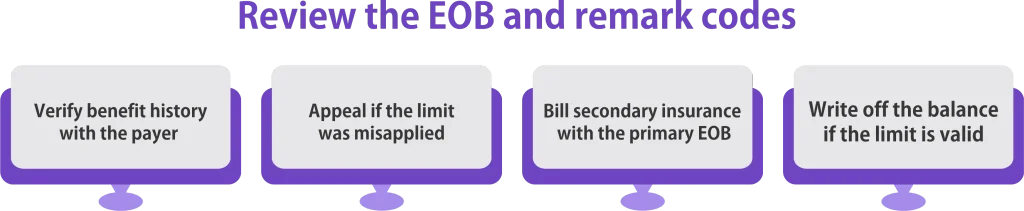
Medicare’s DME contractor guidance on Reason Code 119 also lists redetermination with documentation as the appeal path. Commercial payers follow a similar pattern. In short, appeals without evidence fail, while appeals with usage records often recover real money.
First Actions by Situation
| Situation | First Action | If That Does Not Work |
|---|---|---|
| Payer miscounted units or visits remain | Appeal with usage records and portal history | Escalate through redetermination with documentation |
| Medicare therapy above the threshold without KX | Add the modifier and resubmit with medical necessity notes | Appeal if the notes were already complete |
| Early DME replacement after a change in condition | Submit records of the change and any ABN obtained | Appeal with the full medical record |
| Valid exhaustion with secondary coverage | Bill the secondary payer with the primary EOB | Track the secondary claim to payment |
| Valid exhaustion with no secondary coverage | Write off the balance per the payer contract | Document the adjustment for audit |
Rebilling a CO-119 denial code balance to the patient turns a contract problem into a compliance problem. So keep those balances off patient statements.
How to Prevent the CO-119 Denial Code
Prevention beats an appeal every time. First, verify benefits and remaining visits before the first appointment. Our guide to ways to verify patient eligibility covers the options. Next, track utilization as it builds and set an alert at about three quarters of the known cap.
In addition, pair the KX modifier with progress notes whenever a Medicare therapy claim nears the threshold. Finally, review repeat denials by payer each month. Most benefit-limit denials turn out to be front-end problems, and disciplined medical billing and coding catches them before the claim goes out.
Bottom Line on the CO-119 Denial Code
This code tells you exactly where you stand: the benefit is gone, the balance is on the provider, and the patient is off limits. Read the remarks first, verify usage, appeal only with evidence, and push valid exhaustion to a secondary payer when one exists.
Frequently Asked Questions
What does the CO-119 denial code mean?
The patient’s benefit maximum for that service has been reached within the current time period. The CO prefix makes the balance a contractual obligation, so the provider writes it off rather than billing the patient.
Can a patient be billed under CO-119?
No. The adjusted amount stays with the provider. PR-119 is the patient-billable version of the same number.
What is remark code M86?
A Remittance Advice Remark Code stating payment was already made for the same or a similar procedure within the set time frame. Beside CO-119 it usually signals a frequency or duplicate-service issue, not a plain dollar cap.
What does denial code 119 mean on Medicare?
Medicare applies Reason Code 119 when a benefit maximum has been reached, most often in outpatient therapy and DME. Therapy above the threshold for 2026 ($2,480 for PT and SLP combined, $2,480 for OT) needs the KX modifier plus supporting documentation, and DME claims face Reasonable Useful Lifetime replacement limits.
Is CO-119 the same as PR-119?
Same number, different money. CO-119 writes the balance off under the payer contract. PR-119 sends it to the patient.