Two weeks after the visit, the remittance comes back: coverage ended the day before the appointment. The patient said the insurance was good, and maybe someone even checked it in September, before the plan lapsed. Now the service is done, and the balance is aging against a payer that never owed it. Knowing how to verify patient eligibility, and doing it on a schedule, prevents this denial for the cost of a few minutes. In practice, the offices with clean front-end numbers do not own the most software. Instead, they run the check at named points and never let it drift into whatever the front desk can fit between phone calls.
Quick answer: You can verify patient eligibility three ways: the payer’s online portal, a phone call to the payer, and the HIPAA-standard 270/271 electronic transaction. Most practices use them as layers. The 270/271 batch handles the volume, while portals and phone calls handle the exceptions.
How to verify patient eligibility, step by step
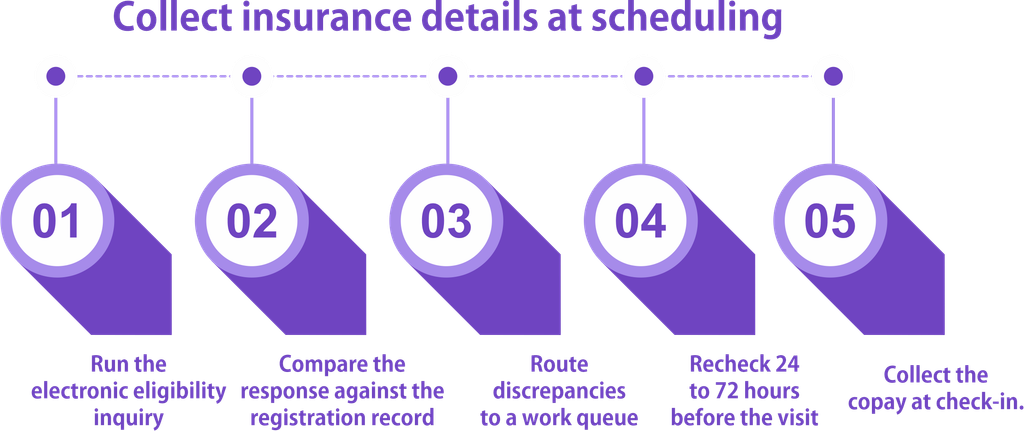
Step 1: Capture the card details at scheduling
The first chance to verify patient eligibility comes at scheduling, so treat the card as data, not paperwork. The name must match the payer’s file exactly, because a nickname that never reached the carrier reads as a different person. Collect:
- Full legal name, exactly as the payer has it
- Date of birth
- Member ID and group number
- Images of both sides of the card for the file
Don’t skip this: Ask the question most offices skip: whose policy is this? A dependent booked under the wrong subscriber looks fine on paper but fails at the payer. As a result, the front desk is the last person who can fix it before the visit.
Step 2: Run the inquiry and compare the response
Next, run the inquiry and compare the response, field by field, with what registration recorded. Active coverage on the date of service comes first, but it is only the first line. Also confirm each of these:
- Plan product: an HMO, a PPO, a Medicare Advantage plan and a Medicaid managed care plan can carry different rules under one brand name.
- Network participation for the rendering provider and the service location.
- Patient cost share: the copay, the remaining deductible and the coinsurance percentage.
- Referral and prior authorization requirements.
- Coordination-of-benefits order when a patient holds two policies.
Step 3: Record the result and route the exceptions
Finally, record the result and route the exceptions. The verification date, the method used, the payer’s reference or trace number and any follow-up item go into the patient’s record. Anything that does not match, such as a termed policy, an old member ID or an authorization flag, moves to a work queue. That queue needs a named owner, and the team should clear it before the patient arrives.
Method one: verify eligibility in the payer portal
For one patient and one question, the carrier’s portal is the fastest way to verify patient eligibility. On the better sites, a member search returns the copay, the deductible remainder and out-of-pocket totals. That is exactly the data the front desk needs to quote a payment. However, the trouble starts with the second payer, and the third. Logins pile up, one per carrier, and the sites disagree about what to show. Some list balances down to the cent, while others only confirm that the card is real.
Method two: verify eligibility by phone
Then there is the phone, the method printed on the back of every card. It still has value, because a person can sort out what no form field captures. For example, two carriers may dispute which one is primary, a behavioral health benefit may sit with a separate administrator, or a secondary plan may carry its own deductible. The cost is staff time. A question answered in forty seconds online can take half a workday on hold.
Pro tip: The call reference number separates a useful call from a wasted one. Write it down next to the date and the representative’s name. Then, if the payer later denies what the call confirmed, the practice has a record.
Method three: the 270/271 eligibility transaction
The 270/271 pair is the HIPAA-standard electronic way to verify patient eligibility, and most automated checking runs on it.
- The 270 is the inquiry a practice sends. It carries the patient’s demographics, the subscriber ID, the provider’s NPI and tax ID, and a service type code for the category of care.
- The 271 is the payer’s structured response. A good one returns coverage status, copay, coinsurance, remaining deductible and authorization flags within seconds.
What makes this method scale is the batch run. A practice management system or clearinghouse can send a 270 for every patient on tomorrow’s schedule overnight. In the morning, the front desk gets a short exception list. For Medicare, CMS runs its own channel, the HIPAA Eligibility Transaction System, which accepts the same transaction pair. In addition, CAQH operating rules set what a usable response must contain. Even so, payers differ in how much detail they return, so a thin 271 still ends in a phone call.
Where practices get hurt is treating the 271 as more than it is. The transaction shows that the patient was enrolled on that date. However, it says nothing about whether this specific service is covered, subject to medical policy, or waiting on an authorization nobody requested.
Key point: Coverage confirmed is not payment promised. Practices that learn this once tend to teach it to every new hire: eligibility is step one, never the whole gate.
Patient eligibility verification methods at a glance
| Method | Best for | Watch for |
|---|---|---|
| Payer portal | One patient, one question | One login per carrier; detail varies by site |
| Phone call | Coordination-of-benefits puzzles | Hours on hold; always get a call reference number |
| 270/271 batch | Whole schedules overnight | Confirms enrollment, not service coverage |
What can be used to verify company information?
Sometimes the mystery party is not the patient but the payer. Third-party administrator logos, employer plans that switched carriers mid-year and merged insurers all leave the billing office asking who actually processes the claim. The answer chain runs like this:
- The card itself, the starting point.
- The clearinghouse’s payer lookup, which lists each company’s electronic payer ID, whether claims need enrollment first, and where paper claims go.
- Payer provider manuals, which fill in the fine print on filing deadlines and appeals.
- State insurance departments, which keep public registers that show whether a carrier is licensed in the state.
Watch out: A payer ID error does something worse than cause a denial. It causes a rejection, so the claim bounces before adjudication and never appears on a denial report. The only signal is a payment that never arrives.
Eligibility verification versus benefits verification
The two terms often get used as if they were the same, but they are different checks:
| Check | Eligibility verification | Benefits verification |
|---|---|---|
| Core question | Is coverage active on the date of service? | What does the plan pay for this specific service? |
| What it confirms | Active coverage and the provider’s network participation | Copay, remaining deductible, coinsurance split, visit limits and exclusions |
| Authorizations | Not covered by this check | Whether a referral or authorization is required |
| Denial risk if skipped | Claims for patients with lapsed or wrong coverage | Excluded services, spent frequency limits, missing authorizations |
A patient can pass the first check and still trigger a denial. For example, the service may be excluded, the frequency limit may be spent, or nobody obtained the authorization. So both checks belong in the same workflow. In fact, mature front offices treat them as one task with two outputs, often under a single verification of benefits (VOB) step.
When to verify patient eligibility
First, verify patient eligibility at booking, because whatever the check finds has weeks to cure. Next, run a batch pass on the whole schedule two to five business days out. Finally, treat check-in as the last gate. On top of that, some churn never follows your calendar:
- Medicaid coverage can change from month to month, and rules taking effect in 2027 move many expansion adults to six-month renewals.
- Every January 1 resets calendar-year plans, including deductibles.
- Job changes rewrite employer coverage whenever they happen, not when it suits the schedule.
A card verified in December is a December fact. Treating it as a February fact is how offices end up holding balances nobody owes.
The verification schedule
Here is a simple calendar to verify patient eligibility without overloading the front desk:
| When | What runs | Why it matters |
|---|---|---|
| At booking | Portal or 270/271, manually | Problems found here have weeks to cure |
| 2 to 5 business days out | Batch 270/271 on the full schedule | Catches lapses after booking |
| Day before and morning of | Recheck Medicaid and high-churn plans | Medicaid coverage can change month to month |
| At check-in | Card on file vs payer response | The final gate before the copay |
Why the check pays for itself
The math is simple. A check before the visit costs minutes, while a denial after the visit costs rework, delay and sometimes the whole balance:
On top of that, a patient who never saw the bill coming is harder to collect from, in ways no report captures. Because of this, practices that keep the routine running see fewer front-end denials, collect copays at the window and give patients estimates they can trust. If your team cannot keep up, a dedicated billing virtual assistant can run the daily checks and work the exception queue.
The bottom line
So what methods can be used to verify patient eligibility? In practice, there are three, and they work as layers rather than rivals. The electronic transaction does the volume, the portal and the phone call handle the exceptions, and the schedule tells each layer when to run. When these checks are part of a full medical billing and coding service, every claim starts from confirmed coverage. And if coverage was confirmed but a claim still failed, read why verified claims still get denied.
Frequently Asked Questions
What is patient eligibility verification?
It is the front-end check that confirms a patient’s insurance is active for the date of service, that the provider participates in the plan’s network, and that the visit meets any referral or authorization requirement. Run before the service, it prevents the denial. Run after, it only documents it.
What are the main methods used to verify patient eligibility?
Three. The payer’s online portal handles one patient and one question. A phone call resolves what no form field captures, like two carriers fighting over which is primary. The 270/271 electronic transaction does the volume, checking an entire schedule overnight in a batch.
What is a 270/271 transaction?
A HIPAA-standard electronic pair. The 270 is the inquiry your practice sends, carrying demographics, subscriber ID, and the provider’s NPI. The 271 is the payer’s structured response, returning coverage status, copay, coinsurance, and remaining deductible within seconds. Medicare runs the same pair through its own channel, HETS.
How far in advance should eligibility be verified?
Three checkpoints. At booking, because problems found there have weeks to cure. Two to five business days out, when a batch pass covers the whole coming schedule. And at check-in, the final gate, where the card on file gets compared against the payer’s latest response.
What is the difference between eligibility verification and benefits verification?
Eligibility confirms active coverage and network participation. Benefits verification goes further and asks what the plan pays for the specific service: copay, remaining deductible, coinsurance split, visit limits, exclusions, and authorization requirements. A patient can pass the first check and still generate a denial.
What happens if eligibility is not verified?
The service goes out the door against coverage that may have lapsed, and the denial lands with no good option. Either the balance ages against a payer who was never responsible, or it turns into a patient conversation nobody wants. Eligibility and registration problems rank among the most common causes of denials in industry survey data.