
In the healthcare industry, understanding credentialing vs contracting is essential for maintaining steady reimbursements, reducing claim denials, and ensuring smooth payer relationships. Although these terms are often used interchangeably, they are two completely different processes that directly impact a provider’s ability to get paid by insurance companies.
For healthcare practices, hospitals, and medical groups, confusion between credentialing and contracting can lead to delayed payments, denied claims, compliance risks, and revenue cycle disruptions.
In this guide, Health Med Affairs explains the key differences between credentialing and contracting, how both processes work, why they matter for medical billing, and how providers can avoid costly mistakes.
What Is Credentialing?
Provider credentialing is the process of verifying a healthcare provider’s qualifications, education, licenses, certifications, training, and professional history.
Insurance companies, hospitals, and healthcare organizations use credentialing to confirm that a provider is qualified to deliver patient care safely and legally.
Credentialing typically includes verifying:
- Medical licenses
- Board certifications
- DEA registration
- Work history
- Education and residency
- Malpractice insurance
- Hospital privileges
- Background checks
- NPI information
- CAQH profile data
Without proper credentialing, providers cannot participate in insurance networks or receive reimbursements from payers.
Why Credentialing Matters
Credentialing protects:
- Patients
- Insurance companies
- Healthcare organizations
- Revenue cycle operations
A provider who is not credentialed may face:
- claim denials
- reimbursement delays
- inability to join payer networks
- compliance risks
- revenue loss
For new practices, credentialing is often one of the first and most important administrative processes before seeing patients.
What Is Contracting?
Contracting is the process of establishing a legal and financial agreement between a healthcare provider and an insurance payer.
While credentialing verifies qualifications, contracting determines:
- reimbursement rates
- fee schedules
- payment terms
- network participation
- provider obligations
- payer obligations
A payer contract defines how much the provider will be paid for medical services and under what conditions claims will be reimbursed.
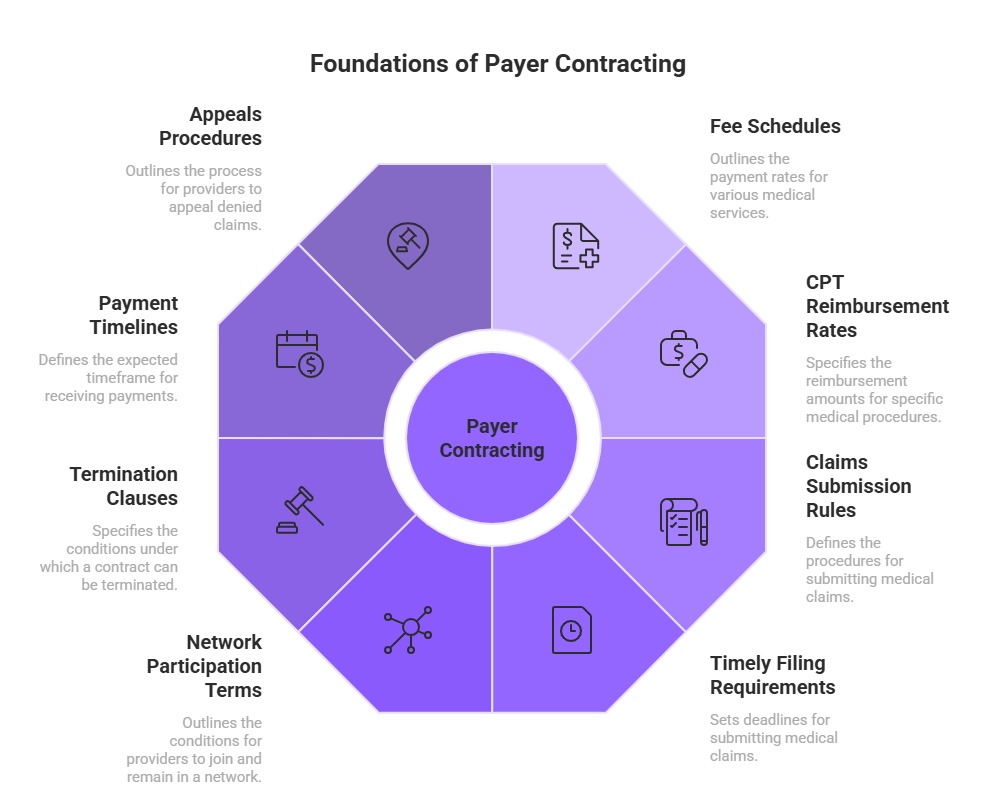
Key Components of Payer Contracting
Healthcare contracting usually includes:
- Fee schedules
- CPT reimbursement rates
- Claims submission rules
- Timely filing requirements
- Network participation terms
- Termination clauses
- Payment timelines
- Appeals procedures
Without contracting, a provider may technically be credentialed but still unable to receive in-network reimbursements.
Credentialing vs Contracting: Quick Answer
The simplest way to understand credentialing vs contracting is this:
- Credentialing verifies that a provider is qualified, while contracting establishes how the provider gets paid.
- Credentialing focuses on compliance and provider verification.
- Contracting focuses on financial agreements and payer reimbursement.
- Both are necessary for successful insurance participation and medical billing operations.
Credentialing vs Contracting: Key Differences
| Credentialing | Contracting |
| Verifies provider qualifications | Establishes payer agreement |
| Focuses on compliance and eligibility | Focuses on reimbursement and payment |
| Includes licenses and certifications | Includes fee schedules and payment terms |
| Conducted by credentialing departments | Conducted by payer contracting teams |
| Required before network participation | Required before in-network billing |
| Involves CAQH and provider verification | Involves negotiation and legal agreements |
| Can take 60–120 days | Can take 30–90 days |
| Ensures provider legitimacy | Ensures financial reimbursement |
Credentialing vs Contracting vs Enrollment
Many healthcare providers also confuse enrollment with credentialing and contracting.
Here’s the difference:
Credentialing
Verifies provider qualifications and background.
Contracting
Establishes reimbursement agreements with payers.
Enrollment
Registers the provider within the payer’s system so claims can be submitted and processed.
These three processes work together to enable providers to participate in insurance networks successfully.
The Step-by-Step Process
Understanding the sequence of credentialing and contracting is critical.
Step 1: Obtain an NPI Number
Providers must first obtain:
- Type 1 NPI (individual provider)
- Type 2 NPI (organization)
Step 2: Complete CAQH Profile
CAQH stores provider credentialing information in one centralized database used by many insurance companies.
Step 3: Submit Credentialing Applications
Payers review:
- licenses
- education
- certifications
- work history
- malpractice coverage
Step 4: Credential Verification
Insurance companies perform primary source verification and background checks.
Step 5: Contract Negotiation
Once credentialing is approved, providers negotiate:
- reimbursement rates
- fee schedules
- participation terms
Step 6: Provider Enrollment
After contracts are finalized, providers are added to payer networks and can begin billing.
Step 7: Claims Submission
Providers can now submit claims for reimbursement as in-network participants.
Why Credentialing Matters in Medical Billing
Credentialing directly affects the revenue cycle.
If credentialing is incomplete or delayed, providers may experience:
- denied claims
- payment delays
- out-of-network billing
- interrupted cash flow
- compliance issues
Many providers lose thousands of dollars due to credentialing backlogs or incomplete applications.
Common Credentialing Delays
Common causes include:
- incomplete CAQH profiles
- expired licenses
- missing documentation
- incorrect provider information
- failure to follow up with payers
Even small errors can delay approvals for weeks or months.
Why Contracting Matters for Reimbursements
Contracting determines how much a provider gets paid.
Poorly negotiated contracts can significantly reduce practice revenue.
Common Contracting Issues
Providers often:
- accept low reimbursement rates
- overlook unfavorable contract clauses
- fail to negotiate fee schedules
- misunderstand payer amendments
Some payer contracts are intentionally complex and difficult to interpret.
Without proper review, providers may unknowingly agree to:
- lower reimbursement rates
- restrictive billing terms
- unfavorable payment timelines
How Long Does Credentialing and Contracting Take?
Timelines vary by payer and specialty.
Average Credentialing Timeline
- 60–120 days
- Sometimes longer for hospitals or government payers
Average Contracting Timeline
- 30–90 days
- Negotiations may extend timelines
Recredentialing
Most payers require recredentialing every 2–3 years.
Failure to recredential on time can lead to:
- network termination
- payment interruptions
- denied claims
Common Mistakes Providers Make
Confusing Credentialing With Contracting
Many providers assume credentialing automatically includes contracting.
It does not.
Both processes must be completed separately.
Seeing Patients Before Enrollment Is Complete
Some providers begin seeing patients before payer enrollment finishes.
This can result in:
- non-payable claims
- reimbursement denials
- financial losses
Incomplete CAQH Profiles
Missing or outdated CAQH information is one of the biggest causes of delays.
Failing to Negotiate Contracts
Accepting the first payer contract offer may reduce long-term profitability.
Missing Recredentialing Deadlines
Expired credentialing can interrupt network participation and revenue flow.
Benefits of Outsourcing Credentialing and Contracting
Managing credentialing and payer contracting internally can be overwhelming for many healthcare practices.
Outsourcing helps providers:
- reduce administrative workload
- accelerate approvals
- minimize claim denials
- improve payer communication
- increase reimbursement accuracy
- avoid costly delays
Professional credentialing specialists understand payer requirements, timelines, and compliance standards.
How Health Med Affairs Helps Providers
At Health Med Affairs, we help healthcare providers streamline credentialing, payer contracting, and medical billing operations.
Our services include:
- provider credentialing
- CAQH enrollment
- payer contracting
- provider enrollment
- medical billing
- revenue cycle management
- denial management
- insurance verification
We work with providers across multiple specialties to improve reimbursements, reduce delays, and strengthen revenue cycle performance.
Our team ensures:
- accurate documentation
- faster approvals
- payer follow-up
- contract review support
- compliance management
Why Credentialing and Contracting Are Critical for Revenue Cycle Success
Credentialing and contracting are not just administrative tasks.
They are revenue-driving processes that directly impact:
- cash flow
- insurance reimbursements
- claim approvals
- patient access
- practice growth
Healthcare providers who properly manage both processes experience:
- fewer claim denials
- faster payments
- stronger payer relationships
- improved operational efficiency
Final Thoughts
Understanding credentialing vs contracting is essential for every healthcare provider, medical practice, and healthcare organization.
Although these processes are closely related, they serve different purposes:
- credentialing verifies qualifications
- contracting establishes reimbursement agreements
Both are critical for successful payer participation, claim reimbursement, and revenue cycle management.
Healthcare providers who properly manage credentialing and contracting can avoid costly delays, improve cash flow, and strengthen long-term financial performance.
If your practice needs support with credentialing, payer contracting, or medical billing services, Health Med Affairs can help simplify the process and optimize your revenue cycle.
Frequently Asked Questions
Is credentialing the same as contracting?
No. Credentialing verifies provider qualifications, while contracting establishes reimbursement agreements with insurance payers.
Which comes first, credentialing or contracting?
Credentialing usually comes first because payers must verify provider qualifications before offering contracts.
Can providers bill insurance before credentialing is complete?
In most cases, no. Claims submitted before credentialing and enrollment approval may be denied.
How long does provider credentialing take?
Credentialing typically takes between 60 and 120 days depending on the payer and provider specialty.
What is CAQH in credentialing?
CAQH is a centralized database that stores provider information used by insurance companies during the credentialing process.
Why is payer contracting important?
Payer contracting determines reimbursement rates, payment terms, and participation in insurance networks.