

ABA therapy billing strategies help behavioral health practices cut claim denials, close authorization gaps, and keep cash flow steady. Applied Behavior Analysis (ABA) billing is not like standard medical billing. It needs precise CPT coding, careful tracking of timed units, payer-specific authorization control, and clinical notes that support every unit. For ABA practice owners, getting these processes right means fewer payment delays, protected revenue, and therapy that is not interrupted by paperwork.
Quick answer: The most effective ABA therapy billing strategies are simple to name: verify benefits and authorization before treatment, code 97151–97158 correctly, bill units from documented time, track authorized units after every session, and audit claims before they go out. Most ABA denials trace back to a gap in one of these five steps.
Key takeaways
- Prevent costly claim denials: Verify eligibility, authorization limits, CPT codes, and documentation before you submit ABA claims.
- Stay ahead of authorization deadlines: Track approved units, end dates, and reauthorization rules so treatment and payment are not disrupted.
- Improve billing accuracy: Follow payer rules for timed CPT codes, overlapping sessions, concurrent care, and provider qualifications.
- Strengthen documentation: Keep session notes, treatment records, and authorization logs that support medical necessity and every billed unit.
- Support practice growth: Specialized ABA billing support reduces admin work and lets clinical teams focus on patient care.
Why Traditional Medical Billing Models Fail for ABA Therapy
Traditional billing systems are built around office visits, procedures, and single encounters. ABA therapy, however, is delivered across many sessions, several providers, and rolling authorization periods. That is why ABA therapy billing strategies have to look different from a general practice workflow.
When ABA clinics rely on conventional workflows, the same problems repeat. Units are counted wrong, authorizations lapse, payments slow down, and avoidable denials pile up.
Timed Units in ABA Therapy Billing
Unlike many standard medical services, most ABA CPT codes are billed in 15-minute units. For example, a 60-minute direct treatment session usually equals four units, depending on payer rules.
Count from documented treatment time, never from the scheduled appointment. Unrecorded breaks and rounding are where this goes wrong.
Errors start when clinics count units from the scheduled appointment instead of the documented treatment time. Unrecorded breaks, wrong rounding, and mismatched session lengths all create discrepancies.
To prevent this, reconcile treatment records with submitted units, and follow each payer’s time-reporting rules.
Overlapping Sessions and Concurrent Billing Conflicts
ABA treatment often involves registered behavior technicians (RBTs), Board Certified Behavior Analysts (BCBAs), and caregivers in related services. However, overlapping appointments do not automatically qualify for separate payment.
For example, CPT guidance allows 97155 to be reported alongside 97153 when the qualified professional directs the technician during the same session. Even so, some insurers restrict or deny that pairing. So practice owners must separate appropriate concurrent services from duplicate billing, and they should check payer policy before claims go out.
Why ABA Reauthorization Deadlines Require Closer Monitoring
Many ABA plans approve treatment for about six months at a time, often tracked as 180-day cycles. Still, actual dates and renewal rules vary by insurer.
If a clinic misses an end date, the payer may refuse to pay for services delivered afterward. A reliable tracking system flags approaching deadlines and monitors remaining units. It also gives clinicians enough time to update assessments and treatment plans.
The goal is simple: stop admin gaps from turning into lost revenue or breaks in patient care.
ABA Therapy Billing Strategies That Reduce Revenue Leakage
Effective ABA therapy billing strategies begin before a claim reaches the payer. In most cases, preventing an error costs far less than fixing a rejected or denied claim later. As a result, a structured revenue cycle improves claim accuracy, steadies payments, and cuts rework.
Verify Benefits and Authorization Before Treatment Begins
Complete patient eligibility checks before scheduling covered ABA services, and repeat them when coverage changes. Your billing team should confirm:
- Active insurance coverage and ABA therapy benefits.
- Prior authorization requirements and approved CPT codes.
- Authorized treatment dates and available units.
- Provider credentialing and network participation.
- Patient responsibility, including deductibles and copayments.
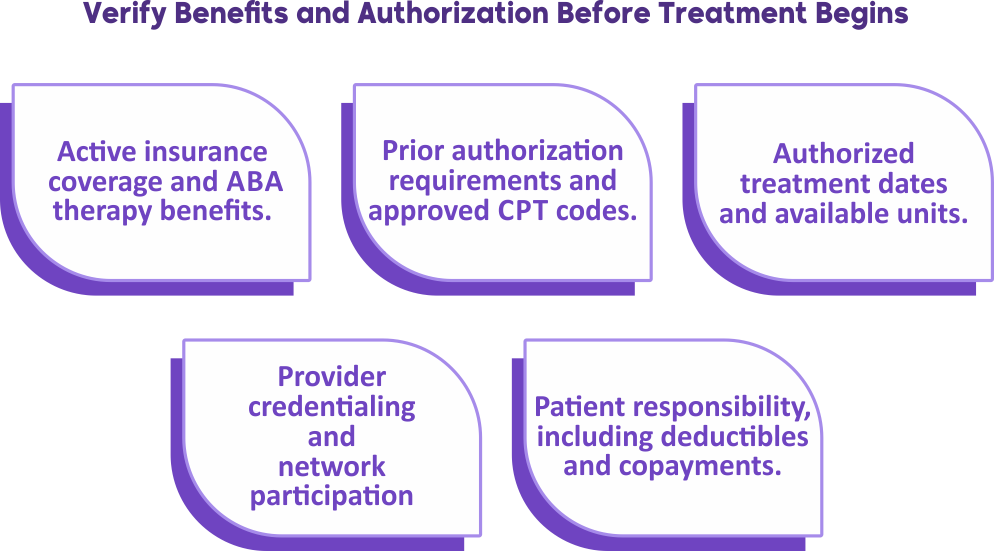
Checking these details early keeps claims from going out for services that are not covered or not authorized. Of all ABA therapy billing strategies, this one prevents the most denials for the least effort.
Apply CPT Codes for ABA Therapy Billing Accurately
Correct CPT selection is the base of clean ABA claims. The adaptive behavior codes in the AMA’s CPT code set include:
| CPT Code | Service Description |
|---|---|
| 97151 | Behavior identification assessment by a qualified healthcare professional |
| 97152 | Behavior identification supporting assessment, administered by a technician |
| 97153 | Individual adaptive behavior treatment by protocol |
| 97154 | Group adaptive behavior treatment by protocol |
| 97155 | Adaptive behavior treatment with protocol modification, administered by a physician or other qualified healthcare professional, face-to-face with one patient, each 15 minutes (may include simultaneous direction of a technician) |
| 97156 | Family adaptive behavior treatment guidance |
| 97157 | Multiple-family group adaptive behavior treatment guidance |
| 97158 | Group adaptive behavior treatment with protocol modification |
These codes are reported in 15-minute units. However, their documentation, provider qualification, and reporting rules differ. So make sure your billing team follows current CPT guidance and payer contracts, not outdated templates.
Match Authorized Units With Delivered Services
Reconcile every completed session against the patient’s remaining authorized units.
Reconcile after every session. Without live tracking, the 101st unit gets scheduled and the claim is denied as exceeding the authorization.
Without real-time tracking, a clinic can schedule services past the approved limit without noticing. An authorization dashboard that links scheduling, clinical notes, and billing helps prevent these losses.
Conduct Pre-Submission Claim Audits
Before you submit an ABA claim, check that these items match: CPT code, service date, rendering provider, authorization number, billed units, and session notes. Even a minor mismatch can delay payment. A pre-submission audit is one of the cheapest ABA therapy billing strategies to run every week.
How to Navigate Applied Behavior Analysis Authorization Guidelines
Knowing each payer’s authorization guidelines keeps treatment schedules steady and payments on time. Because rules vary across commercial insurers, Medicaid programs, and other plans, ABA practices need a payer-specific approach rather than one standard workflow. That is why authorization control sits at the center of most ABA therapy billing strategies.
Initial Authorization Requirements and Medical Necessity
Before approving ABA treatment, insurers may ask for diagnostic information, clinical assessments, a treatment plan, and proof of medical necessity. Depending on the payer, a request may include:
- Autism spectrum disorder diagnostic documentation.
- Initial behavioral assessment findings.
- Measurable treatment goals and intervention plans.
- Recommended treatment frequency and duration.
- Required provider credentials and clinical signatures.
An incomplete request can delay approval and create extra admin work.
Reauthorization Timelines and Clinical Progress Reports
Reauthorization often requires updated notes that show progress, continued medical necessity, and goals for the next period. On a six-month cycle, waiting until the final weeks to prepare that packet puts treatment at risk.
A practical fix is to set internal reminders 60, 30, and 15 days before expiration. Then adjust those intervals to each payer’s submission rules. Clinical and billing teams should also coordinate early, so updated assessments and progress reports are ready before the current approval ends.
Managing Concurrent Care Authorization in ABA
Concurrent care authorization matters most when several professionals or services are involved in one patient’s care. Some insurers allow certain services at the same time. Others, however, restrict them by CPT pairing, provider role, setting, or authorization terms.
To avoid conflicts, first confirm that concurrent services are covered. Next, document the distinct clinical purpose of each service. Finally, make sure no provider time is counted twice. When separate organizations are involved, coordination of benefits rules may also apply.
ABA Therapy Billing Strategies for Better Documentation
Reducing ABA therapy claim denials takes more than correct claim forms. Payers also expect clinical records to support the services, duration, and units billed. In fact, consistent documentation is one of the most practical ABA therapy billing strategies for preventing payment disputes.
Common Documentation Errors That Trigger Denials
Common problems include missing start and end times, missing provider signatures, and units the notes do not support. Vague session notes that do not describe the service are another frequent cause. In addition, payers flag gaps between the authorized treatment plan and the services actually billed.
For example, a claim for protocol modification (97155) without notes that show the modification can lead to payer questions or a denial. So use standard documentation templates, but make sure each note reflects the actual session.
Building Clean Authorization Logs and Tracking Systems
A central authorization log lets practice owners monitor approvals and spot billing risks before claims go out. An effective log should contain:
- Patient name and insurance payer.
- Authorization number and approved CPT codes.
- Authorization start and expiration dates.
- Approved, utilized, and remaining treatment units.
- Assigned providers and applicable service restrictions.
- Reauthorization submission status and follow-up dates.
Update the log often, and reconcile it with scheduling and billing records. Automated reminders also lower the risk of expired approvals or exhausted units.
Aligning ABA Therapy Session Notes With Billing
ABA session notes should show what service occurred, who provided it, when it happened, and how it ties to the treatment plan. Depending on the service and payer, notes may also need goals, behavior data, interventions, patient responses, caregiver involvement, or protocol changes.
Accurate notes support medical necessity reviews, audits, and appeals. If denials continue despite these fixes, our denial management team can find the recurring coding, authorization, and documentation issues behind them.
ABA Therapy Billing Compliance for Clinic Owners
Staying compliant means watching payer policies, provider qualifications, coding rules, and documentation standards. Otherwise, compliance gaps lead to denied claims, repayment demands, or payer audits.
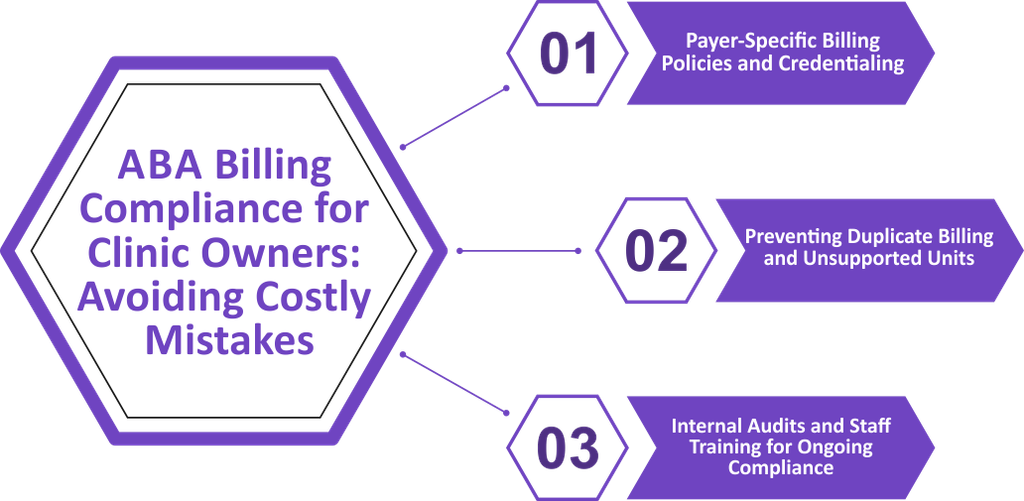
Payer-Specific ABA Therapy Billing Policies and Credentialing
Insurers set different rules for eligible ABA providers, supervision, modifiers, place-of-service codes, and covered activities. Before you submit claims, confirm that rendering providers meet the payer’s credentialing requirements. Also check that billed services fall within coverage rules. Then review billing policies again whenever a payer contract or guideline changes.
Preventing Duplicate Billing and Unsupported Units
Duplicate billing happens when the same provider time or activity is reported twice without a valid coding basis. To catch it, use scheduling controls and billing reviews. They should flag overlapping appointments, duplicate entries, and units that exceed documented time. Clear provider roles and accurate session records lower the risk further.
Internal Audits and Staff Training for Ongoing Compliance
A routine billing and coding audit finds errors before they become recurring losses. Review authorization records, CPT selection, provider credentials, session notes, and claim outcomes on a set schedule. In addition, train staff on payer changes and common denial patterns. A steady compliance process protects revenue and keeps billing accurate and ethical.
How Expert ABA Therapy Billing Supports Practice Growth
As ABA practices grow, billing gets harder. More patients, providers, authorization periods, and payer contracts all add admin work. Without specialized oversight, that work eats staff time and slows growth. Outsourcing is often the fastest way to put ABA therapy billing strategies to work. Dedicated ABA billing services help in three ways:
- Higher first-pass acceptance. Accurate coding, authorization checks, note review, and timely submission mean fewer claims need correction or appeal. As a result, payments become more predictable.
- Less admin load on clinicians. A dedicated team handles insurance follow-up, corrections, payment posting, and denial tracking. So BCBAs and RBTs spend their time on treatment.
- Continuity of care. Proactive monitoring prepares renewals, flags exhausted units, and answers payer questions before coverage lapses.
Bottom Line: ABA Therapy Billing Strategies That Last
ABA practice growth depends on more than patient volume. It also needs accurate billing, timely authorizations, compliant notes, and a reliable revenue cycle. When clinic owners put these ABA therapy billing strategies in place, they reduce preventable denials, protect cash flow, and keep treatment on schedule.
Frequently Asked Questions
How long does insurance reimbursement take for ABA therapy claims?
Reimbursement timelines vary by insurer, contract, and claim accuracy. Clean electronic claims often process faster, while claims requiring medical review or corrections may take longer.
Can ABA therapy services be billed through telehealth?
Some insurers cover eligible ABA services through telehealth. Coverage depends on the CPT code, payer policy, provider qualifications, and applicable state requirements.
What is the difference between an ABA claim rejection and a denial?
A rejection occurs when a claim fails initial processing checks. A denial occurs after the insurer adjudicates the claim and determines that payment is not warranted.
Can ABA clinics bill secondary insurance?
Yes, when the patient has eligible secondary coverage. Clinics must follow coordination-of-benefits requirements and submit the primary insurer’s payment information as required.
What revenue cycle KPIs should ABA practice owners monitor?
Important metrics include first-pass claim acceptance, denial rate, days in accounts receivable, net collection rate, and outstanding claim balances.
How often should ABA clinics reconcile insurance payments?
Daily reconciliation is a useful practice for busy clinics. Regular reviews help identify underpayments, unpaid claims, posting errors, and discrepancies requiring follow-up.