

To reduce A/R over 90 days, identify every outstanding claim or patient balance older than 90 days, determine why it remains unpaid, and assign a specific recovery action. Prioritize high-value claims, denied claims, payer underpayments, missing documentation, and accounts approaching timely filing or appeal deadlines. Track each follow-up until the balance is paid, appropriately adjusted, or determined to be uncollectible under the practice’s policies. Review the A/R aging report weekly and fix recurring billing problems to prevent new balances from becoming overdue.
Key Takeaways
- A/R over 90 days represents money that has remained outstanding for more than 90 days under your report’s aging methodology.
- A high percentage of aged A/R can indicate delayed claim submission, denials, payer issues, or ineffective follow-up.
- Prioritize claims by deadline, recoverability, balance, and reason for nonpayment—not age alone.
- Verify timely filing and appeal deadlines before resubmitting or appealing old claims.
- Use consistent A/R metrics to measure recovery progress and prevent repeat problems.
- Do not automatically write off an old account simply because it has aged beyond 90 days.
1. What Does A/R Over 90 Days Mean in Medical Billing?
Accounts receivable (A/R) is the money a healthcare practice is owed for services already provided but not yet collected. It may include unpaid insurance claims, payer underpayments, and outstanding patient balances.
A/R over 90 days refers to receivables that have aged beyond 90 days according to the date and method used in the practice’s A/R report. Depending on the billing system, aging may be calculated from the date of service, claim submission, or another configured date. Practices should use a consistent method when comparing reports.
Common aging categories include:
| A/R aging bucket | What it generally indicates |
| 0–30 days | Recently billed balances that may still be within normal processing time |
| 31–60 days | Balances requiring monitoring and follow-up when payment is delayed |
| 61–90 days | Accounts that may need more active investigation |
| 91–120 days | Aged balances that often need prioritized recovery action |
| Over 120 days | Older balances requiring claim-specific review and a clear resolution plan |
A claim in the 91–120-day bucket is not automatically uncollectible. It may be awaiting payer processing, missing documentation, or an appeal decision. However, the longer an account remains unresolved, the more important it becomes to identify the reason and protect any remaining filing or appeal rights.
2. How to Calculate A/R Over 90 Days
A useful way to assess aged receivables is to calculate the percentage of total A/R that is more than 90 days old.
Formula:
A/R over 90 days (%) = (A/R older than 90 days ÷ Total A/R) × 100
Example
Suppose a medical practice has $200,000 in total outstanding receivables, with $40,000 aged beyond 90 days.
($40,000 ÷ $200,000) × 100 = 20%
This means 20% of the practice’s outstanding A/R is over 90 days old.
The result helps identify how much of the total receivables balance sits in older aging categories. It does not, by itself, tell you how much money can be recovered. For that, the billing team must review claim status, payer rules, documentation, and patient responsibility.
How to calculate days in A/R
Days in A/R is a different metric. A common calculation is:
Days in A/R = Total A/R ÷ Average daily net patient service revenue
For example, if a practice has $300,000 in A/R and averages $10,000 in net patient service revenue per day:
$300,000 ÷ $10,000 = 30 days in A/R
Use a consistent revenue period and accounting methodology when comparing results. Days in A/R measures how much revenue remains outstanding relative to daily revenue; the A/R-over-90-days percentage measures the share of receivables that has aged beyond 90 days.
Neither metric has one universal target for every specialty, payer mix, and practice size. Compare performance with historical results and appropriate specialty-specific benchmarks.
3. What Causes Medical A/R to Exceed 90 Days?
Aged receivables usually have a specific cause. Simply calling a payer repeatedly without identifying the problem can consume staff time without improving collections.
Common causes of old A/R
Claim denials: Claims may be denied for coding errors, medical necessity issues, missing documentation, authorization problems, or coverage limitations.
Rejected claims: A claim rejected before adjudication may need correction and resubmission. The billing team should verify the rejection reason and applicable submission deadline.
Delayed claim submission: Claims submitted late may have less time for correction or follow-up before payer filing limits expire.
Payer underpayments: The payer may have processed a claim but paid less than expected. Staff should compare the remittance advice with the applicable contract, fee schedule, and patient benefit information.
Missing information: Payers may request medical records, referrals, authorization details, or other supporting documents.
Ineffective follow-up: Claims may remain unresolved because no one owns the account, follow-up dates are missing, or payer responses are not acted on promptly.
Patient balance delays: Deductibles, coinsurance, incomplete statements, and unresolved billing questions can delay patient collections.
The first step in medical A/R cleanup is to classify the balance correctly. A denied claim, a pending claim, a payer underpayment, and a patient balance require different recovery actions.
4. How to Prioritize A/R Follow-Up in Medical Billing
A/R follow-up should be based on both financial impact and urgency. Working the oldest account first is not always the best approach.
Use these priorities when reviewing an A/R aging report:
- Approaching deadlines: Identify claims nearing payer timely filing, corrected-claim, or appeal deadlines.
- High-value balances: Review large outstanding claims that could materially affect cash flow.
- Denied or rejected claims: Identify the cause and determine whether correction, resubmission, or an appeal is appropriate.
- Underpaid claims: Compare payer payments with expected reimbursement and investigate discrepancies.
- Pending claims: Check whether the payer needs information or whether additional follow-up is overdue.
- Patient balances: Confirm that insurance processing is complete and that the patient responsibility is accurate before pursuing collection.
Create a claim-level action queue
For each account, record:
- Patient or account identifier, handled according to your privacy policies
- Payer and date of service
- Outstanding balance and aging bucket
- Claim status and denial reason, if applicable
- Timely filing or appeal deadline
- Last follow-up date and payer reference number
- Required next action
- Assigned staff member and next follow-up date
Every account should have an owner and a defined next step. This turns an aging report into a recovery work queue rather than a static list of unpaid balances.
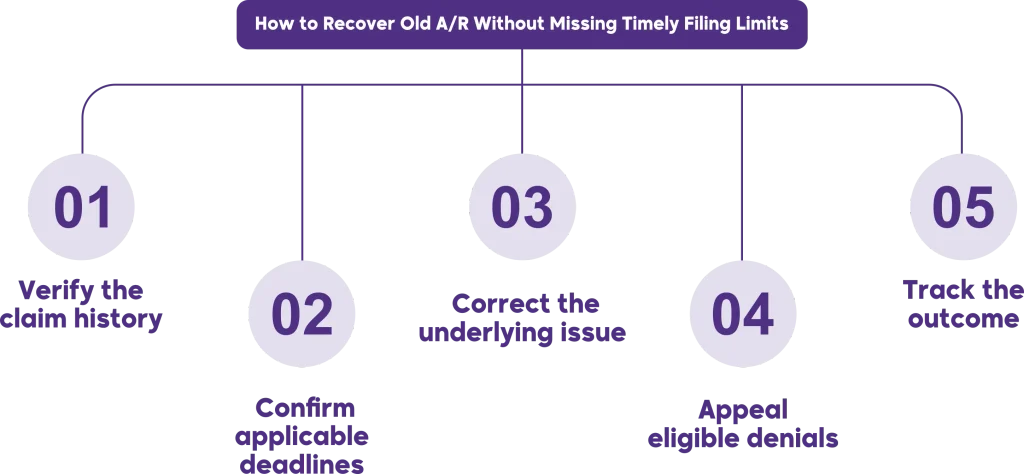
5. How to Recover Old A/R Without Missing Timely Filing Limits
Old A/R recovery requires more than resubmitting every unpaid claim. First, determine whether the claim was submitted, accepted, adjudicated, denied, or left pending.
Step 1: Verify the claim history
Review the original submission date, clearinghouse acknowledgment, payer acceptance, remittance advice, and all previous follow-up notes. If the claim was rejected before adjudication, identify the correction needed.
Step 2: Confirm applicable deadlines
Timely filing rules vary by payer, plan, and claim type. Medicare Fee-for-Service generally requires claims to be submitted within one calendar year of the date of service, subject to limited exceptions. Commercial and other government payer deadlines may differ.
Check the applicable payer policy before resubmitting a claim or filing an appeal. Do not assume that a corrected claim or a phone call resets the original deadline.
See the official CMS Medicare claims timely filing guidance.
Step 3: Correct the underlying issue
Depending on the claim, the next action may involve correcting demographic information, fixing coding errors, supplying requested documentation, resolving authorization issues, or submitting a corrected claim.
Step 4: Appeal eligible denials
Review the denial explanation, supporting documentation, payer appeal requirements, and filing deadline. Submit an appeal when there is a valid basis and the claim is eligible for reconsideration.
For Medicare Fee-for-Service, review the CMS official appeals guidance to understand the applicable process.
Step 5: Track the outcome
Record the date, action taken, reference number, payer response, and next follow-up date. Continue monitoring until the claim is paid, appropriately adjusted, or resolved through another documented outcome.
Important: A claim denied for untimely filing may have limited or no appeal options depending on the payer and circumstances. Check the governing rules before assuming it can be recovered.
6. How to Handle Denied Claims and Payer Underpayments
Denial management and underpayment recovery are important parts of reducing aged A/R, but they require different workflows.
Denied claims
For each denied claim:
- Review the denial code and payer explanation.
- Determine whether the issue is administrative, coding-related, documentation-related, or coverage-related.
- Correct the claim or gather the required supporting information.
- Submit the appropriate corrected claim or appeal within the applicable deadline.
- Track the payer’s response and prevent the same error from recurring.
A denial should not be written off automatically. First determine whether the claim is recoverable, whether the denial is valid, and what action the payer permits.
Payer underpayments
For a potentially underpaid claim:
- Compare the payment with the contract or applicable reimbursement methodology.
- Review the EOB or electronic remittance advice.
- Check adjustments, deductibles, coinsurance, and other patient responsibility.
- Identify any payment discrepancy.
- Request reconsideration or take other appropriate action when supported by the claim terms and payer rules.
Accurate payment posting is essential because incorrect posting can make a paid or partially paid claim appear unresolved—or hide a real underpayment.
7. How to Use an Accounts Receivable Aging Report
An accounts receivable aging report organizes unpaid balances by age, helping the practice see where revenue is getting stuck.
A useful report should show the balance in each aging bucket and, where possible, break it down by payer, claim status, specialty, and responsible team member.
Example of an A/R aging report
The following is a simplified, illustrative example for a medical practice.
| Aging bucket | Outstanding A/R | Percentage of total |
| 0–30 days | $80,000 | 40% |
| 31–60 days | $50,000 | 25% |
| 61–90 days | $30,000 | 15% |
| 91–120 days | $20,000 | 10% |
| Over 120 days | $20,000 | 10% |
| Total | $200,000 | 100% |
In this example, A/R over 90 days is $40,000: the sum of the 91–120-day and over-120-day categories. That represents 20% of total A/R.
The next step is to investigate those $40,000 in balances. For example, some may be denied claims requiring appeals, some may be pending with payers, and others may involve patient balances or payment discrepancies. The report alone cannot determine which amounts are collectible.
What warning signs should you look for?
- The over-90-day percentage is rising month over month.
- A large portion of A/R belongs to one payer or specialty.
- High-value claims remain unresolved without a documented next step.
- Denials repeat for the same reasons.
- Patient balances remain outstanding despite completed insurance processing.
- Payment posting or reconciliation errors create inaccurate balances.
Review these patterns weekly or at another frequency appropriate to claim volume. Use the findings to assign recovery tasks and correct problems upstream.
8. How to Reduce A/R Days and Prevent Future Aging
Recovering old A/R is only part of the solution. Practices also need to prevent new claims from entering older aging categories unnecessarily.
Submit clean claims promptly
Check demographic information, insurance details, coding, modifiers, authorizations, and required documentation before submission. Monitor clearinghouse responses so rejected claims are corrected quickly.
Strengthen eligibility verification
Verify coverage and patient benefits before services are provided. Confirm authorization and referral requirements where applicable, and document verification results.
Improve denial management
Track denial reasons by payer and category. If the same errors recur, review the underlying registration, coding, documentation, authorization, or submission workflow instead of repeatedly correcting individual claims.
Post payments accurately
Reconcile payer payments, adjustments, contractual write-offs, and patient responsibility against remittance advice. Investigate discrepancies promptly so the A/R report reflects the actual outstanding balance.
Establish consistent follow-up intervals
Set follow-up schedules based on payer requirements, claim status, balance, and deadlines. Escalate accounts when a payer has not responded or when the next step requires specialist review.
Monitor performance metrics
Track the following measures over time:
- A/R over 90 days as a percentage of total A/R
- Days in A/R
- Denial rate
- Clean claim rate or first-pass acceptance rate, using a consistent definition
- Net collection rate
- Underpayment recovery
- Timely filing losses
- Write-offs by reason
- Patient balance collection performance
Use these measures together. For example, falling days in A/R alongside a growing number of write-offs may not indicate a genuine improvement in collections.
9. When Should a Practice Consider Medical A/R Cleanup Services?
A dedicated medical A/R cleanup project may be useful when a practice has accumulated a large volume of old claims, experienced staffing shortages, changed billing systems, or identified unresolved denials and underpayments.
Before starting a cleanup, determine the scope and establish rules for classifying balances as recoverable, pending, disputed, patient responsibility, or potentially uncollectible.
A structured cleanup process should include:
- Reviewing the full aging report and validating balances.
- Segmenting claims by age, payer, value, and issue.
- Checking filing and appeal deadlines.
- Assigning recovery actions to individual accounts.
- Documenting payer contacts and claim outcomes.
- Reviewing trends and preventing repeat errors.
- Reporting collections, unresolved balances, and appropriate adjustments.
Avoid promising that all old A/R can be recovered. Some claims may be beyond applicable deadlines, unsupported by documentation, excluded from coverage, or otherwise uncollectible. The objective is to recover eligible revenue and resolve every balance accurately.
Health Med Affairs provides accounts receivable and follow-up support to help practices monitor outstanding claims, coordinate payer follow-up, and address aging balances. Practices can also explore medical claims processing services and denial management services when unresolved claims require correction, investigation, or appeals.
Reduce A/R Over 90 Days With a Structured Recovery Plan
High A/R over 90 days can make cash flow less predictable and increase the effort required to collect earned revenue. A consistent recovery process helps practices identify the cause of unpaid balances, prioritize the right accounts, protect deadlines, and reduce recurring billing problems.
Health Med Affairs can support your practice with accounts receivable follow-up, medical claims processing, and denial management. Explore our medical billing and RCM services to learn more.
Frequently Asked Questions
Q1. What is a good A/R aging percentage?
Ans: There is no single A/R aging percentage that is ideal for every medical practice. The appropriate target depends on specialty, payer mix, reimbursement patterns, billing processes, and the report’s aging methodology. Monitor the share of A/R over 90 days over time and compare it with relevant benchmarks and your practice’s historical performance.
Q2. How often should a medical practice review its A/R aging report?
Ans: Many practices benefit from reviewing aging reports weekly, with more frequent review for high-value claims or accounts approaching filing and appeal deadlines. The appropriate frequency depends on claim volume, payer requirements, and staffing.
Q3. When should an old medical A/R balance be written off?
Ans: A balance should be considered for write-off only after the practice reviews its collectibility, payer rules, patient responsibility, documentation, and applicable deadlines. Follow the organization’s written adjustment policy and document the reason for any write-off. Aging beyond 90 days alone is not sufficient justification.
Q4. Does a denied claim always mean the practice cannot collect payment?
Ans: No. Some denials can be corrected or appealed when the claim is eligible and supporting documentation or other requirements can be satisfied. Review the denial reason, payer rules, and applicable deadlines before deciding whether to pursue recovery or adjust the balance.
Q5. Should patient balances be included in an A/R over 90 days report?
Ans: Yes, if the report is designed to include both insurance and patient receivables. However, patient balances should be identified separately from insurance A/R so the billing team can apply the appropriate follow-up, collection, and compliance procedures.