
Primary source verification in healthcare is the step that turns a provider’s paperwork into proof. Instead of trusting a copy of a license or diploma, the organization confirms each credential with the body that issued it. It sits at the heart of provider credentialing, so when it stalls, payer enrollment and payments stall too.
Quick answer: Primary source verification (PSV) means confirming a provider’s license, education, board certification, DEA registration and history directly with the original source. Examples include a state medical board or the National Practitioner Data Bank. Hospitals, health plans and accreditors such as NCQA and The Joint Commission require it before a provider can treat patients or join a network.
This guide covers primary source verification in healthcare from start to finish: sources, steps, accreditation rules and revenue impact.
What Is Primary Source Verification?
Primary source verification is the process of checking a credential directly with the organization that issued it. For example, a credentialing team confirms a medical license on the state board’s website rather than accepting a photocopy. Because the data comes straight from the issuer, it shows the current status, including any expirations, restrictions or discipline.
The goal is simple: make sure every provider is qualified, licensed and legally allowed to practice. In turn, that protects patients, payers and the organization itself.
Why Primary Source Verification in Healthcare Matters
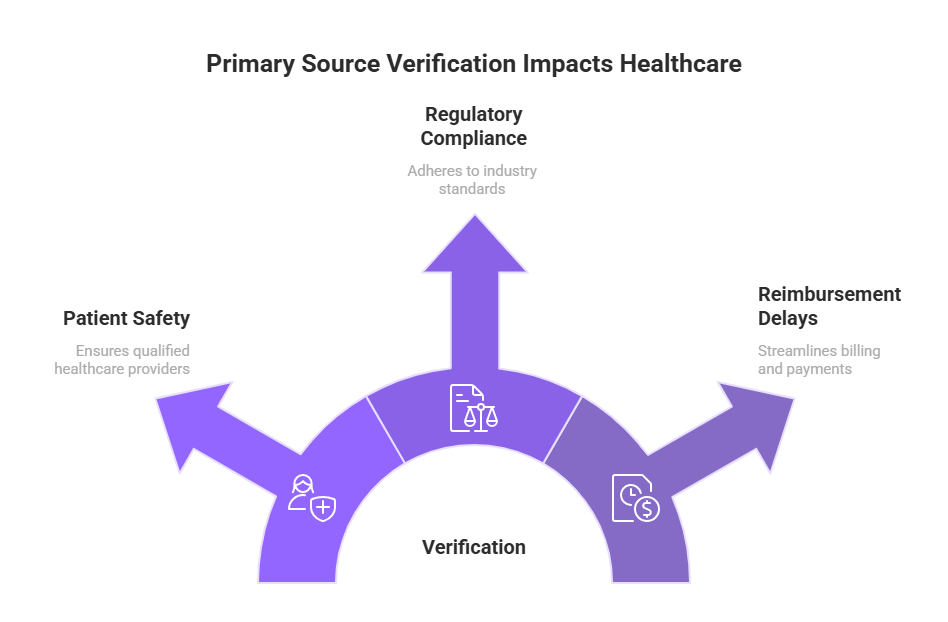
PSV does three jobs at once. It keeps patients safe, it keeps the organization compliant, and it keeps payments moving.
- Patient safety: It catches forged documents, expired licenses and hidden disciplinary history before a provider sees patients.
- Compliance: Accreditors and health plans require it during credentialing and recredentialing, so gaps can lead to findings in an audit.
- Revenue: Payers will not finish enrollment until verification is complete, so delays push back the first paid claim.
What Qualifies as a Primary Source?
A primary source is the original issuer of a credential. In some cases, accreditors also accept a designated equivalent source, such as the AMA Physician Masterfile for education or the ABMS for board certification. The table below lists the most common sources.
| Credential | Primary source |
|---|---|
| Medical license | State medical board |
| Board certification | ABMS or the specialty board |
| Medical degree and training | Medical school, residency program or an approved equivalent source |
| DEA registration | Drug Enforcement Administration |
| NPI | NPPES registry |
| Malpractice claims history | National Practitioner Data Bank (NPDB) |
| Malpractice coverage | Insurance carrier |
| Sanctions and exclusions | OIG exclusion list, SAM.gov and state Medicaid lists |
Organizations can do this work themselves or use a credentials verification organization. If you are weighing that option, read our guide on how a CVO handles verification.
Primary Source vs Secondary Source Verification
A secondary source is any indirect copy, such as a photocopied license or a provider’s own CV. It is useful for reference, but it rarely meets accreditation standards on its own.
| Factor | Primary source verification | Secondary source |
|---|---|---|
| How it is checked | Directly with the issuing authority | From copies or indirect sources |
| Reliability | High, shows current status | Lower, may be outdated or altered |
| Accreditation | Meets NCQA and Joint Commission standards | Usually not acceptable alone |
| Example | State board confirms the license online | Provider emails a scan of the license |
The Primary Source Verification Process, Step by Step
Most organizations follow the same basic workflow. A clear order helps teams avoid rework and missed items.
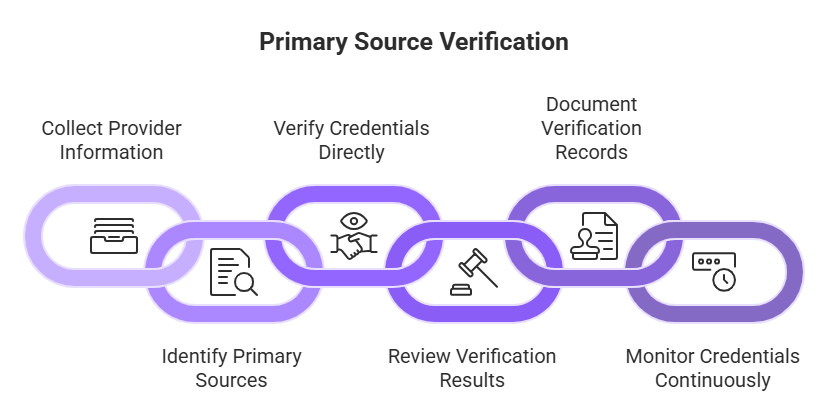
- Collect provider data. Gather licenses, certifications, education, work history, DEA registration, malpractice coverage and references. Our credentialing document checklist lists what to request.
- Match each item to its source. For example, the license goes to the state board and the board certification goes to the specialty board.
- Verify directly. Use the source’s website, secure portal, written confirmation or phone call.
- Review the results. Check expiration dates, active status, restrictions, sanctions and any mismatch with the application.
- Document everything. Record the date, source, verifier and result so the file is ready for audit.
- Monitor ongoing. Track renewals, board actions and exclusions between recredentialing cycles.
Accreditation and Compliance Requirements
Several bodies set the rules for primary source verification in healthcare. Their standards differ in detail, so always check the current manual that applies to your organization.
NCQA
Most health plans follow NCQA credentialing standards. These call for verification of key credentials within set time limits before a credentialing decision, and they require recredentialing at least every 36 months. As a result, payers often hold applications until every item is verified.
The Joint Commission
Accredited hospitals must verify licensure, training and current competence before granting privileges. They also re-verify at reappointment and keep records that show how each item was confirmed.
CMS and Federal Databases
CMS rules for hospitals, Medicare Advantage plans and Medicaid managed care plans require formal credentialing. In addition, organizations should screen providers against the OIG exclusion list and query the National Practitioner Data Bank where they are eligible to do so. Billing for an excluded provider can create serious repayment risk.
Common Primary Source Verification Challenges
Although the steps are clear, primary source verification in healthcare is slow work. These are the usual bottlenecks:
- Manual requests: Fax, mail and phone verifications can take weeks.
- Different state systems: Each board has its own website, format and response time.
- Foreign training: Overseas schools may respond slowly or keep records in other formats.
- Small teams: One coordinator may juggle dozens of providers and payers.
- Expiring items: A license or malpractice policy can lapse mid-application, so the file must be updated.
Continuous Monitoring and Automation
Many organizations now monitor credentials all year instead of only at onboarding and recredentialing. Credentialing software can pull license status, flag upcoming expirations and run monthly exclusion checks. Therefore, problems surface early, before they affect patient care or claims.
How PSV Affects Your Revenue Cycle
Primary source verification in healthcare is often the slowest part of payer enrollment. Until a payer finishes it, the provider cannot be loaded as in-network. So visits during that gap may deny, pay at out-of-network rates or need to wait.
Weak PSV also creates later risk. For instance, a missed exclusion or lapsed license can lead to recoupments on claims that were already paid. Clean files, on the other hand, mean faster onboarding and fewer surprises.
Best Practices for Faster Verification
- Use one standard checklist for every new provider.
- Keep each provider’s CAQH profile complete and attested; our CAQH profile management service can help.
- Set alerts 90 days before licenses, DEA registrations and malpractice policies expire.
- Run exclusion checks at least monthly.
- Audit a sample of credentialing files each quarter.
- Use experienced credentialing staff or an outside partner when volume spikes.
Bottom Line
Primary source verification in healthcare is more than a compliance box. It protects patients, satisfies accreditors and, just as important, keeps enrollment and payments on schedule. Build a clear workflow, document every check, and monitor credentials between cycles. If your team is stretched, an experienced credentialing partner can take the work off your desk.
Frequently Asked Questions
What is primary source verification in healthcare?
Primary source verification is the process of confirming provider credentials directly with the original issuing organization or authority.
Why is primary source verification important?
PSV protects patient safety, ensures compliance, supports credentialing, and helps prevent reimbursement delays.
What is considered a primary source?
Examples include:
- state medical boards
- universities
- certification boards
- DEA databases
- NPDB
- OIG databases
Is CAQH considered primary source verification?
No. A CAQH profile stores information that the provider reports, so it is not the original issuing authority. Payers still verify key items with the primary source.
How long does primary source verification take?
Timelines vary depending on:
- provider specialty
- state licensing boards
- payer requirements
- credentialing complexity
Manual verification may take weeks, while automated systems can significantly reduce turnaround times.
What happens if primary source verification is incomplete?
Incomplete PSV may lead to:
- credentialing delays
- payer enrollment rejections
- denied claims
- compliance violations
- reimbursement interruptions