
Why, even with the most advanced digital platforms in place, do healthcare providers continue to spend much of their day on administrative tasks rather than patient care? Administrative workloads, staff issues, and expanding patient demand are all placing more pressure on healthcare systems. According to recent industry data, administrative processes consume between 30% and 40% of clinical staff time, reducing time available for direct patient care and increasing physician stress.
A Healthcare Virtual Assistant is being used as a support layer to handle these non-clinical tasks. According to analyst research, the global healthcare virtual assistant market is expected to grow at a CAGR of 16%-27% 2035, with a value spanning from USD 910 million to 1.9 billion in 2025-2026, depending on segmentation. This represents increasing utilization in hospitals, clinics, and telehealth systems. However, performance is set by how successfully these assistants are integrated into the billing, clinical, and compliance procedures.
This blog describes how a Healthcare Virtual Assistant works across healthcare operations. It also identifies advantages such as reduced administrative workload and increased billing support.
What is a Healthcare Virtual Assistant in Modern Healthcare Systems
Healthcare delivery is under pressure from rising patient volume, staffing shortages, and growing administrative work. Many healthcare providers struggle to manage documentation, billing, insurance tasks, and patient coordination at the same time. A Healthcare Virtual Assistant is used to support these non-clinical and coordination-heavy tasks within healthcare settings. This improves workflow continuity across clinical and administrative teams. The term Healthcare Virtual Assistant refers to a structured support role used in hospitals, clinics, and billing operations to reduce operational delays.
This section explains the core meaning of a Healthcare Virtual Assistant and how it functions in real healthcare environments. It also separates human support roles from AI-based systems used in modern healthcare workflows.
Definition and Scope of Healthcare Virtual Assistant
A Healthcare Virtual Assistant is a remote support role that assists healthcare organizations with administrative, clinical coordination, billing, and patient communication tasks. It works within structured healthcare systems and supports providers, billing teams, and administrative staff.
Core scope includes:
- Appointment scheduling and calendar management
- Patient intake and registration support
- Insurance eligibility checks and coordination
- Medical billing data preparation
- EHR and documentation updates
- Patient follow-up communication
Difference Between Human and AI-Based Assistants
Healthcare Virtual Assistants operate through two models: human-based support and AI-based systems. Both are used in healthcare workflows, but their functions and limitations are different. The comparison below explains their operational roles in healthcare settings.
| Aspect | Human-Based Healthcare Virtual Assistant | AI-Based Healthcare Virtual Assistant |
| Task Handling | Manages complex tasks requiring judgment and communication | Handles repetitive and rule-based tasks |
| Patient Communication | Direct communication with patients and providers | Automated replies and chat-based responses |
| Billing Support | Assists with claim review, follow-ups, and coordination | Limited to data entry and basic processing |
| Clinical Support | Supports documentation, EHR updates, and coordination | Provides reminders and basic record handling |
| Decision Making | Uses experience and healthcare knowledge | Follows programmed rules and algorithms |
| Flexibility | Adapts to changing workflows and patient needs | Works within fixed system parameters |
| Compliance Handling | Supports HIPAA-sensitive workflows with supervision | Depends on system configuration and data rules |
| Error Management | Can identify and correct workflow issues | Limited ability to detect complex errors |
| Best Use Case | Billing teams, practice managers, and provider support | Scheduling, reminders, and basic automation tasks |
Healthcare Virtual Assistant in Clinical and Administrative Workflows
This section breaks down two main areas of support: front desk operations and clinical coordination tasks. Each part shows how healthcare processes are handled in practical settings.
Front Desk and Patient Intake Support
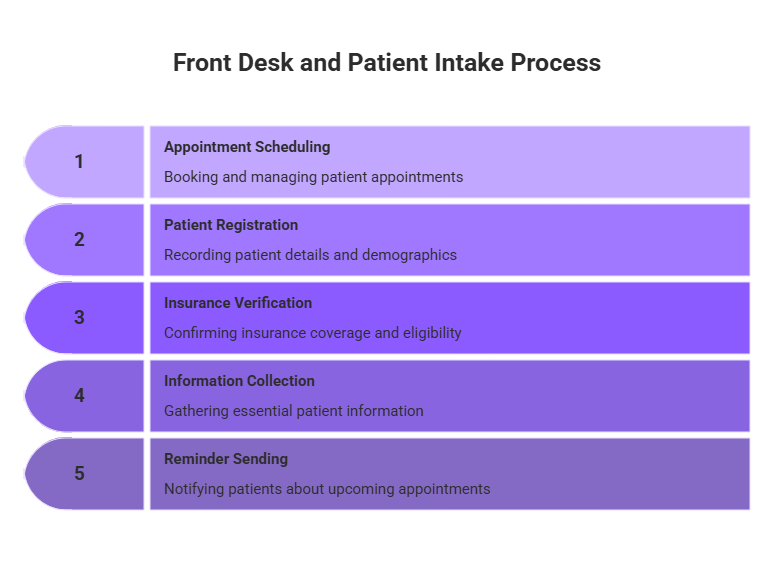
Front desk operations are often the first point of contact in healthcare settings. Errors or delays at this stage can affect scheduling, billing accuracy, and patient experience. A Healthcare Virtual Assistant supports intake processes by managing structured administrative tasks.
Key responsibilities include:
1. Appointment scheduling and rescheduling
2. Patient registration and demographic entry
3. Insurance eligibility verification
4. Collection of basic patient information
5. Sending reminders for visits and follow-ups
Clinical Support Functions
Clinical workflows require accurate documentation and timely coordination between providers and support staff. A Healthcare Virtual Assistant assists in non-clinical tasks that support patient care delivery.
Key functions include:
1. Updating electronic health records (EHR)
2. Assisting with clinical documentation entry
3. Supporting telehealth session coordination
4. Preparing patient summaries for provider review
5. Managing follow-up communication after visits
Role of Healthcare Virtual Assistant in Billing and Coding Operations
Billing and coding workflows in healthcare require accurate data entry, timely claim submission, and proper coordination between clinical documentation and insurance systems. Delays or errors in this process often lead to claim rejections, payment delays, and revenue loss.
This section explains how billing support and coding assistance function in real healthcare environments. It focuses on how tasks are divided across billing staff, coders, and virtual support roles.
Medical Billing Support Tasks
Medical billing processes depend on accurate patient data, correct coding input, and timely submission to insurance payers. A Healthcare Virtual Assistant supports billing teams by managing pre-claim and post-claim tasks.
Key responsibilities include:
- Preparing claim submission data
- Checking patient insurance details before billing
- Assisting with charge entry and record updates
- Tracking claim status with insurance payers
- Supporting payment posting coordination
- Flagging incomplete or missing billing information
Coding and Documentation Support
Medical coding requires accurate translation of clinical services into standardized codes such as CPT, ICD, and HCPCS. A Healthcare Virtual Assistant supports coders by organizing documentation and preparing structured data for review.
Key functions include:
- Organizing patient records for coding teams
- Assisting in documentation completeness checks
- Supporting coders with data entry tasks
- Highlighting missing clinical information
- Preparing charts for coding review
- Coordinating between providers and coding staff
Healthcare Virtual Assistant for Insurance and Compliance Teams
This section explains how insurance coordination and compliance support functions in healthcare settings. It focuses on eligibility handling, claims tracking, and documentation control.
Insurance and Claims Coordination
Insurance and claims coordination involves verifying patient coverage, managing prior authorizations, and tracking claim status with payers. A Healthcare Virtual Assistant supports these tasks by maintaining structured communication between providers and insurance companies.
Key responsibilities include insurance eligibility checks, prior authorization tracking, and claim status follow-ups. It also supports communication with insurance adjusters and claims teams to reduce delays. This helps billing staff focus on core revenue cycle tasks.
By managing repetitive insurance workflows, administrative delays are reduced across the billing cycle. It also helps reduce claim rejections caused by missing or incomplete insurance information. This improves overall reimbursement timelines.
Compliance and Data Handling Support
Compliance workflows require strict handling of patient data, documentation accuracy, and adherence to healthcare regulations. A Healthcare Virtual Assistant supports compliance teams by organizing records and maintaining structured data processes.
Key functions include HIPAA-aligned data handling, audit preparation support, and maintaining documentation consistency. It also assists healthcare compliance officers in tracking required records for internal and external reviews. This reduces administrative burden during audits.
Accurate documentation support helps reduce compliance risks linked to incomplete or inconsistent records. It also improves coordination between billing, clinical, and regulatory teams. This ensures better alignment with healthcare policy requirements.
Virtual Health Care Assistant and Virtual Nurse Assistant Roles
Healthcare systems are expanding remote support roles to handle patient communication, care coordination, and basic clinical support tasks. These roles reduce workload pressure on clinical staff and improve continuity of care across virtual and in-person settings.
Virtual Health Care Assistant Functions
A virtual health care assistant supports non-clinical patient engagement and coordination tasks across healthcare systems. It plays a key role in improving communication between patients and healthcare providers.
Key responsibilities include appointment coordination, patient reminders, and basic health-related communication support. It also assists in managing patient queries related to visits, prescriptions, and follow-ups. These tasks help reduce delays in patient interaction workflows.
By handling repetitive communication tasks, healthcare staff can focus more on clinical decision-making. It also improves patient engagement by ensuring timely updates and structured communication. This supports better continuity of care across healthcare services.
Virtual Nurse Assistant Functions
A virtual nurse assistant supports nurses by managing remote coordination and documentation-related tasks. It is commonly used in telehealth and chronic care monitoring environments.
Key functions include supporting telehealth sessions, preparing patient summaries, and assisting with remote monitoring coordination. It also helps in organizing patient data before clinical review. This reduces administrative load on nursing staff.
In many healthcare systems, virtual nurse assistants support follow-up care coordination and patient communication. This improves efficiency in nursing workflows and reduces delays in post-visit care management. It also supports better organization of patient records for clinical review.
Benefits of Healthcare Virtual Assistant in Healthcare Systems
This section explains the key operational, financial, and communication benefits linked to its use. It focuses on measurable improvements across healthcare delivery systems.
Operational Benefits
A Healthcare Virtual Assistant improves daily workflow efficiency by reducing administrative delays in healthcare settings. It helps healthcare staff focus more on clinical responsibilities instead of repetitive operational tasks.
Key operational benefits include:
1. Faster appointment scheduling and coordination
2. Reduced delays in patient intake and registration
3. Improved documentation handling and data entry accuracy
4. Better coordination between clinical and administrative teams
5. Reduced workload pressure on front-office staff
Financial and Billing Benefits
A Healthcare Virtual Assistant supports financial workflows by improving billing accuracy and reducing claim-related errors. It assists revenue cycle teams in maintaining structured billing processes.
Key financial benefits include:
- Fewer claim submission errors due to better data preparation
- Improved billing cycle accuracy and consistency
- Reduced delays in insurance processing and reimbursements
- Better tracking of payments and claim status updates
- Lower risk of revenue loss from incomplete documentation
Challenges in Adopting Healthcare Virtual Assistant
Challenges often appear in system compatibility, staff coordination, and regulatory compliance. The Healthcare Virtual Assistant requires proper planning and structured implementation to function effectively within clinical, billing, and administrative workflows.
This section outlines the main barriers healthcare organizations face during adoption. It focuses on operational, technical, and compliance-related challenges.
Integration Challenges
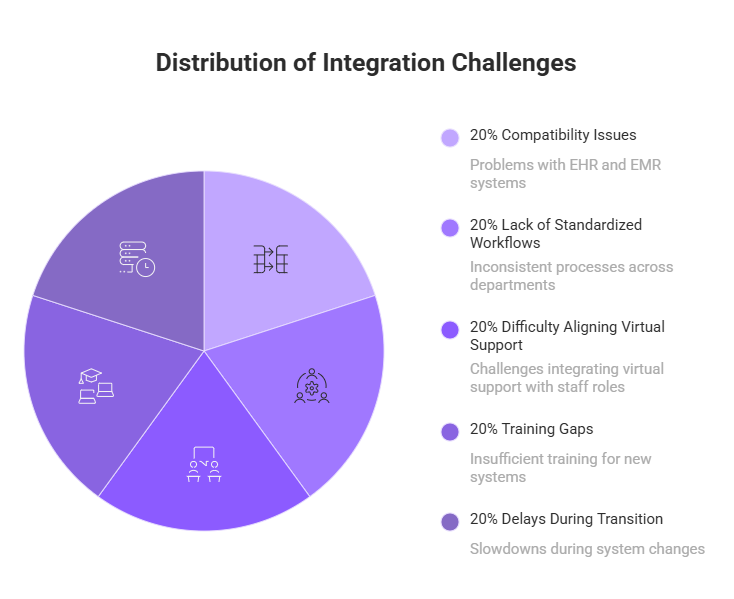
A Healthcare Virtual Assistant must align with existing healthcare systems such as EHR, billing platforms, and scheduling tools. Poor integration can disrupt workflows and reduce operational efficiency.
Key integration challenges include:
1. Compatibility issues with EHR and EMR systems
2. Lack of standardized workflow processes across departments
3. Difficulty aligning virtual support with in-house staff roles
4. Training gaps for staff using new systems
5. Delays during system transition phases
Compliance and Security Concerns
Healthcare data handling requires strict compliance with privacy and security regulations. A Healthcare Virtual Assistant must operate within defined legal and security frameworks to avoid risks.
Key compliance concerns include:
1. HIPAA data protection requirements
2. Secure handling of patient records and billing data
3. Risk of unauthorized data access
4. Need for audit-ready documentation practices
5. Variations in regional healthcare regulations
Conclusion
Healthcare systems continue to face pressure from administrative workload, staffing shortages, and increasing patient demand. A Healthcare Virtual Assistant helps reduce operational delays by supporting billing, documentation, scheduling, insurance coordination, and patient communication workflows.
As healthcare operations become more digitally connected, virtual support roles are expanding across hospitals, clinics, telehealth systems, and billing departments. Functions linked to virtual health care assistant and virtual nurse assistant roles are also improving workflow coordination in remote and hybrid care settings.
Healthcare organizations that align virtual assistant support with billing systems, documentation standards, and regulatory requirements are better positioned to reduce administrative pressure and improve operational continuity.
FAQs
What does a Healthcare Virtual Assistant do in healthcare operations?
A Healthcare Virtual Assistant supports administrative and coordination tasks such as scheduling, billing support, insurance verification, documentation handling, and patient communication. It helps healthcare teams reduce operational workload and improve workflow efficiency.
How does a Healthcare Virtual Assistant support medical billing teams?
It assists with claim preparation, insurance checks, payment tracking, charge entry support, and documentation organization. This helps reduce billing errors and improve revenue cycle workflows.
What is the difference between a virtual health care assistant and a virtual nurse assistant?
A virtual health care assistant primarily assists patient communication and administrative coordination tasks. A virtual nurse assistant facilitates nursing processes, telehealth coordination, and remote patient monitoring.
Can a Healthcare Virtual Assistant help with compliance and HIPAA requirements?
Yes. A Healthcare Virtual Assistant can support HIPAA-aligned documentation handling, audit preparation, and secure patient data management under healthcare compliance protocols.
What challenges do healthcare organizations face when adopting Healthcare Virtual Assistant systems?
Common challenges include EHR integration issues, staff training gaps, workflow alignment problems, and healthcare data security requirements. Proper implementation planning helps reduce these operational risks.