

Credentialing in medical billing is the step that lets a provider bill insurance and get paid. It verifies a clinician’s licenses, education, training, certifications and history before a payer adds them to its network. Without it, even experienced providers face denied claims, delayed payments and compliance risk.
Quick answer: Credentialing is how insurers confirm a provider is qualified before allowing in-network billing. The usual steps are collecting documents, completing CAQH, applying to each payer, primary source verification and approval with an effective date. It often takes 60 to 120 days, and claims sent before approval are commonly denied.
Whether you are a physician, therapist, clinic owner or billing manager, understanding this process protects revenue and reduces admin headaches. This guide covers what credentialing is, why it matters, the main types, the step-by-step process, timelines, common mistakes and when outsourcing makes sense.
What Is Credentialing in Medical Billing?
Credentialing in medical billing is the process of verifying a provider’s qualifications before they can bill insurance companies for services. Payers use it to confirm that a provider holds valid licenses and has the education, training and certifications to deliver safe care.
In effect, it connects providers to insurance networks. Once credentialed and enrolled, a provider can participate in-network, submit claims and receive payment. Without it, payers often deny claims or pay them out-of-network. Payers typically review:
- Medical licenses and board certifications
- Education, residency and training history
- Work experience
- Malpractice coverage and claims history
- DEA registration and NPI
These checks help reduce fraud and protect patients. Moreover, credentialing is ongoing: most payers re-credential providers every two to three years, and delays at any point can stop income because payers will not pay claims until approval is complete.
Why Credentialing Matters in Medical Billing
Credentialing affects payment, credibility and compliance. Even highly experienced professionals cannot get in-network payment until it is done.
Timely Reimbursement
Insurers pay in-network rates only to providers who are credentialed and enrolled. As a result, incomplete or lapsed credentialing leads to claim denials, delayed payments, payment interruptions and lost revenue.
Trust With Patients and Payers
Patients often choose providers in their insurance network. Credentialing shows both patients and payers that a provider meets professional standards, which supports reputation and long-term growth.
Regulatory Compliance
Credentialing helps providers stay compliant with payer policies, state laws and federal rules. On the other hand, letting it lapse can lead to contract termination, billing restrictions and recoupments.
Types of Credentialing in Medical Billing
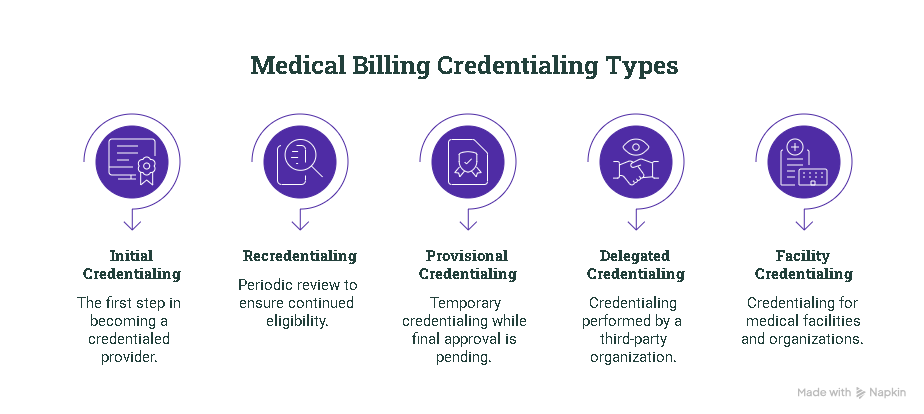
Payers and facilities use different types of credentialing depending on the provider’s role and stage. Knowing them helps you prepare the right documents.
- Initial credentialing: the first full review when a provider applies to join a network, including license, education, work history, background and malpractice checks.
- Re-credentialing: a periodic review, often every two to three years for commercial plans, to confirm the provider still meets standards.
- Provisional credentialing: temporary participation some plans allow while the full review is pending, often for new hires.
- Delegated credentialing: a payer lets a large group or health system credential its own providers under an agreement, which speeds onboarding.
- Facility credentialing: payers also credential hospitals, labs, imaging centers and clinics as organizations, based on licenses, accreditation and policies.
Credentialing by Provider Type
Requirements also vary by specialty. For example, physicians face detailed checks of medical school, residency, fellowship, board status, licenses, DEA and malpractice history. Payers review nurse practitioners for nursing licenses, advanced practice certification and, in some states, collaboration agreements. Mental health professionals need state licenses and, for some roles, supervision records.
Telehealth adds another layer, because providers usually need a license in each state where patients are located and must meet each payer’s virtual care rules. That is why many virtual groups rely on telehealth credentialing services to manage multi-state files.
Credentialing Process in Medical Billing
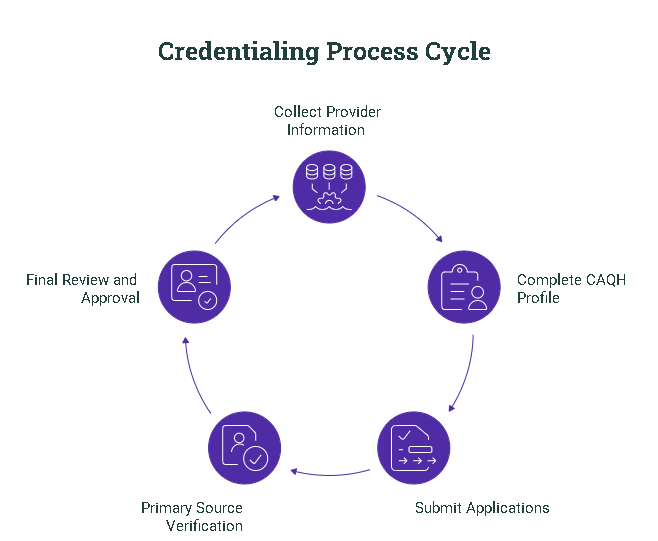
The process varies a little by payer, but most follow the same five steps.
Step 1: Collect Provider Information
First, gather the license, DEA certificate, NPI, board certifications, CV, malpractice certificate and tax details. Accuracy matters, because even small errors cause delays. Our guide to medical credentialing documents lists every item.
Step 2: Complete the CAQH Profile
Next, build or update the provider’s CAQH ProView profile with education, work history, locations, insurance and references, then attest it. Many commercial plans pull data from CAQH, so an outdated profile is one of the most common causes of delay. Ongoing CAQH profile maintenance keeps attestations current.
Step 3: Submit Payer Applications
Then, apply to commercial plans, Medicare and Medicaid, as individual, group or facility applicants. Medicare enrollment runs through PECOS on the CMS side, while each state runs its own Medicaid portal. Each payer has its own rules and timeline. Note that Original Medicare has no networks. Medicare enrollment does not make you in-network with Medicare Advantage or commercial plans. Each one needs its own contract and credentialing.
Step 4: Primary Source Verification
The payer verifies credentials directly with medical schools, licensing boards, certifying bodies and sometimes past employers. This step confirms that every document is authentic.
Step 5: Approval and Effective Date
Finally, the payer approves the file, signs or loads the contract and assigns an effective date. From that date, the provider can treat members in-network and submit claims.
Before, During and After Approval
Before applying, renew expiring licenses, update malpractice coverage, verify CAQH and confirm practice addresses. During review, answer payer requests quickly, check status regularly and keep copies of everything. After approval, track expiration dates, re-attest CAQH, report practice changes and prepare for re-credentialing. Otherwise, a lapse can interrupt payment.
Credentialing vs Enrollment vs Privileging
These three terms are related but serve different purposes. Confusing them often leads to delayed payments and denied claims.
| Process | Main purpose | Done by | Outcome |
|---|---|---|---|
| Credentialing | Verifies provider qualifications | Payers, hospitals, CVOs | Provider approved as qualified |
| Enrollment | Sets up billing with a payer | Medicare, Medicaid, commercial plans | Provider can submit claims |
| Privileging | Authorizes specific procedures | Hospitals and facilities | Clinical permissions granted |
For example, a surgeon may be credentialed and enrolled with an insurer but still need hospital privileges before operating there. Likewise, a provider can be credentialed yet unable to bill if enrollment and contract loading are not finished. Our article on credentialing versus enrollment explains this handoff in more detail.
How Long Does Medical Credentialing Take?
Timelines for credentialing in medical billing depend on the payer, specialty, state and file quality. As a general guide, many commercial plans take about 60 to 120 days, and some take longer. Medicare often processes complete applications in roughly 30 to 90 days, while Medicaid timelines vary by state. Hospital privileging can take several months because of committee reviews.
Common slowdowns include missing documents, incomplete CAQH profiles, slow payer or licensing board responses, high application volume and inaccurate data. To speed things up, keep documents current, review applications before submission, watch payer messages and follow up on a set schedule.
Common Credentialing Mistakes and Challenges
Most delays come from avoidable admin errors rather than a lack of qualifications. Watch for these:
- Outdated practice addresses or inconsistent work history
- Expired malpractice coverage or delayed license renewals
- Incorrect NPI or the wrong taxonomy code
- Missing signatures or supporting documents
- CAQH profiles that are not updated or attested
- Ignored payer follow-up requests
In addition, growing practices face multi-state licensing, telehealth payer rules, staff shortages, re-credentialing deadlines and payer policy changes. Each one adds paperwork, so a structured workflow with deadline tracking and routine follow-up makes a big difference.
Documents Required for Medical Credentialing
Every payer differs slightly, so keep an organized file for each provider. The core items are:
| Document | Purpose |
|---|---|
| Medical license | Confirms legal authority to practice |
| DEA certificate | Verifies controlled substance authority |
| NPI | Identifies the provider |
| Board certification | Validates specialty training |
| Malpractice insurance | Confirms liability coverage |
| CV | Shows education and work history |
| CAQH profile | Stores provider data for many payers |
| Photo ID | Confirms identity |
| Tax ID information | Needed for enrollment and payment |
| Hospital privileges | Shows facility affiliations |
Some payers also ask for references, CME records, background checks, work history explanations or immunization records. Review the file regularly so licenses, coverage and certifications never lapse.
Benefits of Outsourcing Credentialing in Medical Billing
As requirements grow more complex, many practices outsource this work to a provider credentialing and enrollment team. A specialist team knows payer rules, catches errors before submission and follows up consistently. As a result, staff spend less time on forms, compliance deadlines are tracked and providers can bill sooner.
Outsourcing helps most for solo practices with limited staff, multi-provider clinics with high volume, telehealth companies with multi-state needs and new or expanding practices. Signs you may need help include frequent enrollment denials, slow payer approvals, expired credentials, staff overload and missed re-credentialing dates. To see exactly what a partner handles, read what credentialing companies do.
Best Practices for Successful Credentialing
- Centralize records: keep licenses, DEA, certifications, malpractice, CAQH data and work history in one system with expiration alerts.
- Keep CAQH current: verify locations, contacts, licenses, insurance and history, then re-attest on schedule.
- Start re-credentialing early: begin months ahead, track each payer’s dates, assign an owner and log payer contacts.
- Use tracking tools: credentialing software and automated reminders reduce manual errors as your roster grows.
Bottom Line
Credentialing in medical billing is the foundation for getting paid. It affects reimbursement, compliance, credibility and patient access. Providers who keep documents organized, watch deadlines and stay on top of payer requests avoid most delays and denials. Whether you handle it in-house or with outside help, timely credentialing protects cash flow and keeps care uninterrupted.