

Is your practice spending too much time managing billing instead of patient care? Medical billing remains one of the most time-intensive administrative functions in healthcare. Industry benchmarks available in 2026 show that the average initial medical claim denial rate remains around 11.8%, and reworking a denied claim can cost providers $25 to more than $100, depending on the complexity of the correction or appeal. These challenges increase administrative workload, delay reimbursement, and affect practice cash flow.
A Medical Billing Virtual Assistant helps healthcare organizations manage billing responsibilities remotely by supporting insurance verification, charge entry, claim submission, payment posting, and denial follow-up. While remote billing support can reduce administrative workload and improve operational efficiency, practices must also evaluate compliance requirements, coding knowledge, data security, workflow integration, and communication processes before assigning billing responsibilities.
This guide explains the responsibilities of a Medical Billing Virtual Assistant and how they support the medical billing revenue cycle. It also covers billing workflows, CPT, HCPCS Level II, and ICD-10-CM coding fundamentals, as well as the key factors healthcare organizations should consider before incorporating remote billing support into their operations.
What Is a Medical Billing Virtual Assistant?
A Medical Billing Virtual Assistant supports healthcare organizations by handling remote medical billing and administrative tasks that help maintain an efficient revenue cycle. This section explains the role, who benefits from these professionals, and the qualifications required to perform billing responsibilities accurately and in compliance with healthcare regulations.
Definition of a Medical Billing Virtual Assistant
A Medical Billing Virtual Assistant is a trained remote professional who performs medical billing tasks for healthcare providers, hospitals, clinics, and medical billing companies. Working through secure systems, they help manage billing operations without being physically present in the practice.
Their responsibilities may include:
1. Insurance eligibility verification
2. Patient demographic verification
3. Charge entry
4. Claim preparation and submission
5. Payment posting
6. Denial follow-up
7. Accounts receivable (A/R) support
8. Patient billing assistance
Difference Between a Medical Billing Virtual Assistant and a General Virtual Assistant
Although both roles provide remote support, their responsibilities and required knowledge differ significantly.
| Medical Billing Virtual Assistant | General Virtual Assistant |
| Performs healthcare billing tasks | Performs general administrative tasks |
| Understands medical billing workflows | Typically has no billing knowledge |
| Works with CPT, HCPCS Level II, and ICD-10-CM documentation | Does not require medical coding knowledge |
| Supports insurance claims and payment posting | Manages emails, scheduling, and data entry |
| Follows HIPAA compliance requirements | May not require healthcare compliance training |
| Uses EHR, PM software, and billing platforms | Uses standard office productivity software |
How a Medical Billing Virtual Assistant Supports the Revenue Cycle
A Medical Billing Virtual Assistant supports every stage of the revenue cycle, from patient registration to final payment collection. Accurate billing workflows reduce claim errors, improve reimbursement timelines, and help healthcare organizations maintain steady cash flow.
Patient Registration and Demographic Review
Accurate patient information is the foundation of successful medical billing. A Virtual Assistant for Medical Billing reviews patient demographics, insurance details, and contact information before services are provided.
Common responsibilities include:
- Verifying patient identity
- Confirming insurance information
- Reviewing referring provider details
- Updating demographic records
- Identifying missing or incorrect information
Insurance Verification and Eligibility Checks
Insurance verification confirms whether a patient’s health plan covers the scheduled services. Completing this step before treatment reduces billing delays and unexpected claim denials.
A Healthcare Virtual Assistant for Medical Billing typically:
- Verifies active insurance coverage
- Reviews benefits and coverage limits
- Confirms copayments, deductibles, and coinsurance
- Checks referral requirements
- Documents eligibility results
Prior Authorization Support
Many procedures, diagnostic tests, and specialty services require payer approval before treatment. Missing authorization can lead to denied claims even when services are medically necessary.
A Remote Medical Billing Assistant helps by:
- Identifying services requiring authorization
- Preparing supporting documentation
- Submitting authorization requests
- Tracking approval status
- Updating provider and scheduling teams
Charge Entry
Charge entry converts documented healthcare services into billable charges using approved coding and documentation.
Typical responsibilities include:
- Reviewing encounter documentation
- Entering CPT, HCPCS Level II, and ICD-10-CM information
- Verifying provider details
- Confirming service dates
- Identifying incomplete documentation before claim creation
Claim Scrubbing
Claim scrubbing identifies billing issues before claims are submitted to insurance payers. This quality review improves clean claim rates and reduces avoidable denials.
Common review areas include:
- Coding accuracy
- Missing modifiers
- Patient demographic errors
- Insurance information
- National Correct Coding Initiative (NCCI) edit conflicts
- Required documentation
Electronic Claim Submission
After claims pass internal review, they are submitted electronically through a clearinghouse to the appropriate insurance payer.
During this process, the virtual assistant:
- Reviews claim completeness
- Confirms payer information
- Monitors clearinghouse acceptance reports
- Corrects rejected electronic claims
- Resubmits corrected claims when necessary
Payment Posting
Payment posting records reimbursements received from insurance companies and patients. Accurate posting keeps financial records current and identifies unpaid balances.
Responsibilities include:
- Posting Electronic Remittance Advice (ERA) payments
- Reviewing Explanation of Benefits (EOB) statements
- Recording patient payments
- Reconciling payment differences
- Identifying underpayments or overpayments
Denial Management
Claim denials affect reimbursement and increase administrative costs. A Medical Billing Virtual Assistant reviews denied claims, identifies the cause, and prepares corrective actions.
Common denial reasons include:
- Coding errors
- Missing documentation
- Eligibility issues
- Authorization omissions
- Duplicate claims
- Filing deadline violations
Appeals Processing
Some denied claims qualify for appeal after supporting documentation is reviewed. Effective appeals improve reimbursement when claims are incorrectly denied.
Appeal activities include:
- Reviewing denial explanations
- Gathering clinical documentation
- Correcting billing errors
- Preparing appeal letters
- Tracking payer responses
Accounts Receivable Follow-Up
Accounts receivable (A/R) follow-up focuses on unpaid and partially paid claims. Regular monitoring helps reduce outstanding balances and improve revenue collection.
Typical tasks include:
- Reviewing aging reports
- Contacting insurance payers
- Following up on pending claims
- Correcting outstanding claim issues
- Updating payment status
Patient Billing and Collections
After insurance processing is complete, patients may receive statements for remaining balances. Clear billing communication helps improve payment collection and patient satisfaction.
A Medical Billing Virtual Assistant Services professional may assist with:
- Preparing patient statements
- Explaining outstanding balances
- Processing patient payments
- Establishing payment arrangements
- Responding to billing inquiries
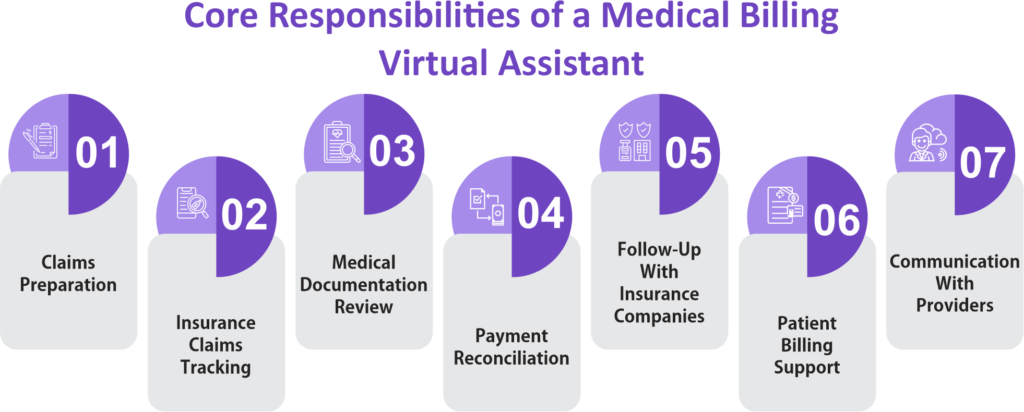
Core Responsibilities of a Medical Billing Virtual Assistant
A Medical Billing Virtual Assistant performs billing and administrative tasks that support accurate claim processing and consistent revenue cycle operations. Their responsibilities help healthcare organizations reduce billing delays, maintain documentation quality, and improve communication throughout the reimbursement process.
Claims Preparation
Preparing claims is one of the primary responsibilities of a medical billing virtual assistant. Before submitting a claim, the assistant reviews patient information, provider documentation, and billing codes to identify missing or incorrect details.
Typical responsibilities include:
1. Reviewing patient demographics
2. Confirming CPT®, HCPCS Level II, and ICD-10-CM code documentation
3. Verifying provider and payer information
4. Checking required modifiers
5. Preparing clean claims for submission
Insurance Claims Tracking
Claim submission is only one part of the billing process. A Virtual Assistant for Medical Billing monitors claim status throughout the payer review process and follows up when issues occur.
Common tracking activities include:
1. Monitoring submitted claims
2. Reviewing the clearinghouse reports
3. Identifying rejected or pending claims
4. Recording claim status updates
5. Coordinating claim corrections when needed
Medical Documentation Review
Medical documentation supports the services billed to insurance payers. Reviewing documentation before claim submission helps reduce coding discrepancies and billing errors.
Documentation review may include:
1. Confirming provider signatures
2. Checking encounter documentation
3. Identifying missing clinical information
4. Matching documentation with billed services
5. Reporting documentation deficiencies for correction
Payment Reconciliation
Payment reconciliation compares insurance reimbursements with submitted claims to identify payment differences and outstanding balances.
Responsibilities include:
1. Reviewing Electronic Remittance Advice (ERA)
2. Comparing payments with billed charges
3. Identifying underpayments or overpayments
4. Recording contractual adjustments
5. Reporting payment discrepancies
Follow-Up With Insurance Companies
Insurance carriers may request additional information before processing a claim. Timely follow-up helps prevent unnecessary payment delays.
A Healthcare Virtual Assistant for Medical Billing may:
1. Contact payer representatives
2. Verify claim status
3. Respond to documentation requests
4. Resolve claim processing issues
5. Track pending reimbursements
Patient Billing Support
After insurance payments are processed, patients may receive statements for remaining balances. Billing support helps patients understand their financial responsibility.
Common responsibilities include:
1. Preparing patient statements
2. Explaining insurance balances
3. Answering billing questions
4. Processing patient payments
5. Documenting billing communications
Patient Billing Support
Billing reports provide healthcare organizations with information about financial performance and claim activity. These reports help practice managers evaluate billing efficiency and identify areas requiring attention.
Common reports include:
1. Claim status reports
2. Accounts receivable aging reports
3. Denial reports
4. Payment summary reports
5. Outstanding balance reports
6. Collection reports
Communication With Providers
Effective communication between billing staff and healthcare providers helps resolve documentation issues before claims are submitted. This collaboration improves billing accuracy and reduces reimbursement delays.
A Remote Medical Billing Assistant may communicate with providers to:
1. Clarify clinical documentation
2. Request missing encounter information
3. Verify coding-related questions
4. Discuss payer requirements
5. Report billing trends affecting reimbursement
Medical Coding Knowledge Required for Medical Billing Virtual Assistants
A Medical Billing Virtual Assistant should understand the coding systems and documentation standards used in medical billing. Certified medical coders frequently assign codes, but billing personnel must understand coding rules to create accurate claims, identify billing concerns, and promote timely reimbursement.
CPT Codes
Current Procedural Terminology (CPT®) codes describe the medical, surgical, and diagnostic services performed by healthcare providers. These five-digit codes, maintained by the American Medical Association (AMA), are used by Medicare, Medicaid, and most commercial insurance payers to process claims.
A Medical Billing Virtual Assistant should be able to:
- Verify that CPT codes match the documented services.
- Check whether required modifiers are included.
- Identify missing or incomplete procedure information.
- Confirm that billed services are supported by provider documentation.
HCPCS Level II Codes
Healthcare Common Procedure Coding System (HCPCS) Level II codes identify products, supplies, medications, durable medical equipment (DME), ambulance services, and other healthcare items not included in CPT.
A Virtual Assistant for Medical Billing should understand how HCPCS Level II codes are used to:
- Bill medical supplies and equipment.
- Report injectable drugs and biological products.
- Submit claims for ambulance transportation.
- Support Medicare and Medicaid billing requirements.
ICD-10-CM Diagnosis Codes
ICD-10-CM diagnosis codes describe a patient’s medical condition, symptoms, injuries, or diseases. These codes establish the medical necessity for the services reported on a claim.
Medical billing professionals should verify that:
- Diagnosis codes support the billed procedures.
- The diagnosis is documented in the patient’s medical record.
- Code specificity meets payer requirements.
- Claims include the appropriate diagnosis sequence.
Medical Billing Modifiers
Modifiers provide additional information about a procedure or service without changing the CPT or HCPCS code itself. They help insurance payers understand the circumstances under which a service was provided.
A Healthcare Virtual Assistant for Medical Billing should recognize common modifier situations, including:
- Services performed on separate anatomical sites.
- Distinct procedural services.
- Reduced or discontinued services.
- Multiple procedures during the same encounter.
- Professional and technical components.
Documentation Requirements
Complete medical documentation supports every billed service and demonstrates that the care provided matches the claim submitted to the insurance payer. Incomplete records may lead to claim denials, payment delays, or audit findings.
Before preparing a claim, a Medical Billing Virtual Assistant should review documentation for:
- Patient demographics
- Date of service
- Provider signature, when required
- Clinical notes supporting medical necessity
- CPT, HCPCS Level II, and ICD-10-CM code documentation
- Required referrals or prior authorizations
National Correct Coding Initiative (NCCI) Edits
The National Correct Coding Initiative (NCCI), developed by the Centers for Medicare & Medicaid Services (CMS), promotes correct coding and helps prevent improper claim payments. NCCI edits identify code combinations that generally should not be reported together unless specific circumstances apply.
A Remote Medical Billing Assistant should understand how NCCI edits help:
- Identify incorrect code combinations.
- Detect duplicate billing.
- Review modifier requirements when applicable.
- Reduce avoidable claim denials.
- Support Medicare billing compliance.
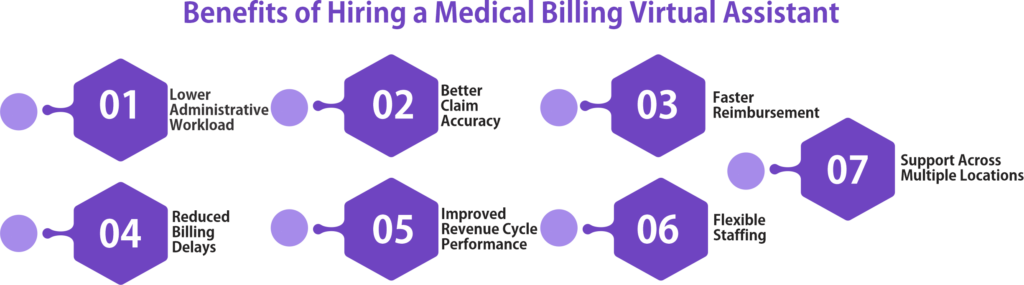
Benefits of Hiring a Medical Billing Virtual Assistant
A Medical Billing Virtual Assistant helps healthcare organizations manage billing responsibilities more efficiently while supporting accurate claim processing and revenue cycle operations. The benefits depend on clear workflows, proper training, secure access to billing systems, and compliance with payer and HIPAA requirements.
Lower Administrative Workload
Administrative responsibilities such as insurance verification, claim preparation, payment posting, and accounts receivable follow-up consume significant staff time. Delegating these tasks to a Medical Billing Virtual Assistant allows healthcare providers and office staff to spend more time on patient care and clinical operations.
Key advantages include:
- Less time spent on routine billing tasks
- Reduced workload for front-office staff
- Improved appointment scheduling efficiency
- Better allocation of internal resources
Better Claim Accuracy
Accurate claims improve reimbursement and reduce avoidable denials. A Virtual Assistant for Medical Billing reviews billing information before submission to identify missing documentation, coding inconsistencies, and demographic errors.
This support helps practices:
- Submit cleaner claims
- Reduce coding-related billing errors
- Improve documentation quality
- Decrease claim corrections after submission
Faster Reimbursement
Claims submitted with complete documentation and accurate billing information are generally processed more efficiently by insurance payers. Timely follow-up on pending claims also reduces unnecessary payment delays.
A billing virtual assistant supports faster reimbursement by:
- Preparing complete claims
- Monitoring claim status
- Correcting rejected claims promptly
- Following up with insurance companies
- Posting payments without delay
Reduced Billing Delays
Billing delays may result from incomplete documentation, missing authorizations, incorrect patient information, or coding issues. Addressing these problems before claim submission improves billing efficiency.
A Healthcare Virtual Assistant for Medical Billing helps reduce delays by:
- Verifying patient and insurance information
- Confirming prior authorization requirements
- Reviewing billing documentation
- Tracking claim progress
- Responding to payer requests for additional information
Improved Revenue Cycle Performance
Every stage of the revenue cycle affects financial performance. A medical billing virtual assistant supports consistent workflows from patient registration through payment collection.
Benefits include:
- Improved claim submission timelines
- Better accounts receivable management
- Lower denial rates
- More consistent payment posting
- Improved financial reporting
Flexible Staffing
Healthcare organizations often experience changes in patient volume, seasonal demand, or staffing availability. Medical Billing Virtual Assistant Services provide additional billing support without requiring permanent on-site staffing.
Flexible staffing can help practices:
- Manage temporary workload increases
- Support provider expansion
- Cover employee leave
- Assist with backlogged claims
- Scale billing operations as patient volumes change
Support Across Multiple Locations
Healthcare systems with multiple clinics or provider locations often require centralized billing coordination. A Remote Medical Billing Assistant can support billing activities across different locations while working through secure cloud-based billing platforms.
Common responsibilities include:
- Standardizing billing workflows
- Monitoring claims from multiple offices
- Coordinating communication with providers
- Tracking reimbursement across locations
- Supporting centralized revenue cycle reporting
Conclusion
A Medical Billing Virtual Assistant supports healthcare organizations by improving billing workflows, reducing administrative workload, and helping maintain accurate claim processing throughout the revenue cycle. With knowledge of medical billing, coding, payer requirements, and HIPAA compliance, these professionals contribute to more efficient reimbursement and stronger financial performance.
Before incorporating Medical Billing Virtual Assistant Services, healthcare organizations should evaluate experience, coding knowledge, software proficiency, compliance practices, and communication processes. Choosing qualified remote billing support helps practices maintain accurate billing operations while adapting to changing patient volumes and operational needs.
FAQs
What does a Medical Billing Virtual Assistant do?
A Medical Billing Virtual Assistant performs remote billing tasks such as insurance verification, charge entry, claim submission, payment posting, denial follow-up, accounts receivable management, and patient billing support to help healthcare organizations maintain an efficient revenue cycle.
What qualifications should a Medical Billing Virtual Assistant have?
A qualified Medical Billing Virtual Assistant should understand medical billing workflows, CPT®, HCPCS Level II, and ICD-10-CM coding principles, HIPAA requirements, insurance claims processing, and have experience using EHR, practice management, and medical billing software.
How does a Medical Billing Virtual Assistant improve revenue cycle performance?
By preparing accurate claims, tracking reimbursements, following up on denials, posting payments promptly, and monitoring accounts receivable, a Medical Billing Virtual Assistant helps reduce billing errors, improve claim acceptance rates, and support timely reimbursement.
Is a Medical Billing Virtual Assistant HIPAA compliant?
A Medical Billing Virtual Assistant can work in compliance with HIPAA when using secure systems, encrypted communication, role-based access controls, and following the healthcare organization’s privacy, security, and Business Associate Agreement (BAA) requirements.
Which healthcare organizations benefit from Medical Billing Virtual Assistant Services?
Medical Billing Virtual Assistant Services are beneficial for physician practices, hospitals, outpatient clinics, physical therapy centers, chiropractic offices, dental practices, behavioral health providers, home health agencies, and medical billing companies that need reliable remote billing support.