

What happens if you miss your Medicare revalidation deadline? In short, your Medicare Administrative Contractor (MAC) can deactivate your billing privileges, and Medicare generally will not pay for services you provide while you are deactivated. CMS requires most providers and suppliers to revalidate every five years, and DMEPOS suppliers every three years.
Quick answer: If you miss your Medicare revalidation deadline, the MAC may deactivate your Medicare enrollment. Claims for dates of service during the deactivation are generally not paid. To recover, submit a complete revalidation in PECOS right away, answer every MAC request and hold Medicare claims until your enrollment shows active again.
CMS posts revalidation due dates months in advance, and MACs usually mail or email a reminder a few months before the deadline. Even so, you are responsible for tracking your own date, whether or not a notice arrives. This guide covers the consequences, the recovery steps and how to prevent it next time.
Why Medicare Revalidation Matters
Before looking at what goes wrong, it helps to know why CMS asks for revalidation in the first place. It keeps enrollment data current and protects the program from improper payments.
What Is Medicare Revalidation?
Revalidation is the process CMS uses to confirm that your enrollment information is still accurate. During it, you resubmit and certify your data, including identity, ownership, licensure and practice locations. As a result, CMS can confirm that you still meet Medicare requirements.
Who Must Revalidate and How Often
Most enrolled physicians, non-physician practitioners, group practices and organizations must revalidate when CMS sets their due date. Here is the usual schedule:
- Most providers and suppliers revalidate every five years.
- DMEPOS suppliers revalidate every three years.
- CMS can also request an off-cycle revalidation at any time.
Routine revalidation follows the standard cycle. In contrast, off-cycle requests arrive outside that schedule, often after enrollment changes or data checks, and they carry their own deadline.
What Happens If You Miss Your Medicare Revalidation Deadline?
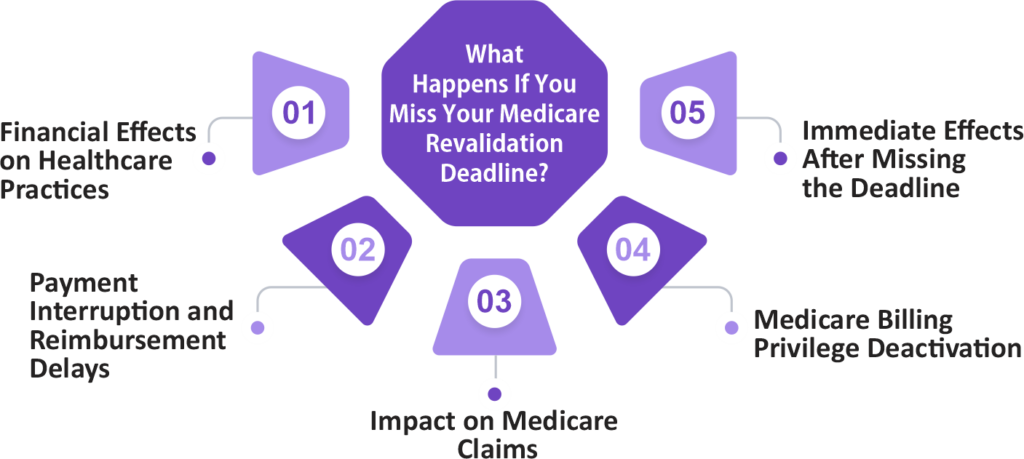
Here is what happens after a missed Medicare revalidation deadline, step by step. The effects start with enrollment status and quickly spread to claims, cash flow and even other providers in your group.
Billing Privileges Can Be Deactivated
If the MAC does not receive a complete revalidation by your Medicare revalidation deadline, it may deactivate your Medicare billing privileges. Deactivation stops Medicare payment, although it is not the same as revocation. In most cases, you can reactivate by submitting a complete revalidation.
Claims During the Gap Are Not Paid
Claims for services furnished while you are deactivated are generally not payable. Under current CMS practice, a reactivated provider typically keeps the same PTAN. However, the gap in billing privileges remains, so the revenue from that period is usually lost.
Groups and Referrals Feel It Too
Deactivation affects more than one clinician. For example, a group cannot bill for a deactivated provider’s services, even if the group itself is current. Likewise, labs, imaging centers and DME suppliers may see denials when a deactivated physician is listed as the ordering or referring provider.
Cash Flow and Workload Take a Hit
Practices that rely on Medicare can see collections drop and A/R grow while the file is fixed. Meanwhile, staff must gather documents, work with the MAC and track the application instead of handling routine work.
Medicare Revalidation Timeline at a Glance
The table below shows the usual sequence. Exact timing can vary by MAC, so always confirm your own due date.
| When | What usually happens | What you should do |
|---|---|---|
| Several months before | CMS posts your due date on its revalidation list. | Note the date and start gathering documents. |
| About 3 to 4 months before | The MAC sends a revalidation notice. | Submit the revalidation in PECOS. |
| Due date | The application must be received and complete. | Confirm receipt and watch for requests. |
| After a missed date | The MAC may deactivate billing privileges. | Submit a complete revalidation at once. |
| After reactivation | Billing resumes; the gap period usually stays unpaid. | Verify status before releasing held claims. |
What to Do If You Miss Medicare Revalidation
Acting quickly after a missed Medicare revalidation deadline limits the gap and speeds reactivation. Follow these steps in order.
Verify Your Enrollment Status
First, check your status and due date in PECOS or on the CMS revalidation list. This tells you whether privileges are still active and what action is needed.
Contact Your MAC
Next, call your MAC’s provider enrollment line. It can explain your status, list outstanding items and give reactivation instructions. Keep a record of every call and letter.
Submit a Complete Revalidation
Then, file the revalidation through PECOS or the right CMS-855 form. Before you submit, confirm ownership, practice locations, licenses and contact details are current, since errors restart the review. Many practices hand this step to a PECOS revalidation team to avoid another rejection.
Respond to Requests and Track the File
During review, the MAC may ask for more documents. Watch email, mail and PECOS notices, and reply before each deadline. Finally, resume Medicare billing only when your enrollment shows active again.
Common Reasons Providers Miss Revalidation Deadlines
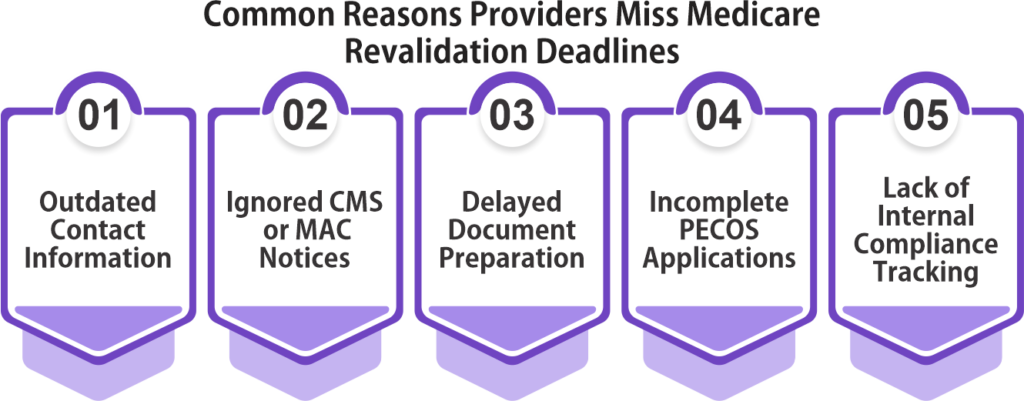
Knowing the usual causes makes them easier to prevent. Most missed deadlines trace back to one of these:
- Outdated contact details: Notices go to the address and email on file, so an old address means no reminder.
- Ignored notices: Letters get mistaken for routine mail, and emails land in spam.
- Late document prep: Waiting until the last weeks leaves too little time to gather records.
- Incomplete PECOS applications: Missing fields or uploads trigger requests and delays. Our list of frequent PECOS errors shows what to check.
- No internal owner: Without one person tracking dates, deadlines slip through the cracks.
How to Avoid Missing Future Medicare Revalidation Deadlines
Prevention takes a simple, repeatable process. These habits help practices revalidate on time, every time.
Watch the CMS Due Date List
Check the CMS revalidation list for every provider at least monthly, so no Medicare revalidation deadline catches you off guard. Do not rely only on MAC reminders. Instead, record each date in a shared calendar as soon as it appears and start gathering documents.
Keep PECOS and Contact Data Current
Update addresses, emails, phone numbers and ownership in PECOS whenever they change. Also review the profile periodically, even when nothing seems different, so notices reach the right person.
Assign One Owner and Set Reminders
Name one person to own revalidation for all providers. Then set several reminders, starting months ahead, and review upcoming dates in regular admin meetings. For larger groups, ongoing credentialing and enrollment management keeps every date on one tracker.
Keep Enrollment Records Organized
Store current copies of licenses, certifications, ownership records and practice details in one place. That way, you can revalidate or answer a MAC request quickly. If you are new to Medicare, our Medicare enrollment steps explain how the original application works.
Bottom Line
So, what happens if you miss your Medicare revalidation deadline? You risk deactivation, unpaid claims for the gap period and extra admin work. However, quick action limits the damage, and a simple tracking process prevents it from happening again. For current rules, check the CMS Medicare site.
FAQs
What happens if I miss my Medicare revalidation deadline?
If you miss the Medicare revalidation deadline, your MAC may deactivate your billing privileges. As a result, claims for services during the deactivation are generally not paid until you revalidate and are reactivated.
How can I check my Medicare revalidation due date?
Check the CMS revalidation due date list or log in to PECOS. Reviewing it regularly helps prevent missed deadlines.
Can I continue billing Medicare after my billing privileges are deactivated?
No. Medicare generally will not pay for services furnished during the deactivation period, even after your enrollment is restored.
How do I reactivate my Medicare enrollment after missing revalidation?
Submit a complete revalidation through PECOS or the right CMS-855 form, and respond promptly to any requests from your MAC.
How can healthcare practices avoid missing future Medicare revalidation deadlines?
Monitor the CMS due date list, keep PECOS information current, assign one person to own revalidation and use reminders to track upcoming dates.