
Are you preparing to enroll in Medicare but unsure where to begin? Starting the process without a clear Medicare Enrollment Checklist for New Physicians and Practices can lead to missing documents, application errors, and delays in obtaining billing privileges. CMS continues to recommend using the Internet-based Provider Enrollment, Chain, and Ownership System (PECOS), and Medicare provider enrollment records are maintained through this system to support accurate enrollment and updates.
What information do you need before submitting your Medicare enrollment application? Providers must verify their National Provider Identifier (NPI), ensure their NPPES and PECOS records match, select the correct CMS-855 enrollment form, and submit complete supporting documentation. In 2026, CMS continues to require no Medicare enrollment application fee for physicians and non-physician practitioners, while certain institutional providers and DMEPOS suppliers may be required to pay a $750 application fee in applicable enrollment situations.
How can you complete Medicare enrollment with fewer delays and fewer corrections? This guide provides a practical Medicare Enrollment Checklist for New Physicians and Practices, covering required documents, CMS enrollment forms, PECOS registration, common application mistakes, expected processing steps, and actions to take after receiving your Provider Transaction Access Number (PTAN). Following these steps can help new physicians and medical practices prepare complete applications and begin Medicare billing more efficiently.
Why Medicare Enrollment Is Required Before Billing Medicare
Medicare enrollment is required before physicians and eligible healthcare providers can submit claims and receive reimbursement for services provided to Medicare beneficiaries. Without an approved enrollment application and a Provider Transaction Access Number (PTAN), Medicare claims cannot be processed.
CMS recommends completing enrollment through PECOS because it supports electronic application submission and status tracking. Providers must also ensure their National Provider Identifier (NPI), practice information, and supporting documents match across CMS records to prevent avoidable delays.
Completing enrollment correctly protects cash flow and reduces claim rejections related to provider eligibility. For new physicians and medical practices, understanding these requirements before seeing Medicare patients helps establish billing compliance from the beginning.
Who Should Use This Checklist
This checklist is intended for new physicians, group practices, independent medical practices, nurse practitioners, physician assistants, and other healthcare professionals enrolling in Medicare for the first time. It is also valuable for practice managers, credentialing specialists, and medical billing teams responsible for provider enrollment.
Medical coders, revenue cycle professionals, and healthcare administrators can use the checklist to confirm that enrollment documents are complete before submission. Organized preparation reduces the risk of missing information that may delay Medicare approval.
Benefits of Preparing Before Starting Enrollment
Preparing documents before beginning Medicare enrollment helps providers complete applications more accurately and respond quickly to requests for additional information. Having required records available also reduces interruptions during the enrollment process.
Before starting your application, gather the following information:
1. National Provider Identifier (NPI)
2. Active state professional license
3. Tax Identification Number (TIN) or Employer Identification Number (EIN)
4. Practice address and contact information
5. Banking details for Electronic Funds Transfer (CMS-588)
6. Ownership and managing employee information
7. Professional certifications and supporting documents
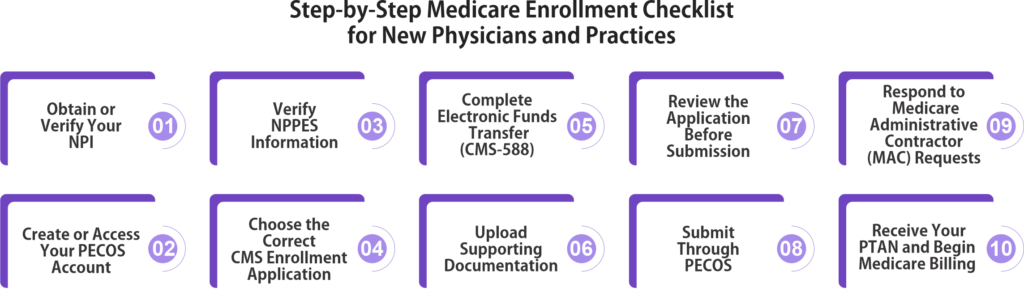
Step-by-Step Medicare Enrollment Checklist for New Physicians and Practices
The Medicare Enrollment Checklist for New Physicians and Practices follows a clear sequence that helps providers complete enrollment accurately and reduce avoidable delays. Completing each step in order improves application quality and supports faster Medicare approval.
Step 1: Obtain or Verify Your NPI
Apply for a National Provider Identifier (NPI) through the National Plan and Provider Enumeration System (NPPES) if you do not already have one. Providers with an existing NPI should confirm that all information is up to date.
Before moving to the next step, verify that your NPI includes:
1. Legal provider name
2. Active NPI status
3. Correct taxonomy code
4. Current practice address
5. Updated contact information
Step 2: Create or Access Your PECOS Account
Create a PECOS account or sign in using your existing login credentials. CMS recommends Internet-based PECOS because it supports electronic enrollment and application tracking.
Before starting your application, confirm that:
1. Your PECOS account is active
2. Login credentials work correctly
3. Your provider profile is accessible
4. Contact information is current
5. You can access enrollment applications
Step 3: Verify NPPES Information
Review your NPPES profile before completing Medicare enrollment. Information in NPPES should match the details entered in PECOS.
Review the following information carefully:
1. Provider name
2. Practice address
3. Taxonomy code
4. Contact information
5. Specialty designation
Step 4: Choose the Correct CMS Enrollment Application
Select the CMS enrollment application that matches your provider or practice type. Using the correct form reduces processing delays and prevents unnecessary corrections.
Common Medicare enrollment forms include:
CMS-855I: Individual physicians and eligible practitioners
CMS-855B: Group practices and organizations
CMS-855R: Reassignment of Medicare benefits
CMS-855O: Ordering or referring providers
CMS-588: Electronic Funds Transfer (EFT)
Step 5: Complete Electronic Funds Transfer (CMS-588)
Complete the CMS-588 form to receive Medicare payments through direct deposit. Include accurate banking information and any supporting documents requested by CMS.
Prepare the following before completing CMS-588:
1. Bank account information
2. Routing number
3. Account number
4. Voided check or bank letter (if requested)
5. Authorized signature
Step 6: Upload Supporting Documentation
Attach all required supporting documents before submitting the application. Missing documents often result in requests for additional information from the Medicare Administrative Contractor (MAC).
Common supporting documents include:
1. State professional license
2. IRS documentation
3. Business formation records
4. Ownership information
5. Government-issued identification
6. Professional certifications
Step 7: Review the Application Before Submission
Review every section of the application before submitting it through PECOS. Confirm that provider, practice, ownership, and banking information are complete and accurate.
Verify the following before submitting:
1. Provider information
2. Practice details
3. Ownership disclosures
4. Banking information
5. Supporting documents
6. Required signatures
Step 8: Submit Through PECOS
Submit your completed Medicare enrollment application through PECOS after confirming all required information. Save a copy of the confirmation page and application records for future reference.
After submission, remember to:
1. Save your confirmation receipt
2. Record the submission date
3. Monitor PECOS status
4. Check email notifications
5. Respond promptly to requests
Step 9: Respond to Medicare Administrative Contractor (MAC) Requests
The Medicare Administrative Contractor may request additional documents or clarification during application review. Respond within the requested timeframe to keep the application moving.
A MAC may request:
1. Additional documentation
2. Identity verification
3. Ownership clarification
4. License verification
5. Banking confirmation
Step 10: Receive Your PTAN and Begin Medicare Billing
After CMS approves your enrollment, you will receive your Provider Transaction Access Number (PTAN). This number identifies your Medicare enrollment for billing purposes.
Before submitting your first Medicare claim, confirm that:
1. Your PTAN has been issued
2. Your NPI is correctly linked
3. Billing software is updated
4. Practice information is accurate
5. Medicare claim settings are active
Medicare Enrollment Requirements by Provider Type
Medicare enrollment requirements vary depending on the provider’s specialty, practice structure, and billing arrangement. Understanding these differences helps physicians and healthcare organizations submit the correct application, prepare the required documents, and reduce enrollment delays.
1. Physicians
Physicians enrolling in Medicare must obtain an active National Provider Identifier (NPI), maintain a valid state medical license, and complete the appropriate CMS enrollment application. Most individual physicians enroll using the CMS-855I form through PECOS.
Physicians should prepare:
- Active NPI
- State medical license
- DEA registration (if applicable)
- Tax Identification Number (TIN) or Employer Identification Number (EIN)
- CMS-855I application
- CMS-588 for Electronic Funds Transfer (EFT)
After approval, physicians receive a Provider Transaction Access Number (PTAN), allowing them to submit Medicare claims and receive reimbursement.
2. Nurse Practitioners
Nurse Practitioners (NPs) who meet Medicare eligibility requirements may enroll independently or work under a group practice, depending on their practice arrangement. Enrollment requires accurate licensing and provider information.
Required documents include:
- Active NPI
- State NP license
- National certification
- Collaborative practice documentation (where required)
- CMS-855I application
- EFT information
Maintaining consistent information across NPPES and PECOS helps reduce processing delays.
3. Physician Assistants
Physician Assistants (PAs) may enroll in Medicare if they meet CMS eligibility requirements. Their enrollment records should accurately reflect supervising or employing practice information when applicable.
Prepare the following before applying:
- Active NPI
- State PA license
- National certification
- Practice information
- CMS-855I application
- Banking information for EFT
Accurate enrollment records help support timely Medicare billing after approval.
4. Physical Therapists
Physical Therapists providing Medicare-covered outpatient therapy services must enroll before billing Medicare. Enrollment also requires compliance with Medicare documentation and billing requirements.
Prepare these documents:
- Active NPI
- State Physical Therapy license
- Practice information
- CMS-855I application
- EFT documentation
Providers should verify that their specialty designation matches Medicare enrollment records.
5. Occupational Therapists
Occupational Therapists enrolling in Medicare should maintain current licensing and provider information before submitting an application. Accurate records help reduce enrollment delays.
Common enrollment requirements include:
- Active NPI
- State Occupational Therapy license
- Practice address
- CMS-855I application
- Banking information
Complete documentation supports faster application review.
6. Mental Health Providers
Eligible psychologists, clinical social workers, clinical counselors (where applicable), and other qualified mental health professionals must enroll before billing Medicare for covered services.
Typical enrollment documents include:
- Active NPI
- State professional license
- Certification or credential information
- Practice details
- CMS enrollment application
Review all licensing information before submitting your application.
7. Chiropractors
Chiropractors may enroll in Medicare to bill for covered chiropractic services allowed under Medicare regulations. Enrollment requires current licensing and accurate provider information.
Prepare the following:
- Active NPI
- State chiropractic license
- Practice information
- CMS-855I application
- EFT documentation
Review Medicare coverage policies before submitting claims for chiropractic services.
7. Dentists
Dentists generally enroll in Medicare only when providing services covered under Medicare regulations or when enrollment is required for ordering or referring certain services.
Common enrollment documents include:
- Active NPI
- State dental license
- Practice information
- Appropriate CMS enrollment form
- Supporting identification documents
Providers should determine the appropriate enrollment category before applying.
8. Group Practices
Group practices enrolling in Medicare must register the organization separately from individual providers. The practice should also establish reassignment of benefits when applicable.
Group practice enrollment generally requires:
- CMS-855B application
- Employer Identification Number (EIN)
- Business formation documents
- Ownership disclosures
- CMS-855R forms for provider reassignment
- CMS-588 for EFT
Maintaining complete ownership and organizational records supports smoother enrollment.
9. Multi-location Practices
Healthcare organizations operating multiple practice locations should verify that each service location is correctly reported during Medicare enrollment. Each location should meet CMS reporting requirements.
Before submitting enrollment information, confirm:
- Practice addresses for every location
- Provider assignments
- Ownership information
- Contact information
- Billing locations
- CMS reporting requirements for each site
Keeping location records current helps reduce billing issues and supports accurate Medicare reimbursement across all practice sites.
Conclusion
Completing the Medicare Enrollment Checklist for New Physicians and Practices helps providers prepare accurate documentation, select the correct CMS enrollment forms, and reduce avoidable processing delays. A well-prepared application supports faster approval and allows physicians and medical practices to begin Medicare billing with greater confidence.
Successful Medicare enrollment requires consistent information across NPPES, PECOS, CMS applications, and supporting documents. Reviewing every requirement before submission helps prevent requests for additional information, minimizes claim delays, and strengthens long-term billing compliance.
As Medicare enrollment requirements continue to evolve, practices should regularly monitor CMS guidance, maintain current provider records, and complete timely revalidation when required. Following a structured enrollment checklist helps new physicians and healthcare organizations establish a strong foundation for compliant and efficient Medicare participation.
FAQs
How long does Medicare enrollment take for new physicians?
Most Medicare enrollment applications are processed within 30 to 90 days, depending on application accuracy, supporting documents, and Medicare Administrative Contractor (MAC) review.
What documents are required for Medicare enrollment?
Providers typically need an NPI, state license, Tax Identification Number (TIN/EIN), CMS enrollment forms, banking information (CMS-588), and supporting business documents.
Which CMS form should a new physician use for Medicare enrollment?
Most individual physicians use CMS-855I, while group practices use CMS-855B. Other forms, such as CMS-855R and CMS-588, may also be required based on the provider’s enrollment situation.
Can I bill Medicare before my enrollment is approved?
No. Providers must receive Medicare approval and a Provider Transaction Access Number (PTAN) before submitting Medicare claims, except in limited circumstances permitted by CMS.
How can I avoid delays during Medicare enrollment?
Verify that your NPI, NPPES, PECOS, licensing, tax information, and supporting documents are accurate and consistent before submitting your Medicare enrollment application.