
Relocating your healthcare practice or expanding into another state can interrupt Medicaid billing if you are unsure how provider enrollment works. How Do I Transfer My Medicaid Enrollment to Another State? It is a common question because Medicaid provider enrollment is generally managed by individual state Medicaid agencies. As of March 2026, more than 74.2 million people were enrolled in Medicaid and CHIP nationwide, making timely provider enrollment essential for uninterrupted reimbursement.
Many providers assume they can transfer an existing Medicaid enrollment to another state, but this often results in application delays and rejected claims. Every state has its own enrollment requirements, provider screening process, participation agreements, and billing policies. Missing documents or applying before obtaining the required state license can delay approval and Medicaid payments.
This guide explains when a new Medicaid provider enrollment is required, the documents needed, common mistakes to avoid, expected processing timelines, and billing considerations. It also outlines practical steps to help healthcare providers maintain compliance and reduce reimbursement disruptions when relocating or expanding into another state.
Can I Transfer Medicaid Enrollment to Another State?
Many providers ask, How Do You Transfer My Medicaid Enrollment to Another State? The answer depends on how Medicaid is administered because provider enrollment is generally handled by each state. Understanding this distinction helps reduce enrollment delays, billing interruptions, and claim denials.
Why Medicaid Provider Enrollment Is State-Specific
Medicaid is a joint federal and state program, but each state administers its own provider enrollment system within federal requirements. This means providers generally cannot move an active Medicaid enrollment from one state to another as they would with a professional license. Instead, they must satisfy the enrollment requirements established by the destination state’s Medicaid agency.
Each state determines its own provider participation agreements, screening procedures, enrollment forms, documentation standards, and effective dates. As a result, processing times and application requirements vary across states. According to CMS, state Medicaid agencies are responsible for provider enrollment and screening in accordance with federal regulations, making provider enrollment a state-managed process rather than a national program.
Transfer vs. New Medicaid Provider Enrollment
Many healthcare providers use the term Transfer Medicaid Enrollment to Another State, but in most situations, the process involves submitting a new Medicaid provider enrollment application rather than transferring an existing enrollment. Although your National Provider Identifier (NPI) remains the same nationwide, your Medicaid participation is generally approved separately by each state’s Medicaid program.
Before applying, verify that you meet the new state’s licensing, ownership disclosure, and provider screening requirements. Some states also require enrollment with Medicaid Managed Care Organizations (MCOs) after state approval before you can bill their members.
How State Medicaid Agencies Manage Provider Enrollment
Every state Medicaid agency reviews provider applications to verify eligibility before granting billing privileges. The review commonly includes professional licensure, NPI validation, ownership disclosures, tax identification, sanctions screening, and supporting documentation. Certain provider types may also undergo fingerprint-based background checks or enhanced screening, depending on federal and state requirements.
After approval, providers receive authorization to participate in that state’s Medicaid program and may begin billing according to the state’s effective date and billing policies. Healthcare providers relocating or expanding into another state should begin the enrollment process early to reduce reimbursement delays and maintain continuity in patient care.
Why Healthcare Providers Must Complete a New Enrollment
Understanding How to Transfer My Medicaid Enrollment to Another State? starts with worry, why providers usually need a new Medicaid enrollment instead of transferring an existing one. Completing the correct enrollment process helps protect billing privileges, supports compliance, and reduces reimbursement delays.
Federal Oversight and State Administration
Medicaid is funded jointly by the federal government and the states, but each state administers its own provider enrollment program. The Centers for Medicare & Medicaid Services (CMS) establishes federal enrollment and screening standards under 42 CFR Part 455, while state Medicaid agencies determine provider participation requirements, enrollment procedures, and billing policies.
Because enrollment is state-specific, approval in one state does not automatically authorize a provider to bill Medicaid in another. Healthcare providers relocating or expanding their practice must submit a new application that meets the destination state’s requirements. This process supports program integrity, verifies provider qualifications, and helps prevent improper payments.
Licensing Requirements Before Enrollment
An active professional license issued by the destination state is typically required before submitting a Medicaid provider enrollment application. Most state Medicaid agencies verify licensure, National Provider Identifier (NPI) information, specialty classification, ownership disclosures, and tax identification during the review process.
Depending on the provider type, additional documents may include DEA registration, board certifications, malpractice insurance information, or facility accreditation. Preparing these records before applying can reduce requests for additional information and shorten processing times.
Individual Providers vs. Group Practices
Enrollment requirements vary for individual practitioners and group practices. Individual providers generally enroll under their own NPI and professional credentials, while group practices must also provide organizational information, ownership disclosures, tax identification details, and practice location records.
If a provider joins an existing group in another state, both the individual provider and the organization may need separate Medicaid enrollment or affiliation approval before claims can be submitted. Reviewing the destination state’s Medicaid Provider Enrollment by State requirements before relocating helps practices maintain billing continuity and avoid unnecessary delays.
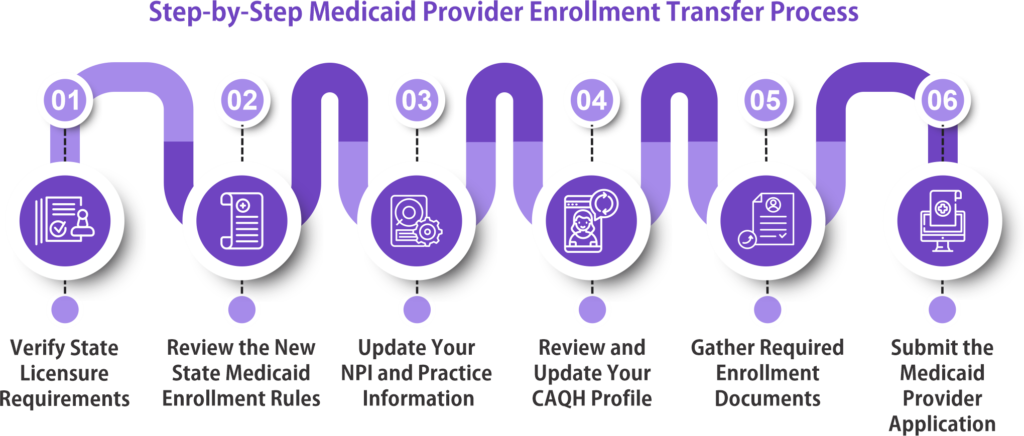
Step-by-Step Medicaid Provider Enrollment Transfer Process
If you are asking, How Do You Transfer My Medicaid Enrollment to Another State?, following the correct enrollment process helps reduce delays and supports uninterrupted Medicaid billing. Completing each step in the proper order improves application accuracy and speeds up approval.
Step 1: Verify State Licensure Requirements
Before applying, confirm that you hold an active professional license in the destination state. Most Medicaid agencies require state licensure before reviewing a provider enrollment application.
Verify license eligibility with the state licensing board.
Complete any required license endorsements before applying.
Step 2: Review the New State Medicaid Enrollment Rules
Each state establishes its own enrollment requirements, provider types, and submission process. Reviewing these rules early helps prevent incomplete applications.
- Visit the destination state’s Medicaid provider enrollment portal.
- Review eligibility, provider classifications, and submission requirements.
Step 3: Update Your NPI and Practice Information
Ensure your National Provider Identifier (NPI) record reflects your current practice information. Accurate provider data helps prevent enrollment delays.
- Update practice addresses in NPPES, if needed.
- Confirm taxonomy codes and contact information are correct.
Step 4: Review and Update Your CAQH Profile
Many payers use CAQH information during credentialing and enrollment reviews. An updated profile supports consistent provider information.
- Review education, work history, and practice details.
- Re-attest your CAQH profile if updates are made.
Step 5: Gather Required Enrollment Documents
Prepare all required documents before starting the application. Missing records commonly delay enrollment approval.
- Professional license and NPI confirmation.
- Tax identification, ownership disclosures, and supporting credentials.
Step 6: Submit the Medicaid Provider Application
Complete the enrollment application using the state’s approved online portal or paper process. Review every section before submission.
- Enter accurate provider and practice information.
- Upload all required supporting documentation.
Step 7: Complete Screening and Verification Requirements
State Medicaid agencies verify provider qualifications before granting billing privileges. Certain provider types may require additional screening.
- Respond promptly to requests for additional information.
- Complete background screening or fingerprinting if required.
Step 8: Sign Provider Participation Agreements
Most Medicaid programs require providers to sign participation agreements before enrollment becomes effective. These agreements define program responsibilities and billing obligations.
- Review participation terms carefully.
- Submit signed agreements within the required timeframe.
Step 9: Enroll with Medicaid Managed Care Organizations (If Required)
Some states require separate enrollment with Medicaid Managed Care Organizations (MCOs) after state Medicaid approval. State enrollment alone may not allow billing for all Medicaid members.
- Identify participating MCOs in your new state.
- Complete payer-specific credentialing and contracting requirements.
Step 10: Confirm Enrollment Approval Before Billing
Wait until your enrollment is approved and the effective date is confirmed before submitting Medicaid claims. Billing before approval may result in claim denials.
- Verify your enrollment status through the state Medicaid portal.
- Confirm billing eligibility before treating Medicaid beneficiaries.
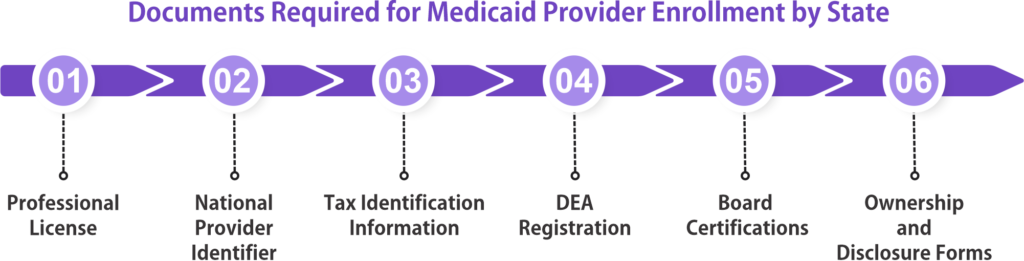
Documents Required for Medicaid Provider Enrollment by State
Preparing complete documentation before applying helps reduce enrollment delays and requests for additional information. Medicaid Provider Enrollment by State requirements vary, but most state Medicaid agencies request a core set of provider and practice documents.
Professional License
An active professional license issued by the destination state is required before most Medicaid enrollment applications are reviewed. The license must remain valid throughout the enrollment process.
- Submit a current state professional license.
- Ensure the license matches the provider’s legal name and specialty.
National Provider Identifier (NPI)
Your National Provider Identifier (NPI) is a permanent federal identifier used during Medicaid enrollment. State Medicaid agencies verify your NPI through the National Plan and Provider Enumeration System (NPPES).
- Provide your individual or organizational NPI.
- Confirm that practice addresses and taxonomy codes are current.
Tax Identification Information
Tax records establish the legal entity responsible for Medicaid reimbursement. The information must match federal tax records and enrollment documents.
- Submit your Employer Identification Number (EIN) or Social Security Number (if applicable).
- Verify the legal business name and tax classification.
DEA Registration (If Applicable)
Providers who prescribe or administer controlled substances may need to submit a valid Drug Enforcement Administration (DEA) registration. Some provider types are exempt from this requirement.
- Include a current DEA certificate when applicable.
- Verify that the registration reflects the correct practice location.
Board Certifications
Some provider specialties must provide board certification or specialty credentials as part of the enrollment review. These documents help verify professional qualifications.
- Submit specialty board certifications when required.
- Include additional certifications requested by the state Medicaid agency.
Ownership and Disclosure Forms
Federal regulations require providers to disclose ownership, control interests, and managing employees during Medicaid enrollment. Complete and accurate disclosures help prevent processing delays.
- Provide ownership and manage employee information.
- Report any required affiliations or controlling interests.
Electronic Funds Transfer (EFT) Information
Electronic Funds Transfer (EFT) allows Medicaid payments to be deposited directly into your designated bank account after claims are approved.
- Submit completed EFT authorization forms.
- Provide supporting banking information requested by the state.
Professional Liability Insurance
Many state Medicaid programs request proof of professional liability insurance during enrollment or credentialing. Coverage requirements differ by provider type and state regulations.
- Submit a current certificate of professional liability insurance.
- Verify that policy coverage remains active throughout the enrollment period.
Conclusion
Understanding the transfer of Medicaid Enrollment to Another State begins with recognizing that Medicaid provider enrollment is generally state-specific. Preparing the required documents, meeting licensing requirements, and following each state’s enrollment process can help reduce delays, protect billing privileges, and support uninterrupted reimbursement.
Planning is essential when relocating or expanding your practice into another state. By completing the Medicaid Provider Enrollment Transfer Process correctly and keeping provider information current, healthcare providers can maintain compliance, minimize claim disruptions, and continue delivering care without unnecessary billing interruptions.
FAQs
Can I transfer my Medicaid provider enrollment to another state?
In most cases, no. Medicaid provider enrollment is state-specific, so providers generally must complete a new enrollment application with the destination state’s Medicaid agency.
How long does Medicaid provider enrollment take in a new state?
Processing times vary by state and provider type, but commonly range from 60 to 120 days if all required documents are submitted correctly.
What documents are required for Medicaid provider enrollment?
Most states require a professional license, NPI, tax identification information, ownership disclosures, EFT details, and other supporting credentials based on the provider type.
Can I bill Medicaid before my new enrollment is approved?
Generally, no. Providers should wait until the state Medicaid agency has approved enrollment and confirmed the effective billing date.
Do I need to update my NPI and CAQH information before applying?
Yes. Keeping your NPI and CAQH profile current helps ensure consistent provider information and can reduce enrollment processing delays.