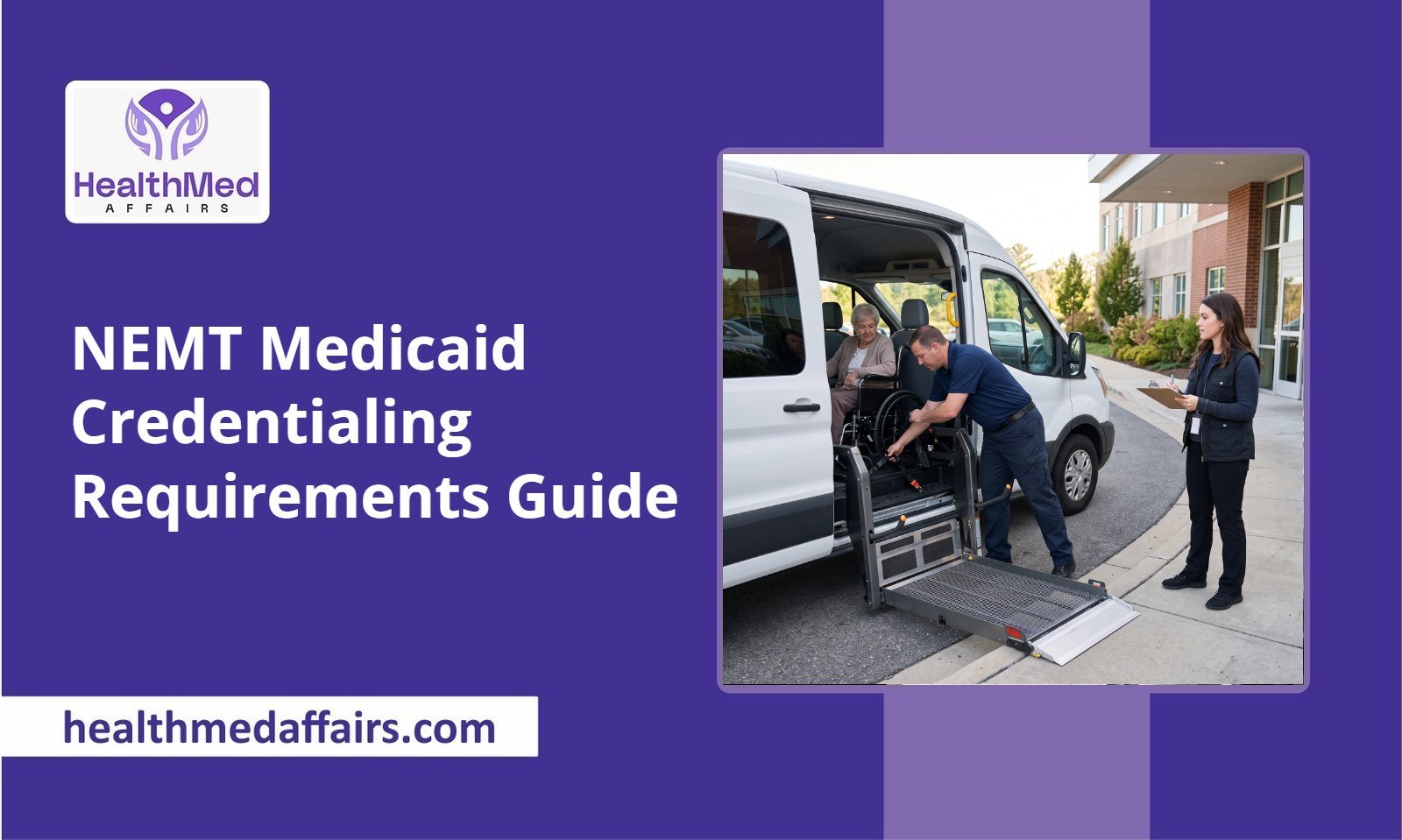
NEMT Medicaid credentialing requirements come from two layers. Federal law sets a short list of minimums that every state must enforce for transportation providers and drivers. Each state, and often its transportation broker or managed care plans, then adds its own rules for licensing, vehicles, insurance, training and inspections. To get paid for Medicaid rides, an NEMT company has to pass both layers and keep passing them.
This guide is for owners and operations managers of non-emergency medical transportation companies who want to enroll with Medicaid, join a broker network or add vehicles and drivers. It covers the federal minimums, typical state and broker standards, ADA vehicle compliance, driver screening, the enrollment steps and the mistakes that delay approval.
Quick answer: Every Medicaid NEMT provider and driver must pass federal exclusion screening, and every driver needs a valid license. Providers also need a process to handle state drug law violations and to report each driver’s driving history to the state. On top of that, expect state enrollment, a broker or plan contract, vehicle inspections, insurance, fingerprint background checks, drug screens and passenger assistance training.
Key takeaways
- Federal minimums apply everywhere. Since December 27, 2021, states must ensure NEMT providers and drivers are not excluded, drivers are licensed, and driving history is disclosed.
- States and brokers set most of the rules. Background checks, drug testing, training, vehicle standards and insurance limits vary by state and by contract.
- Wheelchair vans must meet ADA lift and securement specifications. That includes a 600-pound lift design load and a 30 by 48 inch securement space.
- Credentialing never really ends. Expect monthly exclusion checks, ongoing driving record monitoring and yearly document and vehicle renewals.
What Are NEMT Medicaid Credentialing Requirements?
NEMT Medicaid credentialing requirements are the standards a transportation company, its drivers and its vehicles must meet before Medicaid will pay for rides. Medicaid must assure that eligible members can get to and from covered care. States meet that duty in different ways: some pay providers directly, many contract with a transportation broker, and others include NEMT in managed care plans. As a result, the same company may need to credential with the state, a broker and several plans.
In practice, credentialing has three parts. First, the business enrolls as a Medicaid provider. Next, the state or broker screens and approves each driver and vehicle. Finally, the company signs a contract with whoever manages rides in that region. Our explainer on credentialing vs. enrollment shows why these are separate steps.
Federal NEMT Medicaid Credentialing Requirements and Guidelines
Federal Medicaid non-emergency medical transportation guidelines changed in 2020, and they now form the base of every state program. Section 209 of the Consolidated Appropriations Act, 2021 wrote the transportation assurance into the Social Security Act and added minimum standards for providers and drivers. These minimums apply to services on or after December 27, 2021, and each state had to file a state plan amendment describing how it checks them. The CMS informational bulletin on Section 209 lists four requirements:
- Each provider and each individual driver is not excluded from any federal health care program and is not on the HHS Office of Inspector General exclusion list.
- Also, each individual driver holds a valid driver’s license.
- Each provider has a process to address any violation of a state drug law.
- Each provider has a process to disclose each employed driver’s driving history, including traffic violations, to the state Medicaid program.
In addition, these rules cover transportation network companies, but not public transit authorities. States may verify them through attestation, so a signed form can be part of the process. However, most states and brokers go well beyond these four items, so the full NEMT Medicaid credentialing requirements in your state will be longer.
State Transportation Broker Credentialing
State transportation broker credentialing is where most of the detailed work happens. A broker manages trip requests, assigns rides to network providers and checks that those providers meet the state contract. Brokers usually credential the company once, then approve each driver and vehicle before it can take a trip. They also monitor compliance through audits, complaints and spot inspections.
Broker and state requirements vary. Even so, most include the items below. Always confirm the current list in your state’s provider manual or broker agreement before you apply.
| Area | What states and brokers commonly require |
|---|---|
| Business | State business registration, EIN, NPI, Medicaid enrollment, local operating permits where required |
| Insurance | Commercial auto liability, general liability and workers’ compensation at contract limits, with the broker named as certificate holder |
| Drivers | Minimum age, valid license, clean driving record, fingerprint background check, drug screen, required training |
| Vehicles | Registration, initial and periodic inspection, required safety equipment, ADA compliance for wheelchair vehicles |
| Operations | Trip logs, signatures or electronic trip verification, complaint handling, incident reporting |
| Ongoing | Annual document renewal, monthly exclusion checks, driving record monitoring, re-inspection |
NEMT Driver Background Check Standards Under Medicaid Credentialing Requirements
NEMT driver background check standards go far beyond a license check. For example, one large broker’s Mississippi provider manual requires drivers to be at least 18, pass a fingerprint-based national criminal background check with sex offender registry search, and pass a pre-employment nine-panel drug screen. That same manual removes drivers with recent DWI convictions or too many moving violations, and it requires continuous driving record monitoring. Other states, however, set their own look-back periods and disqualifying offenses.
Most programs also require training before a driver’s first trip. Common courses include:
- Passenger assistance, safety and sensitivity training
- Defensive driving
- First aid, CPR and AED
- Wheelchair securement, for drivers of lift or ramp vehicles
- Bloodborne pathogens and spill kit handling
- HIPAA privacy basics, because drivers see member health information
Watch out: The federal exclusion check is not a one-time step. Screen every owner, manager and driver against the OIG exclusion list and your state’s Medicaid exclusion list before hire and at least monthly after that. One excluded driver can put every claim for their trips at risk.
ADA Vehicle Compliance for NEMT Medicaid Credentialing
ADA vehicle compliance for NEMT matters most for wheelchair vans. For that reason, brokers and states usually point to the federal vehicle accessibility specifications in 49 CFR 38.23 when they inspect lifts, ramps and securement systems. The key numbers are:
- Lift design load: at least 600 pounds.
- Lift platform: at least 28½ inches wide at the platform and 30 by 48 inches of clear space above it.
- Ramp slope: as gentle as practicable and never steeper than 1:4, with tighter limits as the rise increases.
- Securement space: 30 by 48 inches of clear floor space for each wheelchair position.
- Occupant restraint: a seat belt and shoulder harness for each wheelchair position, separate from the wheelchair tiedowns.
Beyond the lift, inspectors also check everyday safety items. Common lists include seat belt extenders, a belt cutter, a first aid kit, a fire extinguisher, reflective triangles, a spill kit and working two-way communication. Therefore, keep a dated inspection record for every vehicle, because brokers often ask for it during audits.
How to Get Credentialed for NEMT Medicaid
If you are wondering how to get credentialed for NEMT Medicaid, follow these steps in order, because each one depends on the last. Skipping ahead, for example applying to a broker before your Medicaid enrollment is active, usually adds weeks.
Step 1Set up the business
First, register the company in your state, get an EIN and apply for a Type 2 NPI as a transportation provider. Then buy the commercial insurance your state and broker require, and collect the certificates.
Step 2Enroll with state Medicaid
Next, submit the state Medicaid provider application for NEMT, with your NPI, ownership disclosures, insurance, licenses and any required site visit. If you already hold Medicaid enrollment in another state, our guide to moving Medicaid enrollment to another state explains why you still need a new application.
Step 3Screen drivers and prepare vehicles
Meanwhile, run background checks, drug screens, driving record checks and exclusion checks for each driver, and finish required training. Next, schedule vehicle inspections and fix any issues before the broker visit.
Step 4Apply to the broker or managed care plans
After that, complete the broker or plan credentialing packet, upload driver and vehicle files, and sign the transportation provider agreement. Our list of documents required for credentialing can help you build a complete packet.
Step 5Go live and stay compliant
Once you are approved, set up trip verification, billing and complaint handling. Finally, calendar every renewal date for insurance, licenses, training, inspections and revalidation.
NEMT Provider Enrollment Requirements by Delivery Model
NEMT provider enrollment requirements depend on how your state delivers the benefit. For this reason, the table below shows the three common models and what each means for a new provider.
| Delivery model | Who credentials you | What to expect |
|---|---|---|
| Fee-for-service | State Medicaid agency | Direct enrollment and billing to the state, often with state-run vehicle and driver checks |
| Statewide or regional broker | Broker, after state enrollment | Broker credentialing packet, driver and vehicle approval, trip assignment through the broker |
| Managed care | Each health plan or its transportation vendor | Separate contracts per plan, with different documents and renewal cycles |
For billing, claims for rides usually use HCPCS transportation codes such as A0100 for taxi, A0130 for wheelchair van and T2003 for an encounter or trip, but each state chooses which codes and modifiers it accepts. So check your state’s fee schedule before you bill.
Common Mistakes With NEMT Medicaid Credentialing Requirements
- Applying to a broker before Medicaid enrollment is active.
- Insurance certificates that miss the required limits or the broker as certificate holder.
- Drivers who start trips before the broker approves their files.
- Skipping monthly exclusion checks after hire, even though screening never stops.
- Wheelchair vehicles with missing securement parts or no inspection record.
- Letting one document expire, because that can pause the whole company in some networks.
Example: Meeting NEMT Medicaid Credentialing Requirements as a New Company
Consider a hypothetical company in a broker state that launches with two sedans and one wheelchair van. First, the owner enrolls with state Medicaid and buys insurance at the broker’s limits. Next, she runs fingerprint checks, drug screens and exclusion checks on three drivers, and books CPR and passenger assistance training. Then the broker inspector fails the van because one securement strap is missing. She replaces it, passes re-inspection, and the broker approves all three vehicles. Finally, she sets up a renewal calendar so no license or certificate lapses.
When to Use NEMT Credentialing Services
Most NEMT owners know how to run trips, but NEMT Medicaid credentialing requirements, broker packets and renewals pull them away from operations. Navigating state-specific broker mandates and vehicle compliance checks can cause month-long delays; relying on specialized NEMT Credentialing Services ensures your application package is complete and audit-ready from day one. It also helps to understand credentialing vs. contracting, since a broker contract is a separate step from approval.
Get your NEMT company Medicaid-ready
We handle Medicaid enrollment, broker packets, driver and vehicle files, and renewals so your vans stay on the road.
Frequently Asked Questions
What are the federal NEMT driver requirements for Medicaid?
Each driver must hold a valid license and must not be excluded from federal health care programs. The provider must also have a process to address state drug law violations and to disclose each driver’s driving history to the state.
Do NEMT drivers need a background check?
Federal law does not spell out a criminal background check, but most states and brokers require one, often fingerprint-based, along with a drug screen and driving record review.
Do I need an NPI to be an NEMT provider?
Most states require a Type 2 organizational NPI for NEMT enrollment and billing. Check your state Medicaid provider manual to confirm.
How long does NEMT Medicaid credentialing take?
It depends on the state, the broker and how complete your packet is. Missing insurance details, unapproved drivers and failed vehicle inspections are the most common causes of delay.
Do wheelchair vans have to meet ADA standards?
Yes. Brokers and states generally inspect lifts, ramps and securement systems against federal accessibility specifications, including a 600-pound lift design load and a 30 by 48 inch securement space.