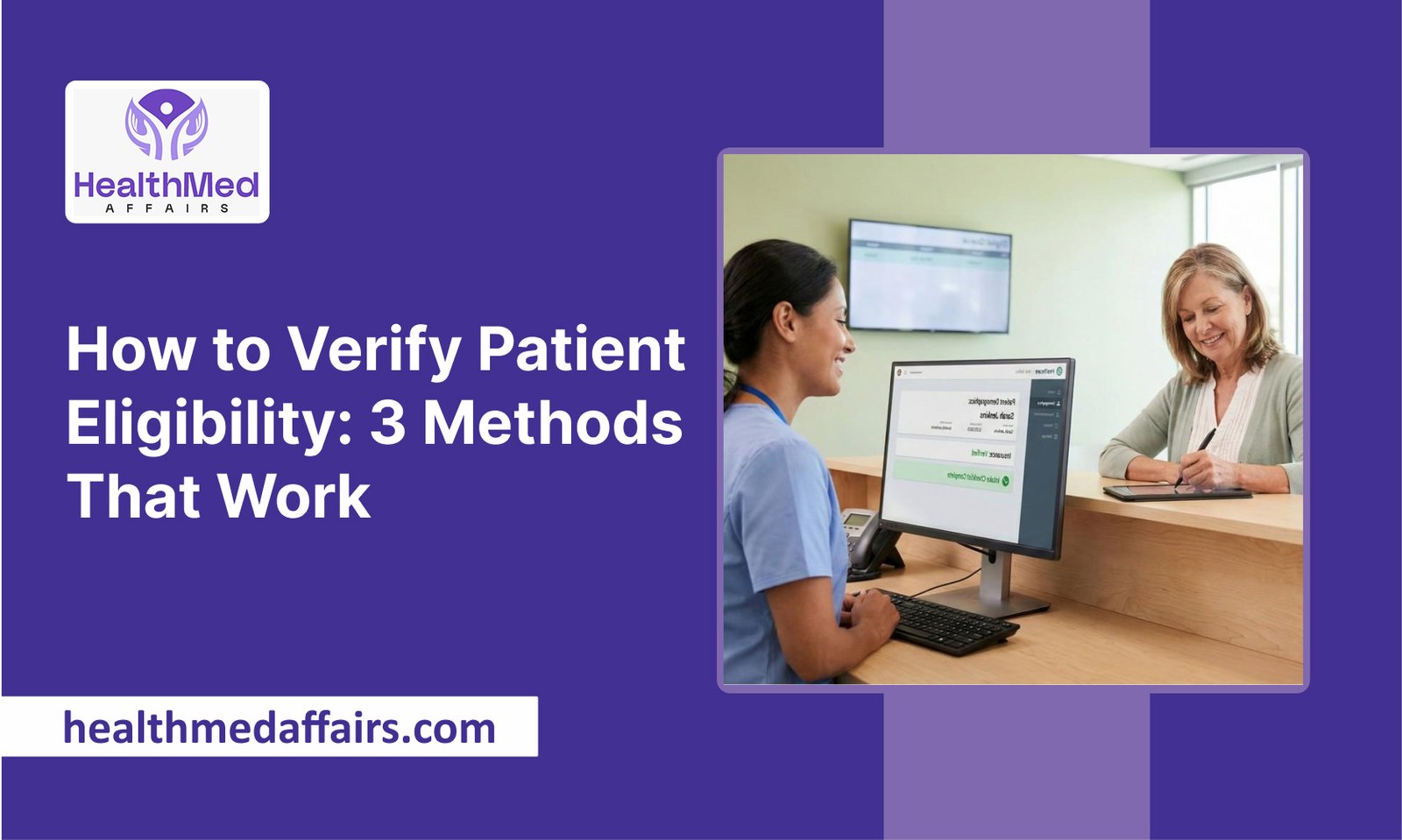
Two weeks after the visit, the remittance comes back: coverage terminated the day before the appointment. The patient swore the insurance was good, and maybe someone even checked, back in September, before the plan lapsed. Now the service is out the door and the balance is aging against a payer who was never on the hook. This is the denial that a coverage check prevents for the cost of a few minutes. The practices with clean front-end numbers are not the ones with the most software. They are the ones that run the process to determine patient’s eligibility on a schedule, with named checkpoints, and refuse to let it drift into whatever the front desk can squeeze between phone calls.
The process to determine a patient’s eligibility, step by step
Take the card at scheduling and take it seriously. The name has to match what the payer has on file, character for character, because a nickname that never reached the carrier’s system reads as a different person. Date of birth, member ID, group number, both sides of the card imaged for the file. Then ask the question most offices skip: whose policy is this? A dependent booked under the wrong subscriber looks fine on paper and fails at the payer, and the front desk is the last person who can fix it before the visit.
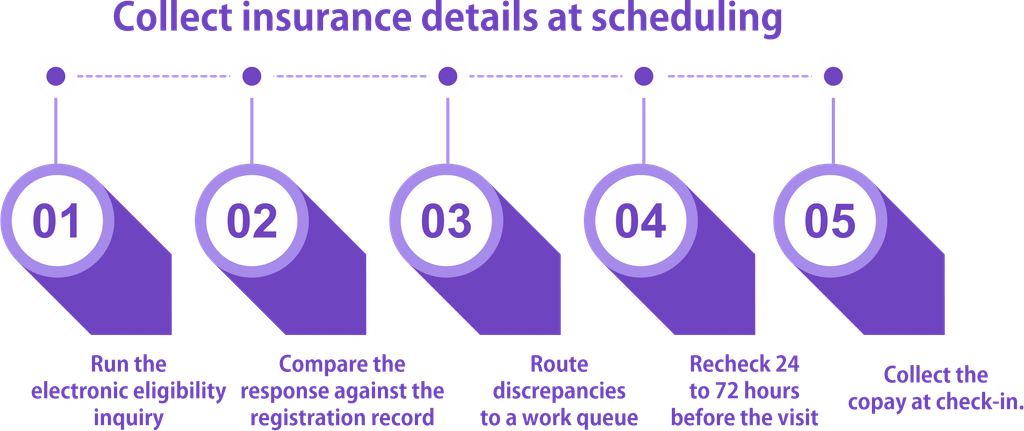
Then the inquiry runs, and the response gets compared field by field against what registration recorded. Active coverage for the date of service is the headline, but it is only the first line. The plan product matters, because an HMO, a PPO, a Medicare Advantage plan, and a Medicaid managed care plan all carry different rules under one brand name. Network participation for the rendering provider and the service location needs confirming, along with the copay, the remaining deductible, and the coinsurance percentage. Referral and prior authorization requirements belong in the same check, and so does the coordination-of-benefits order when a patient holds two policies.
Finally, the result gets recorded and the exceptions get routed. The verification date, the method used, the payer’s reference or trace number, and any follow-up item go into the patient’s record. Anything that does not match, a termed policy, an outdated member ID, an authorization flag, moves to a work queue with a named owner, cleared before the patient arrives.
Method one: the payer’s online portal
One patient, one question: the carrier’s portal handles that case better than anything else. A member search pulls back the copay, the deductible remainder, and out-of-pocket totals on the cooperative sites, which is the exact data a collection quote needs. The trouble arrives with the second payer, and the third. Logins pile up one per carrier, and the sites disagree about what to show. Some publish balances down to the cent. Others confirm the card is real and stop there.
Method two: the phone call
Then there is the telephone, the method the back of the card has advertised for decades. It has not lost its value, because a human being can sort through what no form field captures: two carriers fighting over which is primary, a behavioral health benefit carved out to a separate administrator, a secondary plan with its own deductible. The rule that separates a useful call from a wasted one is the call reference number. Get it, write it down next to the date and the representative’s name, and when the payer later denies what the call seemed to confirm, the practice has a document. What the phone costs is hours. A question answered in forty seconds online can swallow half a workday on hold.
Method three: the 270/271 electronic transaction
The 270/271 pair is the HIPAA-standard electronic method, and it is what most automated eligibility checking runs on. The 270 is the inquiry a practice sends, carrying the patient’s demographics, the subscriber ID, the provider’s NPI and tax ID, and a service type code that asks about the specific category of care. The 271 is the payer’s structured response, and a good one returns coverage status, copay, coinsurance, remaining deductible, and authorization indicators within seconds.
What makes this method scale is the batch run. A practice management system or clearinghouse can fire a 270 for every patient on tomorrow’s schedule overnight and hand the front desk a ready exception list in the morning. Medicare eligibility runs through CMS’s own channel, the HIPAA Eligibility Transaction System, which accepts the same transaction pair. Industry operating rules from CAQH govern what a usable response must contain, and payers remain uneven in how much detail they return, so a thin 271 still ends in a phone call.
Where practices get hurt is treating the 271 as more than it is. Coverage confirmed is not payment promised. The transaction says the patient was enrolled on the date in question; it says nothing about whether this particular service is covered, subject to medical policy, or waiting on an authorization that was never requested. The practices that learn this once tend to teach it to every new hire: eligibility is step one, never the whole gate.
The three methods at a glance
| Method | Best for | Watch for |
| Payer portal | One patient, one question | One login per carrier; detail varies by site |
| Phone call | Coordination-of-benefits puzzles | Hours on hold; always get a call reference number |
| 270/271 batch | Whole schedules overnight | Confirms enrollment, not service coverage |
What can be used to verify company information?
Every so often the mystery party is not the patient but the payer. Third-party administrator logos on cards, employer plans that switched carriers mid-year, two insurers merged into one: all of it leaves the billing office asking who actually processes this claim. The answer chain runs from the card itself to the clearinghouse’s payer lookup, which spells out each company’s electronic payer ID, whether claims require enrollment first, and where paper claims go. The payer’s provider manual fills in the fine print on filing deadlines and appeals, and state insurance departments keep public registers showing whether a carrier is even licensed in the state. A payer ID error does something worse than cause a denial. It causes a rejection, so the claim bounces before adjudication and never appears on any denial report. The only signal is the absence of payment.
Eligibility verification versus benefits verification
The two terms get used interchangeably and they are not the same check. Eligibility verification confirms the patient holds active coverage on the date of service and that the provider participates in the network. Benefits verification goes further and asks what the plan pays for the specific service: the copay, the remaining deductible, the coinsurance split, visit limits, exclusions, and whether a referral or authorization stands between the patient and the claim being paid. A patient can pass the first check and still generate a denial, because the service is excluded, the frequency limit is spent, or the authorization was never obtained. Both checks belong in the same workflow, and mature front offices treat them as one task with two outputs.
When each check should run
When should the check run? At booking, first, because whatever it finds has weeks to cure. Between two and five business days out, the whole coming schedule gets a batch pass, and check-in is the final gate. Then there is the churn nobody schedules. Medicaid re-reviews its rolls every month, and rules taking effect in 2027 move many expansion adults to six-month renewals. Every January 1 resets the plan year. Job changes rewrite employer coverage whenever they happen, not when it is convenient. A card verified in December is a December fact. Treating it as a February fact is how offices end up holding balances nobody owes.
The verification schedule
| When | What runs | Why it matters |
| At booking | Portal or 270/271, manually | Problems found here have weeks to cure |
| 2 to 5 business days out | Batch 270/271 on the full schedule | Catches lapses after booking |
| Day before and morning of | Recheck Medicaid and high-churn plans | Medicaid re-reviews its rolls monthly |
| At check-in | Card on file vs payer response | The final gate before the copay |
Why the check pays for itself
The arithmetic is hard to argue with. Eligibility and registration issues account for about one in three denials in industry survey data, and the preventable share of denials overall sits near ninety percent. A 2025 survey by a large claims vendor found forty-one percent of providers with denial rates above ten percent. Fixing one of those after the fact, on a service already delivered, costs fifteen to twenty-five minutes of staff time, and the conversation with a patient who never saw the bill coming erodes collections in ways no report captures. Verification costs minutes and prevents all of it. Offices that hold the routine post front-end denial rates near five percent, take copays at the window, and give patients estimates worth trusting.
So what methods can be used to verify patient eligibility? Three, in practice, and they are not competing options so much as layers. The electronic transaction does the volume, the portal and the phone call handle the exceptions, and the schedule tells every layer when to run. Practices that want the whole front-end check handled as a standing workflow can hand it to a partner offering eligibility verification services, and keep the front desk facing patients instead of portals. A medical billing company that runs this front end every day starts with a look at the schedule, not the software.
FAQs
What is patient eligibility verification?
It is the front-end check that confirms a patient’s insurance is active for the date of service, that the provider participates in the plan’s network, and that the visit meets any referral or authorization requirement. Run before the service, it prevents the denial. Run after, it only documents it.
What are the main methods used to verify patient eligibility?
Three. The payer’s online portal handles one patient and one question. The phone call resolves what no form field captures, like two carriers fighting over which is primary. The 270/271 electronic transaction does the volume, checking an entire schedule overnight in a batch.
What is a 270/271 transaction?
A HIPAA-standard electronic pair. The 270 is the inquiry your practice sends, carrying demographics, subscriber ID, and the provider’s NPI. The 271 is the payer’s structured response, returning coverage status, copay, coinsurance, and remaining deductible within seconds. Medicare runs the same pair through its own channel, HETS.
How far in advance should eligibility be verified?
Three checkpoints. At booking, because problems found there have weeks to cure. Two to five business days out, when a batch pass covers the whole coming schedule. And at check-in, the final gate, where the card on file gets compared against the payer’s latest response.
What is the difference between eligibility verification and benefits verification?
Eligibility confirms active coverage and network participation. Benefits verification goes further and asks what the plan pays for the specific service: copay, remaining deductible, coinsurance split, visit limits, exclusions, and authorization requirements. A patient can pass the first check and still generate a denial.
What happens if eligibility is not verified?
The service goes out the door against coverage that may have lapsed, and the denial lands with no good option. Either the balance ages against a payer who was never responsible, or it turns into a patient conversation nobody wants. Eligibility and registration issues account for about one in three denials in industry survey data.