
“ABA therapy billing strategies help behavioral health practices reduce claim denials, prevent authorization gaps, and maintain consistent cash flow. Unlike traditional medical billing, Applied Behavior Analysis (ABA) billing requires precise CPT coding, accurate tracking of timed service units, payer-specific authorization management, and compliant clinical documentation. For ABA practice owners, establishing these processes is essential to minimizing reimbursement delays, protecting revenue, and ensuring uninterrupted autism therapy services.”
Key Takeaways
- Prevent costly claim denials: Verify insurance eligibility, authorization limits, CPT codes, and documentation before submitting ABA therapy claims.
- Stay ahead of authorization deadlines: Track approved units, expiration dates, and reauthorization requirements to avoid preventable treatment and payment disruptions.
- Improve billing accuracy: Follow payer-specific rules for timed CPT codes, overlapping sessions, concurrent care, and provider qualifications.
- Strengthen documentation compliance: Maintain accurate session notes, treatment records, and authorization logs to support medical necessity and billed services.
- Support sustainable practice growth: Specialized ABA billing management can reduce administrative workload, improve revenue cycle efficiency, and allow clinical teams to focus on patient care.
Why Traditional Medical Billing Models Fail for ABA Therapy
Traditional medical billing systems are often designed around office visits, procedures, and individual encounters. However, ABA therapy billing requires a more specialized approach because services are frequently delivered across multiple sessions, providers, and authorization periods.
For ABA clinic owners, relying on conventional billing workflows can result in incorrect service units, authorization gaps, delayed reimbursements, and avoidable claim denials.
Unit-Based Timed Billing and Incorrect Claims
Unlike many standard medical services, ABA therapy commonly uses CPT codes billed in 15-minute increments. For example, a 60-minute eligible direct treatment session may represent four billing units, depending on the applicable payer rules.
Errors occur when clinics calculate units from scheduled appointments rather than actual, documented treatment time. Unrecorded breaks, incorrect rounding, and mismatched session durations can create billing discrepancies.
To prevent these issues, clinics should reconcile treatment records with submitted units and follow each payer’s time-reporting requirements.
Overlapping Sessions and Concurrent Billing Conflicts
ABA treatment often involves registered behavior technicians (RBTs), Board Certified Behavior Analysts (BCBAs), and caregivers participating in related services.
However, overlapping appointments do not automatically qualify for separate reimbursement.
For example, CPT codes 97153 and 97155 may be reported concurrently under applicable coding guidance when distinct services are performed by eligible providers. Nevertheless, some insurers restrict or prohibit these combinations.
Practice owners must distinguish clinically appropriate concurrent services from duplicate or unsupported billing and verify payer-specific policies before submitting claims.
Why ABA Reauthorization Deadlines Require Closer Monitoring
Many ABA insurance plans establish authorization periods of approximately six months, often described operationally as 180-day cycles. However, actual authorization dates and renewal requirements vary by insurer.
When a clinic misses an expiration date, services delivered afterward may become nonreimbursable without a valid authorization.
A reliable tracking system should flag approaching deadlines, monitor remaining treatment units, and give clinical teams enough time to complete updated assessments and treatment plans.
The goal is simple: Prevent administrative gaps from becoming financial losses or interruptions in patient care.
ABA Therapy Billing Strategies That Reduce Revenue Leakage
Effective ABA therapy billing strategies begin before a claim reaches the insurance company. For behavioral health practice owners, preventing billing errors is generally more efficient than correcting rejected or denied claims afterward.
A structured revenue cycle process can improve claim accuracy, strengthen payment consistency, and reduce unnecessary administrative work.
Verify Benefits and Authorization Before Treatment Begins
Insurance verification should be completed before scheduling covered ABA services and repeated when coverage changes.
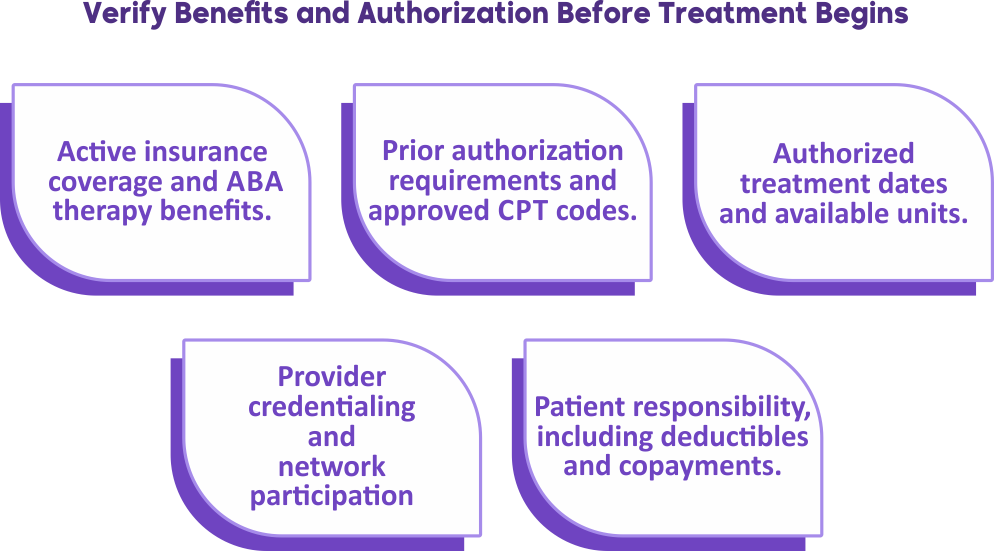
- Active insurance coverage and ABA therapy benefits.
- Prior authorization requirements and approved CPT codes.
- Authorized treatment dates and available units.
- Provider credentialing and network participation.
- Patient responsibility, including deductibles and copayments.
Your billing team should confirm:
Verifying these details early helps prevent claims from being submitted for services that are not covered or properly authorized.
Apply CPT Codes for ABA Therapy Billing Accurately
Knowing CPT codes for ABA therapy billing is essential for avoiding coding errors and supporting appropriate reimbursement.
Commonly used ABA billing codes include:
| CPT Code | Service Description |
| 97151 | Behavior identification assessment by a qualified healthcare professional |
| 97153 | Individual adaptive behavior treatment by protocol |
| 97155 | Adaptive behavior treatment involving protocol modification by a qualified healthcare professional |
| 97156 | Family adaptive behavior treatment guidance |
These codes generally use 15-minute units, but their specific documentation, provider qualification, and reporting requirements differ.
Clinic owners should ensure their billing teams follow current CPT guidance, payer contracts, and applicable coding updates rather than relying on outdated templates.
Match Authorized Units With Delivered Services
Every completed session should be reconciled against the patient’s remaining authorized units.
For example, if a patient has 120 authorized units and has already received 100 eligible units, only 20 units remain available under that authorization.
Without real-time tracking, a clinic may unintentionally schedule services beyond the approved limit.
An authorization dashboard that connects scheduling, clinical documentation, and billing can help prevent these avoidable losses.
Conduct Pre-Submission Claim Audits
Before submitting an ABA claim, verify that the CPT code, service date, rendering provider, authorization number, billed units, and session documentation are consistent.
Even minor discrepancies can delay reimbursement.
Working with experienced medical billing and coding services can help practices establish more consistent claim review processes and identify recurring errors before they affect cash flow.
How to Navigate Applied Behavior Analysis Authorization Guidelines
Understanding Applied behavior analysis authorization guidelines is essential for maintaining consistent treatment schedules and avoiding reimbursement disruptions.
Because authorization requirements vary across commercial insurers, Medicaid programs, and other health plans, ABA practices need a payer-specific approach rather than a single standardized workflow.
Initial Authorization Requirements and Medical Necessity
Before approving ABA treatment, insurers may request diagnostic information, clinical assessments, individualized treatment plans, and evidence supporting medical necessity.
Depending on the payer, an authorization request may include:
- Autism spectrum disorder diagnostic documentation.
- Initial behavioral assessment findings.
- Measurable treatment goals and intervention plans.
- Recommended treatment frequency and duration.
- Required provider credentials and clinical signatures.
Incomplete requests can delay treatment approval and create additional administrative work.
Reauthorization Timelines and Clinical Progress Reports
Reauthorization often requires updated documentation demonstrating treatment progress, continued medical necessity, and proposed goals for the next authorization period.
For plans using six-month approval cycles, waiting until the final weeks to prepare renewal documentation can put treatment continuity at risk.
A practical approach is to establish internal reminders 60, 30, and 15 days before expiration, adjusting those intervals to each payer’s submission rules.
Clinical and billing teams should coordinate early to confirm that updated assessments, progress reports, and supporting documents are ready before the current authorization expires.
Managing Concurrent Care Authorization in ABA
Concurrent care authorization in ABA becomes particularly important when multiple professionals or treatment services are involved in a patient’s care.
Some insurers permit certain services to occur simultaneously, while others apply restrictions based on CPT code combinations, provider roles, treatment settings, or authorization terms.
To reduce billing conflicts, practices should verify whether concurrent services are covered, document the distinct clinical purpose of each service, and ensure that provider time is not duplicated.
When separate organizations or clinicians are involved, coordination of benefits and payer-specific authorization restrictions may also apply.
Reducing ABA Therapy Claim Denials Through Better Documentation
Reducing ABA therapy claim denials requires more than submitting claims correctly. Insurance companies also expect clinical records to support the services, duration, and treatment units reported.
For ABA practice owners, consistent documentation is one of the most practical ways to strengthen billing accuracy and reduce preventable reimbursement disputes.
Common Documentation Errors That Trigger Denials
Common documentation problems include missing session start and end times, incomplete provider signatures, unsupported treatment units, and session notes that do not clearly describe the services delivered.
Another frequent concern is inconsistency between the authorized treatment plan and the actual services billed.
For example, submitting a claim for protocol modification without documentation supporting the relevant clinical activities can lead to payer questions or denials.
Clinics should use standardized documentation requirements while ensuring each note accurately reflects the individual session.
Building Clean Authorization Logs and Tracking Systems
A centralized authorization log allows practice owners to monitor treatment approvals and identify potential billing risks before claims are submitted.
An effective authorization log should contain:
- Patient name and insurance payer.
- Authorization number and approved CPT codes.
- Authorization start and expiration dates.
- Approved, utilized, and remaining treatment units.
- Assigned providers and applicable service restrictions.
- Reauthorization submission status and follow-up dates.
The log should be updated regularly and reconciled with scheduling and billing records.
Automated reminders can further reduce the risk of expired authorizations or exhausted treatment units.
Aligning Session Notes With CPT Codes and Authorized Services
ABA session notes should clearly establish what service occurred, who provided it, when it occurred, and how it relates to the patient’s treatment plan.
Depending on the service and payer, documentation may need to include treatment goals, behavioral observations, interventions, patient responses, caregiver participation, or protocol modifications.
Accurate documentation supports medical necessity reviews, claim audits, and appeals.
When denials continue despite internal improvements, specialized denial management services can help identify recurring coding, authorization, and documentation issues.
ABA Billing Compliance for Clinic Owners: Avoiding Costly Mistakes
Maintaining ABA billing compliance for clinic owners requires ongoing attention to payer policies, provider qualifications, coding requirements, and documentation standards.
Compliance problems can result in denied claims, repayment demands, or payer audits, making proactive oversight essential for financial stability.
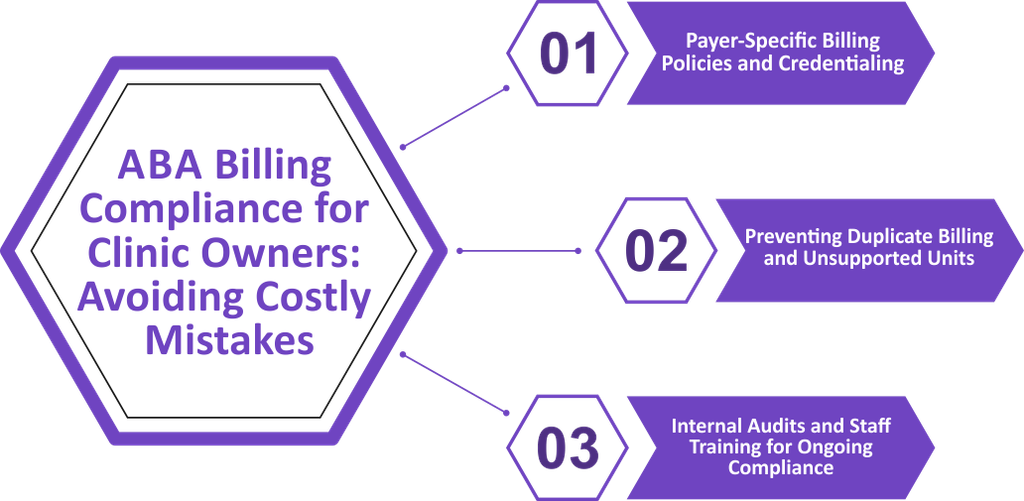
Payer-Specific Billing Policies and Credentialing
Different insurers may establish different requirements for eligible ABA providers, supervision arrangements, modifiers, place-of-service codes, and covered treatment activities.
Before submitting claims, practices should confirm that rendering providers meet the payer’s credentialing requirements and that the services billed fall within applicable coverage rules.
Billing policies should also be reviewed whenever payer contracts or reimbursement guidelines change.
Preventing Duplicate Billing and Unsupported Units
Duplicate billing can occur when the same provider time or treatment activity is reported more than once without an appropriate coding basis.
Practices should use scheduling controls and billing reviews to identify overlapping appointments, duplicate service entries, and units that exceed documented treatment time.
Clear separation of provider responsibilities and accurate session records can reduce these risks.
Internal Audits and Staff Training for Ongoing Compliance
Regular internal audits help identify errors before they become recurring financial problems.
Clinic owners should periodically review authorization records, CPT code selection, provider credentials, session notes, and claim outcomes.
Staff training should also address payer-specific changes and common denial patterns.
A consistent compliance process protects revenue while supporting accurate, ethical billing practices.
How Expert ABA Billing Management Supports Sustainable Practice Growth
As ABA practices expand, billing becomes increasingly complex. More patients, providers, authorization periods, and payer contracts create additional administrative responsibilities.
Without specialized billing oversight, these responsibilities can consume staff time and limit a clinic’s ability to grow efficiently.
Improving First-Pass Claim Acceptance and Cash Flow
Expert ABA billing management emphasizes accurate coding, authorization verification, documentation review, and timely claim submission.
These processes can improve first-pass claim acceptance and reduce the number of claims requiring correction or appeal.
Fewer avoidable billing errors also support more predictable reimbursement and better financial planning.
Reducing Administrative Burden on Clinical Teams
When clinical staff spend significant time resolving billing issues, less time is available for treatment planning, patient support, and operational development.
A dedicated billing management process can streamline insurance follow-ups, claim corrections, payment posting, and denial tracking.
This allows clinical teams to concentrate on delivering quality ABA services.
Protecting Continuity of Care Through Proactive Authorization Management
Authorization delays can affect both practice revenue and patient treatment schedules.
Proactive monitoring helps clinics prepare renewal requests, identify exhausted units, and address payer questions before coverage interruptions occur.
For growing ABA practices, specialized billing support can connect clinical operations with revenue cycle performance.
This creates a stronger foundation for sustainable growth without sacrificing attention to patient care.
Build a Stronger ABA Practice With Smarter Billing Management
Successful ABA practice growth depends on more than increasing patient volume. It requires accurate billing, timely authorizations, compliant documentation, and reliable revenue cycle processes.
By implementing effective ABA therapy billing strategies, clinic owners can reduce preventable claim denials, protect cash flow, and minimize treatment disruptions.
At Health Med Affairs, we help healthcare practices address billing challenges through professional medical billing, coding, and denial management support.
Ready to strengthen your ABA practice’s financial performance? Connect with Health Med Affairs to discuss your billing challenges and explore solutions that support more efficient operations and sustainable growth.
FAQs
Q: How long does insurance reimbursement take for ABA therapy claims?
Ans: Reimbursement timelines vary by insurer, contract, and claim accuracy. Clean electronic claims often process faster, while claims requiring medical review or corrections may take longer.
Q: Can ABA therapy services be billed through telehealth?
Ans: Some insurers cover eligible ABA services through telehealth. Coverage depends on the CPT code, payer policy, provider qualifications, and applicable state requirements.
Q: What is the difference between an ABA claim rejection and a denial?
Ans: A rejection occurs when a claim fails initial processing checks. A denial occurs after the insurer adjudicates the claim and determines that payment is not warranted.
Q: Can ABA clinics bill secondary insurance?
Ans: Yes, when the patient has eligible secondary coverage. Clinics must follow coordination-of-benefits requirements and submit the primary insurer’s payment information as required.
Q: What revenue cycle KPIs should ABA practice owners monitor?
Ans: Important metrics include first-pass claim acceptance, denial rate, days in accounts receivable, net collection rate, and outstanding claim balances.
Q: How often should ABA clinics reconcile insurance payments?
Ans: Daily reconciliation is a useful practice for busy clinics. Regular reviews help identify underpayments, unpaid claims, posting errors, and discrepancies requiring follow-up.